


September 18, 2025, 4:14 am | Read time: 4 minutes
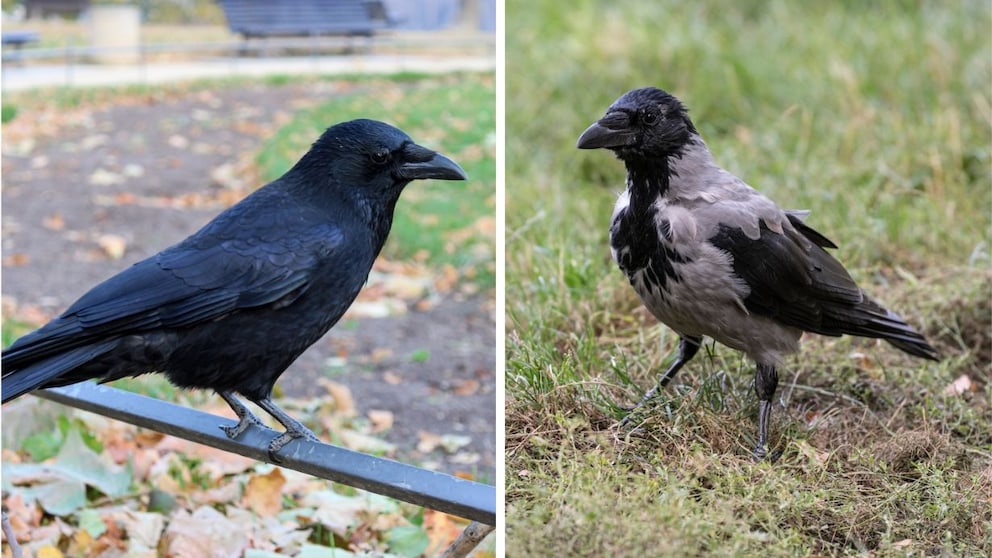
Crows are fascinating birds: intelligent, adaptable, and found in almost all habitats. However, anyone traveling attentively through Germany will notice: While the so-called carrion crows in the west of the country are jet black, their relatives east of the Elbe, the hooded crows, have a striking gray-black plumage. This phenomenon is more than just a matter of appearance–it tells an exciting story of evolution, mate selection, and the emergence of new species.
Why Crows East of the Elbe Look Different
First of all, the different feathers of the animals have nothing to do with the inner-German division. This was evolutionarily so short that it hardly matters. Rather, there is another explanation for why the animals east of the Elbe look different.
During the last ice age, crow populations were separated by glaciers. One group survived on the Iberian Peninsula, the other in the area of today’s Middle East. At some point, a mutation occurred in this eastern population that turned the plumage gray. After the ice retreated, both forms spread northward again–and met in Central Europe. Since then, there has been a clear “border”: west of the Elbe, the jet-black carrion crow; east, the gray-black hooded crow.1
Are Hooded Crows and Carrion Crows Different Species?
Opinions differ on this. For a long time, both were considered subspecies of the so-called carrion crow (Corvus corone). However, newer identification books list them again as separate species: the carrion crow (Corvus corone) and the hooded crow (Corvus cornix).
Genetically, they differ little: only a few genes that control plumage color separate them. Nevertheless, this difference is enough to keep the animals apart. Crows almost always choose their partners based on similarity to themselves. A “gray” bird often doesn’t fit the bill for a black crow–and vice versa.2
Where Are Hooded Crows and Carrion Crows Found?
The distribution is remarkably clear-cut:
- Carrion crows breed in Western Europe, from Spain through France to western Germany.
- Hooded crows are found east of the Elbe, in Eastern Europe, Scandinavia, and as far as the Middle East.
Germany is thus a true transition country: While in the Rhineland, you almost exclusively see black crows, in Berlin or Leipzig, the gray hooded crows dominate the cityscape.3
Where Are Hybrids Found and How Can I Recognize Them?
Where the distribution areas overlap–in a narrow strip along the Elbe–mixed pairings occur. The offspring, known as hybrids, display a colorful spectrum of plumage patterns: sometimes almost black, sometimes with gray spots, sometimes like a hooded crow with an “oversized” black breastplate.
Interestingly, these hybrids are healthy and fertile but find partners less often. Most crows prefer mates that resemble them in color. As a result, the hybrid zone remains narrowly confined.4, 5


Raven or Crow? How to Recognize the Difference

7 Exciting Facts About Corvids
Do Hooded Crows and Carrion Crows Differ in Behavior?
Apart from plumage color, they are very similar. They are opportunistic omnivores, utilizing earthworms, small mammals, carrion, seeds, and human waste alike. Both are exceptionally intelligent: They crack nuts by dropping them on roads or stones and adapt skillfully to human proximity. There are also hardly any differences in social behavior: Pairs often stay together for life, raise their young together, and defend their territory vigorously.6
Conclusion
Whether black or gray, carrion and hooded crows are a prime example of evolution in fast motion. They show how new species can emerge from a common ancestor through isolation, mutation, and mate selection. So, the next time you see a hooded crow flying over Alexanderplatz in Berlin, you’re not just looking at a clever city bird–but at a living chapter of evolutionary history.