


August 20, 2025, 1:05 pm | Read time: 8 minutes
The human flea is actually rare in Central Europe. However, in Berlin, the parasites are currently spreading—likely due to foxes. PETBOOK editor and biologist Saskia Schneider explains how fleas differ among humans, dogs, and cats, whether they are transmissible, and how to get rid of the parasites.
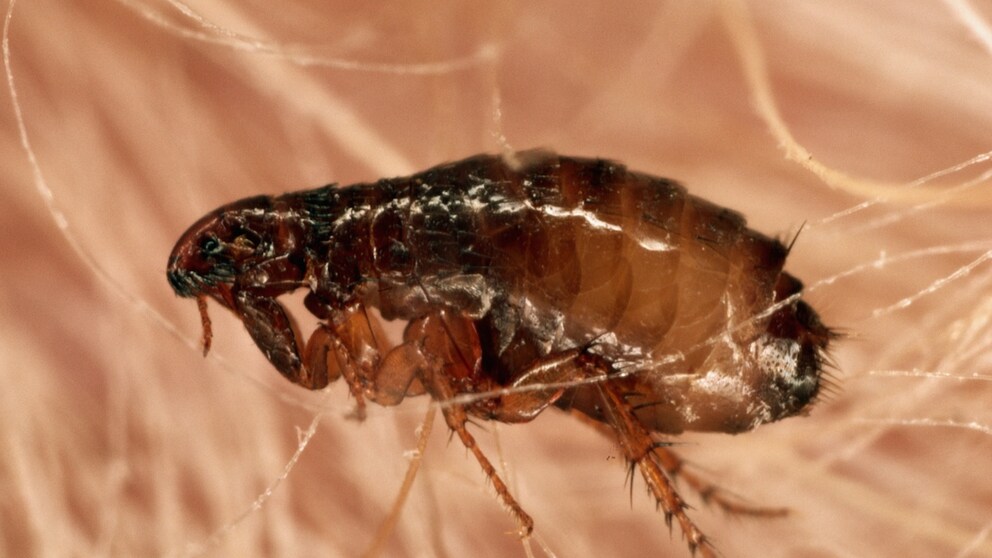
Fleas are tiny, wingless insects that feed on the blood of their hosts. Measuring only two to four millimeters and equipped with strong jumping legs, they can leap up to 50 centimeters—a true record holder in the animal kingdom. Their flat, hard bodies make it easy for them to move through fur or hair without being easily crushed.
The parasites are widespread globally and prefer to live on mammals such as dogs, cats, or even humans. While adult fleas suck blood from the host, most of their offspring—eggs, larvae, and pupae—develop in the environment, such as in carpets, baskets, or crevices. This makes them particularly difficult to eliminate.1
How Human, Dog, and Cat Fleas Differ
There are many types of fleas, but three are particularly relevant to humans and our pets:
- Human flea (Pulex irritans): Now rare in Central Europe. It lacks the typical combs on the head that dog and cat fleas have. Besides humans, it also infests dogs, pigs, hedgehogs, or foxes.2
- Dog flea (Ctenocephalides canis): Prefers dogs but is rare in cities, as cat fleas are more common. Recognizable by its combs and slightly shorter head compared to the cat flea. 3
- Cat flea (Ctenocephalides felis): The most common flea in Europe—and not just on cats. It also infests dogs and other animals. It is recognizable by its longer head compared to the dog flea and its combs. 4
There are many types of fleas, but three are particularly relevant to humans and our pets:
Fleas are only found on the host when they are adults and feeding on blood. Most of their offspring—eggs, larvae, and pupae—develop in the environment, such as in carpets, baskets, or crevices. This makes them particularly difficult to get rid of.
Are Fleas from Dogs and Cats Transmissible to Humans?
Despite the many types of fleas, three are particularly relevant to humans and our pets:
Despite the many types of fleas, three are particularly relevant to humans and our pets:
The bites are unpleasant but usually not dangerous. However, they can trigger allergies and lead to persistent skin problems. Often, people notice an infestation on themselves before they see it on their pets. 5
The bites are uncomfortable but usually not dangerous. They can, however, trigger allergies and lead to persistent skin problems. Especially in the case of a flea allergy, even a single flea can cause severe skin reactions in sensitive animals.
How Do I Know If I Have Fleas?
Typical signs of flea bites include:
- Three bites in a row (“flea street”),
- preferably on the legs, ankles, and feet,
- immediate itching after the bite.
The bites are uncomfortable but usually not dangerous. They can, however, trigger allergies and lead to persistent skin problems. Especially in the case of sensitive animals, even a single flea can cause severe skin reactions.
Fleas are persistent little parasites that can bother not only dogs and cats but also humans. While the human flea is now rare in our region, fleas from dogs and cats are still common. To get rid of a flea infestation requires patience and consistency, as only about five percent of the flea population lives directly on the animal—the rest are in the environment.
For humans:
- Use a flea comb through the fur.
- Place the combed-out debris on a damp paper.
- If they turn reddish, it’s a clear sign of flea infestation.
For pets:
- Use a flea comb through the fur.
- Place the combed-out debris on a damp paper.
- If they turn reddish, it’s a clear sign of flea dirt.
Frequent scratching, restlessness, or hair loss can be early signs of fleas in dogs or cats. However, not all animals show strong itching—some appear unaffected. Even a single flea can cause severe skin reactions in sensitive animals.
Do Fleas Transmit Diseases?
Fleas are persistent little parasites that can bother not only dogs and cats but also humans. While the human flea is now rare in our region, cat fleas are more common and not limited to cats. They can also infest dogs and other animals.
- Dog flea (Ctenocephalides canis): Prefers dogs but is rare in cities as cat fleas are more common. Recognizable by its combs and slightly shorter head compared to the cat flea.
- Cat flea (Ctenocephalides felis): The most common flea in Europe—and not just on cats.
- Human flea (Pulex irritans): Now rare in Central Europe. It lacks the typical combs on the head that dog and cat fleas have. Besides humans, it also infests dogs, pigs, hedgehogs, or foxes.
Fleas are persistent little parasites that can bother not only dogs and cats but also humans. While the human flea is now rare in our region, cat fleas are more common and not limited to cats. They can also infest dogs and other animals.
To eliminate a flea infestation requires patience and consistency, as only about five percent of the flea population lives directly on the animal—the rest are in the environment.
For humans:
- Cool compresses can help relieve itching.
- Antihistamine creams for severe itching.
- Avoid scratching to prevent infections.
For pets:
- Treat with appropriate antiparasitics (spot-ons, tablets, sprays, collars).
- Treat all animals in the household simultaneously.
- Year-round prophylaxis for allergy-prone pets.
In the environment:
- Wash baskets, blankets, and textiles at 140 °F.
- Thoroughly and regularly vacuum carpets and upholstery, and dispose of vacuum bags immediately.
- Use special environmental sprays or foggers if necessary.
Good to know: The plague was primarily spread by the rat flea (Xenopsylla cheopis), which is now insignificant in our region.

My Dog Has Fleas! What Can I Do?

Can Dogs and Cats Experience an Allergic Shock?
How Do I Get Rid of Fleas?
Getting rid of a flea infestation requires patience and consistency, as only about five percent of the flea population lives directly on the animal—the rest are in the environment.
For humans:
- Cool bites with ice, aloe vera, or cooling creams.
- Use antihistamine creams for severe itching.
- Avoid scratching to prevent infections.
For pets:
- Treat with appropriate antiparasitics (spot-ons, tablets, sprays, collars).
- Treat all animals in the household simultaneously.
- Year-round prophylaxis for allergy-prone pets.
In the environment:
- Wash baskets, blankets, and textiles at 140°F.
- Vacuum carpets and upholstery thoroughly and regularly, and dispose of vacuum bags immediately.
- Use special environmental sprays or foggers if necessary.
Home remedies such as ice, aloe vera, or cooling creams can help soothe bites. It’s important not to scratch to avoid infections.
Do Fleas Transmit Diseases?
Fleas are not only annoying; they can also transmit diseases:
- Tapeworm (Dipylidium caninum): Transmitted when a dog or cat swallows a flea. Rarely, children can also be affected.
- Cat scratch disease (Bartonella henselae): Transmitted by fleas from cats, it can cause fever and swollen lymph nodes in humans.
- Rickettsial infections (e.g., Rickettsia felis): Rare bacterial diseases.
Good to know: The plague was primarily transmitted by the rat flea (Xenopsylla cheopis), which is now insignificant in our region.
My Dog Has Fleas! What Can I Do?
Can Dogs and Cats Experience an Allergic Shock?
How Do I Get Rid of Fleas?
Eliminating a flea infestation requires patience and consistency, as only about five percent of the flea population lives directly on the animal—the rest are in the environment.
For humans:
- Cool bites with ice, aloe vera, or cooling creams.
- Use antihistamine creams for severe itching.
- Avoid scratching to prevent infections.
For pets:
- Treat with appropriate antiparasitics (spot-ons, tablets, sprays, collars).
- Treat all animals in the household simultaneously.
- Year-round prophylaxis for allergy-prone pets.
In the environment:
- Wash baskets, blankets, and textiles at 140°F.
- Vacuum carpets and upholstery thoroughly and regularly, and dispose of vacuum bags immediately.
- Use special environmental sprays or foggers if necessary.
Home remedies like ice, aloe vera, or cooling creams can help soothe bites. It’s important not to scratch to avoid infections.
My Dog Has Fleas! What Can I Do?
Can Dogs and Cats Experience an Allergic Shock?
How Do I Get Rid of Fleas?
Getting rid of a flea infestation requires patience and consistency, as only about five percent of the flea population lives directly on the animal—the rest are in the environment.
For humans:
- Cool bites with ice, aloe vera, or cooling creams.
- Use antihistamine creams for severe itching.
- Avoid scratching to prevent infections.
For pets:
- Treat with appropriate antiparasitics (spot-ons, tablets, sprays, collars).
- Treat all animals in the household simultaneously.
- Year-round prophylaxis for allergy-prone pets.
In the environment:
- Wash baskets, blankets, and textiles at 140°F.
- Vacuum carpets and upholstery thoroughly and regularly, and dispose of vacuum bags immediately.
- Use special environmental sprays or foggers if necessary.
Home remedies like tea tree oil, vinegar, or lemon juice can help repel fleas, but they are not as effective as commercial products.
Conclusion
Fleas are persistent little parasites that can bother not only dogs and cats but also humans. While the human flea is now rare in our region, cat and dog fleas are the most common culprits. They cause itchy bites and can transmit allergies or diseases.
To get rid of fleas, you must treat both the animal and the environment simultaneously—and for several weeks. With consistent prophylaxis and good hygiene, the uninvited guests can be kept out for good.