

November 11, 2025, 2:12 pm | Read time: 3 minutes
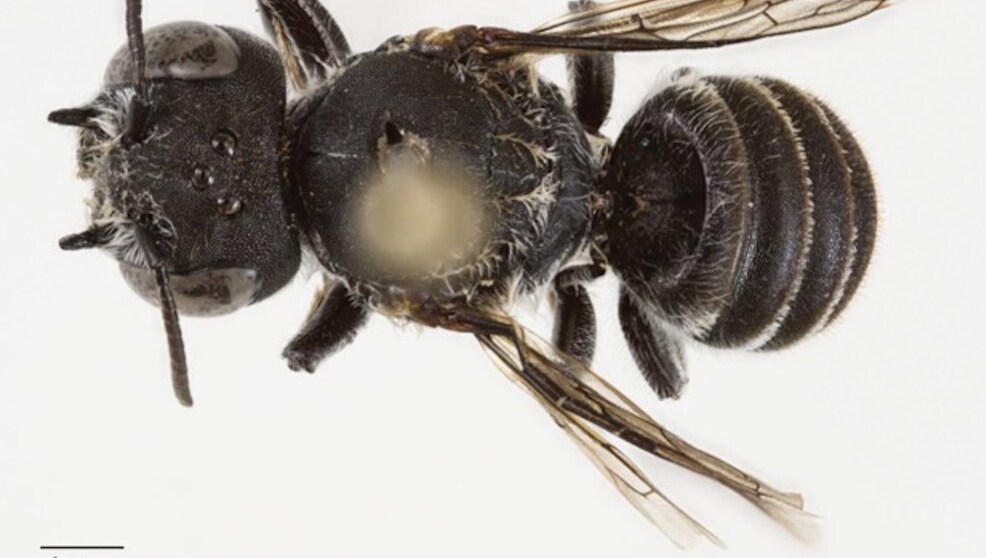
In the remote Goldfields of Western Australia, an extraordinary new bee species has been discovered, resembling a miniature devil with small horn-like protrusions on its head. The appearance of the “Lucifer bee” is causing a stir worldwide. The species is scientifically named Megachile (Hackeriapis) lucifer, partly because its discoverer enjoys watching Netflix.
Netflix Character as Namesake
The new wild bee was a serendipitous find during studies on the rare plant Marianthus aquilonarius, which is found only in a specific area of Australia.
“I discovered the species while examining a rare plant in the Goldfields and observed this bee visiting both the endangered wildflower and a nearby mallee tree,” said Dr. Kit Prendergast, lead author of the study and research associate at the Curtin School of Molecular and Life Sciences, in a press release. Her study of the new species was published in the journal “Journal of Hymenoptera Research.” 1
The unusual name of the bee is no coincidence either: “The female had these incredible little horns on its face. As I was writing the species description, I was watching the Netflix series ‘Lucifer’—the name just fit perfectly. I’m also a big fan of the character, so it was an easy decision,” Prendergast continued.
The Iberian lynx is no longer threatened with extinction
Stingless Bees Granted Rights as the World’s First Insects
Genetic Evidence Confirms New Species
Using DNA barcoding, Dr. Prendergast was able to confirm that the males and females studied belong to a previously unknown species. The morphological features also did not match any species in museum collections, the entomologist explained.
She also emphasized: “It is the first new member of this bee group to be described in over 20 years—showing how much life there is still to discover, even in regions threatened by mining, like the Goldfields.”
Wild Bees Also Under Pressure in Germany
The discovery also highlights how crucial understanding wild bees is not only for conservation in Australia. “Since the new species was found in the same small area as the endangered wildflower, both could be threatened by habitat disturbances and other threats like climate change,” said Prendergast.
The discovery in Australia also sheds light on the situation in Germany. Around 600 wild bee and bumblebee species are native here. Some of them are also specialized on just a single type of flower. More than half of them are considered endangered or threatened with extinction, according to the Federal Agency for Nature Conservation.
The main causes are habitat loss due to intensive agriculture, land sealing, and the use of pesticides. As in Australia, there is often a lack of systematic surveys on the occurrence and pollination performance of native wild bees here.
They are indispensable for the preservation of many plant species and thus for biodiversity as a whole. The discovery of Megachile lucifer therefore also serves as a reminder in Germany of the importance of early detection and protection of native wild bees and their habitats—before they disappear forever.