


September 8, 2025, 12:43 pm | Read time: 5 minutes
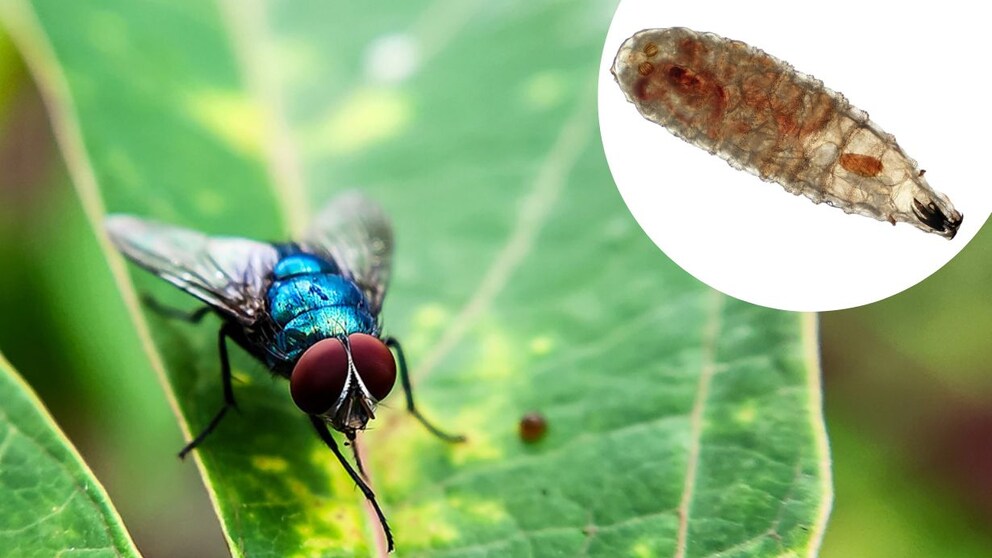
The New World screwworm fly is a type of blowfly whose larvae feed on the flesh of their victims. Currently, the parasite is spreading in North America, threatening not only livestock but also dogs, cats, and rabbits. PETBOOK editor and biologist Saskia Schneider explains how the parasite attacks, which regions are affected, and what pet owners should know.
The dreaded New World screwworm fly (Cochliomyia hominivorax) has been spreading from Panama through Central America to Mexico since 2023. In August 2025, the parasite made headlines when the first travel-related case in a human in the U.S. was confirmed, as reported by sources such as “Focus.” Until then, only animals had been affected by the flesh-eating larvae. The real problem, however, is the infestation of livestock such as cows and cattle, which threatens the U.S. livestock industry with losses in the billions. Pets can also be affected. 1
What Are Screwworm Flies?
Screwworm flies are a type of blowfly whose larvae, also known as maggots, cause myiasis, an infestation of living tissue. Some fly larvae feed exclusively on dead tissue and are even used for wound cleaning.2
The adult flies are 8 to 10 millimeters long, metallic blue-green, with reddish heads and three dark longitudinal stripes on the thorax. Females can lay up to 300—sometimes even 500—eggs in a short time, preferring wounds or body openings of warm-blooded animals.
Why the Fly Larvae Are So Dangerous
The larvae of the screwworm fly must consume living flesh to develop, causing significant damage. If left untreated, the infestation can lead to severe bacterial infections, rapidly worsening the condition of affected animals and potentially resulting in death. The infestation is particularly insidious because it initially appears inconspicuous from the outside, but the wounds quickly enlarge and are characterized by a distinctive putrid smell. 3
The combination of hidden infestation and rapid deterioration makes screwworm fly larvae particularly dangerous.
Do Screwworm Flies Also Infest Pets?
Yes. Screwworm flies can also infest pets such as dogs, cats, and rabbits. They lay their eggs on any lesion, from surgical wounds to tick bites. Affected pets show severe pain; wounds enlarge, do not heal, and oozing secretions may be noticeable in their fur. 4
You can recognize an infestation by the following symptoms:
- Rapidly enlarging wounds
- Restlessness
- Excessive licking/scratching
- Loss of appetite
- Fever
In case of an infestation, see a veterinarian immediately. They can mechanically remove the larvae and eggs and properly treat the wound. If necessary, painkillers or antibiotics will be administered. There are also products specifically effective against screwworm fly maggots, as studies have shown. These can be used for therapy or prevention. 5
Where Are Screwworm Flies Found?
Historically, the distribution area ranged from the southern United States through Mexico and Central America to northern South America. Some Caribbean islands were also affected. Through the Sterile Insect Technique (SIT), the parasite was eradicated on a large scale north of the Panama Canal in the United States in the mid-1960s and later in Central America.
Since 2023, however, there have been massive outbreaks in Central America. Mexico has reported thousands of animal cases since 2024/25. The U.S. is (still) maintaining the Panama barrier with a special technique using sterile flies that can no longer reproduce. Additionally, there are increased controls to prevent a resurgence in the north. 6, 7

How Often Should You Deworm Your Dog and Cat?

How to Protect Your Dog From Black Flies
Can Screwworm Flies Reach Germany?
Despite the strictest controls, it can never be completely ruled out that a fly might reach Europe or even Germany with travelers or through global trade. However, there is no need to fear an infestation of the New World screwworm fly here. The insects require tropical to subtropical conditions with constant temperatures between about 68 and 86°F. The larvae do not survive cold or frost, so the climatic conditions for a stable population are lacking in Central Europe.
For pets and people in Germany, there is no realistic risk of being infested by the screwworm fly. The parasite is particularly problematic in warm regions of the Americas, where it is currently causing massive damage.
How to Protect Yourself and Your Pets From Infestation
Pet owners in or near outbreak areas or traveling should keep the following in mind:
- Do not travel to affected regions: Avoid traveling with dogs or cats to areas with active outbreaks. In the U.S., pre-entry inspections and certificates for dogs are required after visiting affected countries; similar checks are generally advisable.
- Reduce exposure: Avoid contact with affected animals. Keep pets indoors as much as possible.
- Injury prevention: Prevent injuries and treat wounds promptly. Use insect repellents and protective clothing.
- Insect control: Improve stable/farm hygiene and use fly traps.
- Early detection: Look for signs such as rapidly enlarging, foul-smelling wounds, visible larvae (possible from day 3), restlessness, licking/scratching, loss of appetite, and fever.
In case of suspected infestation, see a veterinarian immediately. They can mechanically remove the larvae and eggs and properly treat the wound. Painkillers or antibiotics may be administered if necessary. Additionally, there are treatments specifically effective against screwworm fly maggots, as studies have shown. These can be used for therapy or prevention, but should only be applied after consulting a veterinarian. 8, 9