

September 29, 2026, 3:33 pm | Read time: 4 minutes
He stands motionless in the water for hours, but then strikes with lightning speed: The rare shoebill from East Africa uses its powerful beak to hunt even small crocodiles. The unusual weapon of this approximately 4-foot-tall bird can grow up to 9.6 inches long. Its name comes from its distinctive shape, which resembles a giant shoe. In Sudan, it is called “Abu Markub,” meaning “Father of the Shoe” in English. PETBOOK introduces the fascinating crocodile hunter.
Why the Shoebill Looks So Threatening
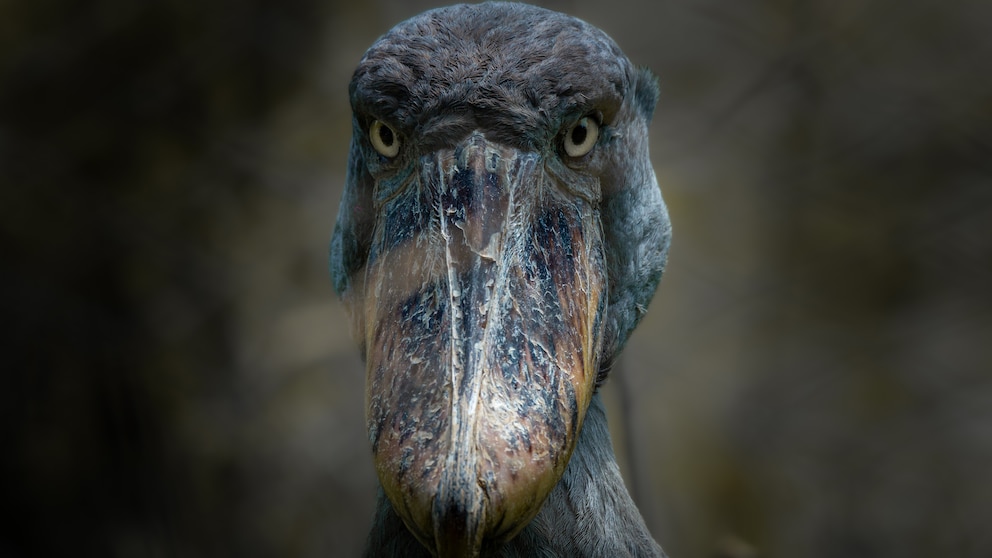
Its enormous, shoe-shaped beak makes the shoebill (Balaeniceps rex) unmistakable. The upper part resembles a pelican’s beak and is equipped with a strong hook at the tip. This allows the swamp dweller to securely hold even defensive prey after grabbing it and then consume it. The lower part is less conspicuous but contributes to the impressive beak depth of about 4.7 inches. Overall, the beak is greenish to brownish in color.
Its facial expression also makes this unusual bird a unique sight: From some angles, the shoebill looks almost cute. However, when viewed from the front, its fixed gaze and massive beak give it a grim, almost threatening appearance. It also makes an acoustic impression: When the large bird clatters its beak, the sound is reminiscent of machine gun fire.

The shoebill lives in swampy and tropical regions of Africa, mainly in Sudan. However, these striking birds can also be found in Tanzania, Uganda, and Zambia. The papyrus swamps along the White Nile are particularly favored by the shoebill. Here, they usually stand alone or in pairs in shallow water–sometimes for hours, completely motionless. They wait in this way until prey swims by.
Its favorite food is the African lungfish. However, other fish, mollusks, amphibians, water snakes, and even small crocodiles are also on the shoebill’s menu. If one of these prey animals swims close enough, the bird strikes with lightning speed, thrusting its massive beak into the water. With the hook at the beak’s tip, it securely holds even defensive animals. It then dismembers its prey with the sharp beak edges and skillfully tosses it directly into its wide-open throat.1
Shoebill’s Way of Life
The shoebill can fly, and quite well at that. It can soar up to 1,640 feet high. However, its flying skills are rarely used. Most of the day, it sits seemingly motionless on the shore. However, it is not inactive here. It closely observes its surroundings and especially the water to not miss any potential prey. Otherwise, its movements are more deliberate than frantic.
It slowly strides through reeds and papyrus. Adult crocodiles and hippos can pose a danger to the bird, and its barely perceptible movements attract less attention. Humans also pose a threat to the shoebill, mainly through the destruction of the sensitive ecosystem the bird needs to survive. 2

Do Flamingos Feed Their Young with Blood? 8 Fascinating Facts About Flamingos

These are the 6 biggest snakes in the world
Shoebill’s Mating Season and Reproduction
Amid the shoreline vegetation, the shoebill builds its nests. It also constructs clutches on islands in rivers or ponds, usually incubating two to three bluish eggs. The surroundings of these nests are typically densely vegetated, making them difficult for predators to spot. Only after 14 weeks can the hatched shoebill chicks stand, and by four months, they are independent and hunt on their own. Until then, the parent birds take turns caring for the chicks.3
Threat to the Abu Markub
The shoebill population is estimated at about 6,500 individuals, with a declining trend. The main reason is the destruction of its habitat. Areas near water in the shoebill’s range are particularly popular with farmers for agriculture. However, this often leads to the destruction of protective shoreline vegetation, depriving the bird of nesting opportunities.