

October 23, 2025, 2:49 pm | Read time: 5 minutes
It’s slimy, mysterious, and one of Europe’s most enigmatic species: the eel. For centuries, researchers have tried to discover where and how these fish reproduce–but to this day, no one knows for sure. One thing is certain: the eel requires a long journey to the Bermuda Triangle to reproduce. This PETBOOK article explains why this is the case and why the fish faces particular challenges today.
No One Has Ever Seen Eels Reproduce
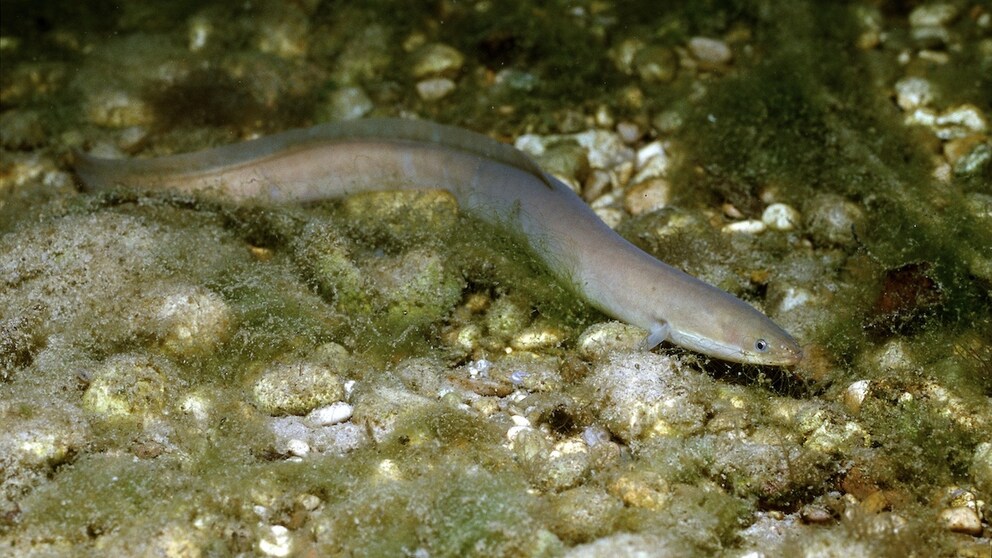
The European eel (Anguilla anguilla) lives in local rivers, ponds, and lakes–but at some point, usually after several years, it disappears. It migrates toward the Atlantic, specifically to the Sargasso Sea, west of Bermuda. There, in the heart of the legendary Bermuda Triangle, the creatures are believed to perform their mysterious mating dance.
But no one has ever seen it. No researcher, no camera, no submarine.
What is known: Adult eels die after laying eggs, and tiny, transparent larvae embark on the years-long journey back to Europe. They are carried by the Gulf Stream–more than 5,000 kilometers across the Atlantic. Only at the coasts do they transform into small glass eels, then yellow eels, and finally into the creatures we know here.
Why a Freshwater Fish Moves to Saltwater
Why the European eel, a freshwater fish, migrates to the saltwater of the Atlantic for reproduction after years in rivers, lakes, and ponds is fascinating. It is due to its unique lifestyle: The eel belongs to the so-called catadromous fish. This means it grows up in freshwater but spawns in the sea–the opposite of fish like salmon, which migrate from the sea to rivers (anadromous).
Before the eel embarks on its long journey, its body undergoes drastic changes:
- Its eyes become larger to see better in the ocean depths.
- Its skin becomes more silvery to blend in with the sea.
- The salt balance of its body adjusts–it can suddenly tolerate saltwater, which would be deadly for normal freshwater fish.
This transformation from yellow eel (in freshwater) to silver eel (on migration) is a biological masterpiece–and a prerequisite for reaching the Bermuda Triangle.
Science Doesn’t Know Why All Eels Head Straight for the Bermuda Triangle
For centuries, the reproductive behavior of the European eel has been a mystery. Although Danish marine biologist Johannes Schmidt suspected the Sargasso Sea as a spawning area based on larval findings in the early 20th century, direct evidence of adult spawning eels or eggs has been lacking. This gap complicates understanding the complex migration of these creatures, which travel up to 10,000 km from European freshwater across the Atlantic.
Since the 1980s, the eel population has drastically declined–the number of young eels has dropped by 95 percent. The causes lie in the lack of understanding of the marine life cycle phase of eels. Research is increasingly focusing on ocean migration. New technologies like satellite-supported pop-up tags now allow for tracking the final stages of this journey–aiming to finally document spawning behavior directly and thereby make protection measures more informed.
The Path Is Clear, but Where Is the Destination?
In 2022, researchers achieved direct evidence for the first time: Using satellite technology, they tracked how adult eels actually migrate to the suspected spawning area. This discovery sheds light on a centuries-old biological puzzle and offers hope for the protection of this highly endangered species.
Researchers equipped 26 female silver eels in the Azores archipelago with satellite transmitters and documented their migration to the Atlantic–a scientific first. Measures were carried out under ethical standards, anesthesia, and with approval from Azores authorities.
The satellite tags recorded average depth, temperature, and position and transmitted this data once they detached from the animal after a programmed time (or upon signal loss). They remained on the fish for between 40 and 366 days, allowing for the first-time tracking of the migration route across the Atlantic.

How to Keep and Care for Sticklebacks in an Aquarium or Garden Pond

Freshwater or Saltwater Aquarium? An Overview of the Differences
All Eels Head Straight for the Bermuda Triangle
This study provides the long-awaited direct evidence that European eels indeed reach their suspected spawning area in the Sargasso Sea. This closes a significant gap in understanding their life cycle. The observation that no animal arrived within the first possible spawning window supports the hypothesis of a migration stretched over longer periods.
The data also reinforce earlier assumptions that Azores eels choose the same route as continental European eels. This suggests that all eels head straight for the Bermuda Triangle to reproduce there. The findings are a milestone in eel research and provide valuable foundations for better aligning protection programs and management strategies with the needs of this highly threatened species.
Humans Block the Eels’ Path
That the origin of eels lies precisely in the region known as the Bermuda Triangle somehow fits: There, where planes and ships are said to disappear, perhaps something similarly inexplicable happens–only in the water. While the eels end their lives there, a new one begins simultaneously. A cycle that humans increasingly disrupt with our constructions and interventions in nature.
This ancient migration of eels, which we still do not fully understand, is interrupted at countless points today. Rivers are obstructed–by locks, weirs, dams, and hydroelectric plants. Often, eels can no longer pass through. They die in turbines, become stranded in canals, or simply find no way back to the sea.
In doing so, we endanger a species whose secrets we have yet to uncover. The European eel is now considered endangered. Likely also because, against all reason, it remains a popular food fish for many, without an effective way to ensure the species’ survival. 1