

August 23, 2025, 1:51 pm | Read time: 9 minutes
Anyone looking to start with aquaristics must decide whether to go for a freshwater or saltwater aquarium—and which inhabitants should move in. PETBOOK explains the differences between the various types of aquariums and what to consider.
Overview
- What Different Types of Aquariums Are There?
- Differences in Water Values, Setup, and Temperature
- Are Saltwater Aquariums More Expensive Than Freshwater Aquariums?
- What Is Needed for the Basic Equipment of Different Aquariums?
- Can You Convert an Aquarium from Freshwater to Saltwater?
- Does It Take Longer to Set Up a Saltwater Aquarium Than a Freshwater Aquarium?
- Freshwater or Saltwater Aquarium: Which Is Suitable for Beginners?
- Sources
What Different Types of Aquariums Are There?
Some love its vibrant colors, others the tranquility it exudes. There’s no question—an aquarium often adds a special touch to a home. But before it adorns your living space, some preliminary considerations are necessary. The most important: Which type should it be?
The options include freshwater and saltwater aquariums (also known as marine aquariums), each with different costs and specific features in terms of equipment and care. But the differences don’t end there. Even within freshwater, there are unique aspects. And what exactly is brackish water? A clear overview of the various possibilities is provided below.
Freshwater Aquariums
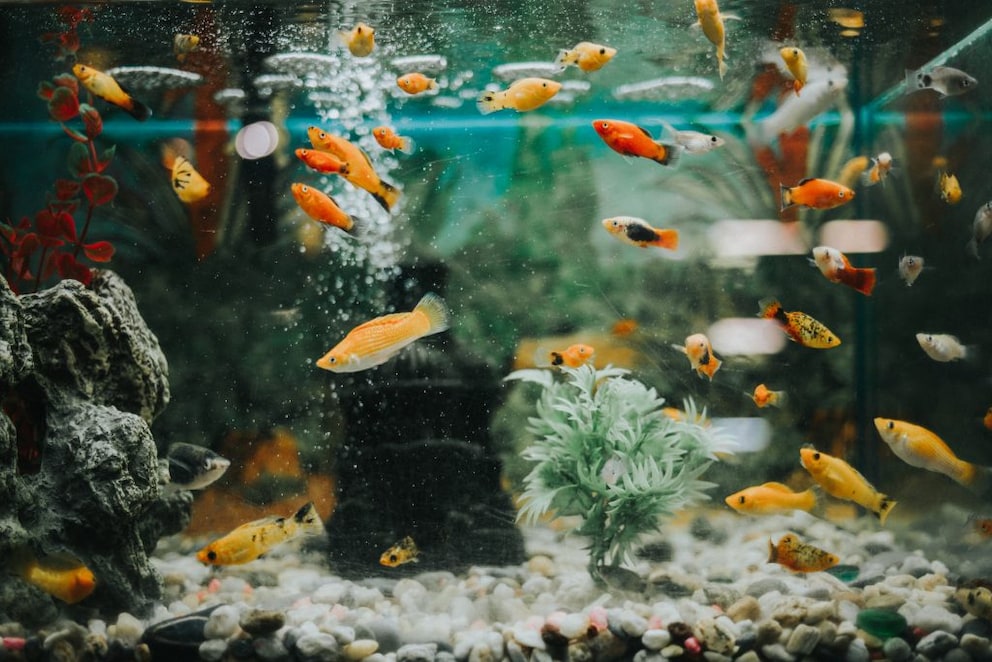
Freshwater aquariums are undoubtedly the most popular, with well-known inhabitants like guppies, platies, or mollies. However, they are also divided into tropical and cold-water variants. The latter are among the most common aquariums, partly because they house popular species like goldfish and require less technology. Many native cold-water fish like bitterlings, sticklebacks, or moderlieschen can also be kept in a garden pond.
Saltwater Aquariums
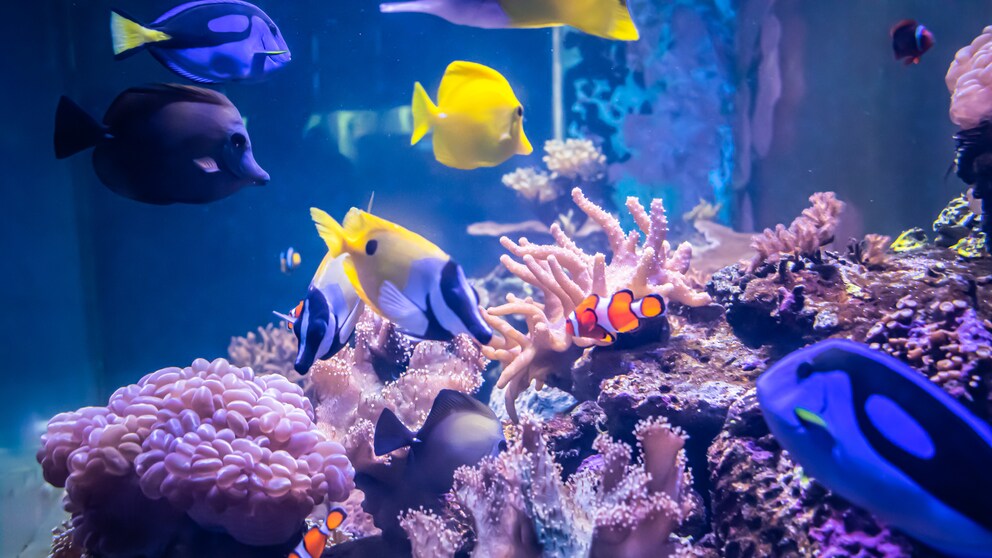
Saltwater aquariums are also referred to as marine or reef aquariums because they mimic the natural habitat of marine life. These are often particularly colorful and home to surgeonfish, clownfish, and corals. Most marine aquariums are tropical tanks, as most reef inhabitants require high temperatures. However, there are also cold-water variants where seahorses, shrimp, and fish from the North and Baltic Seas are kept. Both variants require considerable technology and knowledge.
Brackish Water Aquariums
This variant is a mix of freshwater and saltwater tanks, primarily tackled by particularly experienced aquarists. The water here is usually less salty than in classic marine water, to replicate habitats of mangroves, river deltas, and other estuaries. These are mostly tropical aquariums where pufferfish, archerfish, or killifish thrive.
Community, Species, and Biotope Aquariums
In aquaristics, you encounter many other terms that can be quite confusing when deciding between freshwater and saltwater. Generally, aquariums are distinguished between those where different fish species are kept together and those focused on a single species. The species aquarium is more of a phenomenon in freshwater tanks, while marine tanks are typically modeled after a reef with a complex interplay between various species.
Additionally, there is the biotope aquarium, where only plants and fish that naturally share the same habitat are found—a trend especially in natural cold-water tanks with native freshwater fish.
Another aquarium trend is the nano aquarium, which usually houses freshwater inhabitants or is used as a saltwater aquarium garden. However, this micro tank is generally not suitable for fish but rather for colorful shrimp from freshwater or saltwater. 1
Differences in Water Values, Setup, and Temperature
Freshwater and saltwater aquariums also differ in three aspects: pH value, temperature, and setup.
pH Value
Anyone wanting to keep a specific fish species must create the appropriate living environment for it. In aquariums, this is determined by the pH value, indicating an acidic or basic environment.
In marine aquariums, the pH value is slightly basic, usually between 7.8 and 8.4 pH. Large fluctuations in this value are not well tolerated by the inhabitants. However, with stable water values, almost any reef inhabitant can be placed in the tank.
Some freshwater fish, on the other hand, have a higher tolerance for fluctuations in pH value, so the values in the corresponding aquarium can range from 5 to 9 pH. However, there are also many freshwater fish that cannot handle fluctuations in pH value and require consistently good water quality. Freshwater is not just freshwater, and you must always research which species make good tank neighbors. 2
Temperature
As previously discussed, the temperature in the tank is always important. Most freshwater and saltwater tanks require a higher temperature than room temperature. As a rule of thumb, you can remember about 75 to 79 degrees Fahrenheit for water temperature.
Cold-water aquariums can be significantly cooler. For freshwater, about 64 to 72 degrees, and for cold marine water, about 50 to 64 degrees. Important: Cold-water fish should generally not be kept with tropical fish, as they do not tolerate the higher water temperature well.
Setup
There are also key differences in the setup of various tanks. In freshwater tanks, plants play a central role. They produce oxygen, provide hiding places, and create a natural balance. This is always oriented to the respective fish stock, such as dense plant growth for tetras or open swimming space for angelfish.
Sand or fine gravel is often used as the substrate, where plants can root well. Decorations include roots, stones, or coconut shells. These serve not only for aesthetics but also as hiding places and territory markers for the fish. Three water zones can be populated with fish: bottom, middle, and surface swimmers.
In marine aquariums, reef rock almost always serves as the base. This “live rock” consists of porous rock pieces inhabited by microorganisms. They act as biological filters and are the foundation for the entire cycle. Corals often form the centerpiece in tropical marine aquariums. They are not just decorations but sensitive living organisms that require stable water values.
Furthermore, the tank is structured to create different areas, ensure sufficient flow, and provide the animals with light and space to develop. When stocking, you should pay attention to surface swimmers, reef edge, and reef bottom dwellers. The substrate itself usually consists of fine coral sand or aragonite sand, which also supports the biological balance. Snails, shrimp, or sea urchins help keep the aquarium clean and are an important part of the system.
Are Saltwater Aquariums More Expensive Than Freshwater Aquariums?
Saltwater aquariums are generally more expensive to purchase than freshwater aquariums. This is simply because more accessories are needed for a marine aquarium. Saltwater aquariums are also considerably larger, and the fish are more costly to acquire.
The maintenance of different aquariums does not differ greatly, although higher costs also arise for marine aquariums. The tank must be regularly cleaned, and the water changed. There are also differences in the equipment and maintenance of accessories for freshwater and saltwater aquariums.
What Is Needed for the Basic Equipment of Different Aquariums?
Every aquarium requires a suitable, not too sunny location and a stable base structure. This can also be used to store fish food and other accessories. Additionally, various other items are needed for the different types of aquariums. These are:
Basic Equipment for Freshwater Aquarium
- Water filter
- Heater
- Thermometer
- Lighting (Note: The lighting needs of the respective inhabitants may differ)
Basic Equipment for Saltwater Aquarium
- Heater
- Thermometer
- Lighting (adapt to respective inhabitants)
- Protein skimmer
- Flow pump
- pH meter
- Density meter
- Reverse osmosis system
- Live rock
- Salt
Can You Convert an Aquarium from Freshwater to Saltwater?
If you’ve decided on a type of aquarium and want to switch from freshwater to saltwater inhabitants, this is possible under certain circumstances. However, it requires some planning and a conversion of the system. It’s important to note that freshwater aquariums are usually somewhat smaller than saltwater aquariums, as they require much less technology, which must be planned into the tank. Whether there is enough space for a saltwater aquarium must be determined on a case-by-case basis.
In a saltwater aquarium, a separate tank for the technology is usually integrated. It also has many drill holes and pipes for the equipment. This special tank would be unnecessary and difficult to clean if switching from marine water to freshwater.
Also, the water cannot simply be switched from salty to fresh or vice versa. It is better to set up a new, more suitable tank.
These 5 ornamental fish are suitable for beginners
Fridman’s dwarf perch – how to keep and care for this saltwater fish
Does It Take Longer to Set Up a Saltwater Aquarium Than a Freshwater Aquarium?
There is no general rule for when an aquarium is “finished.” Various factors, such as the size of the tank and the stability of the ecosystem, are decisive. The type of water in the aquarium does not play a significant role.
The so-called running-in phase or cycling time varies for each aquarium. It can take six weeks or longer for all types of aquariums before the tank can be fully stocked.
When adding fish—whether it’s a freshwater or saltwater aquarium—it should be done carefully. The process should also be accompanied by water tests. In the first few days after filling, ammonium and nitrate levels rise, and the aquarium is, biologically, still a hostile desert. Therefore, only through tests can you safely determine when it is ready for its inhabitants.
Freshwater or Saltwater Aquarium: Which Is Suitable for Beginners?
Many report that saltwater aquariums are considered more challenging and less suitable for beginners in aquaristics, but that doesn’t have to be the case. Those who thoroughly inform themselves can also start directly with a marine project in aquaristics.
It is often said that a tropical freshwater aquarium usually forgives minor mistakes more easily than sensitive corals in a marine aquarium. However, many things can go wrong with a freshwater tank, especially if you start with a smaller tank because it seems easier. The opposite is true! The larger the tank, the more stable the water values and ecosystem. For beginners, the advice is: Get a larger aquarium right away and meticulously monitor water values.
In conclusion, it cannot be generally stated which aquarium type is better for beginners, as you should thoroughly research all types—and especially each individual inhabitant—before making a purchase.