

September 5, 2026, 10:05 am | Read time: 4 minutes
Tall trees and buildings are particularly at risk of being struck by lightning during thunderstorms. But what about giraffes, the tallest land animals on Earth? After all, they also tower above their surroundings. PETBOOK explores whether the long necks of these animals actually make them more susceptible to lightning strikes and what role their extraordinary height plays.
Overview
Are Giraffes Struck by Lightning More Often?
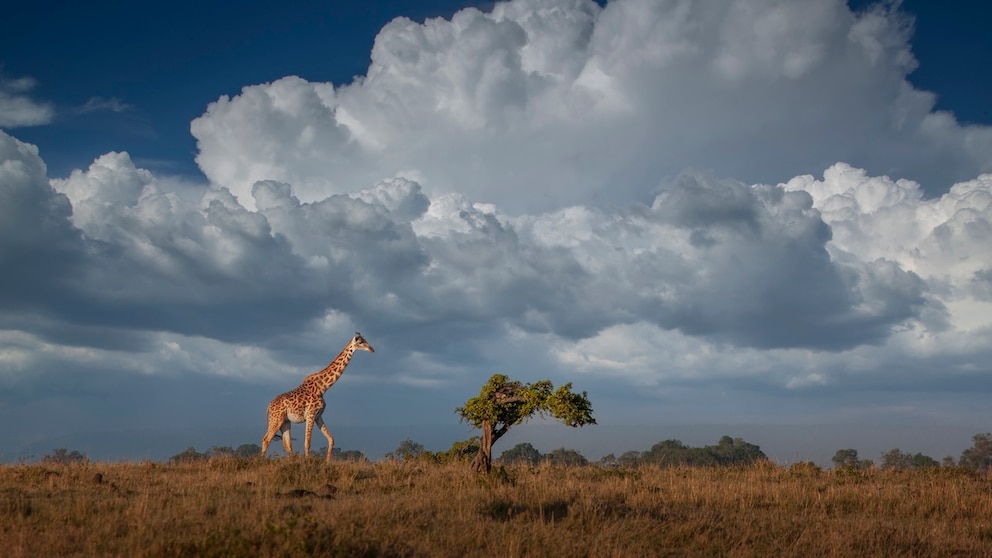
Giraffes can grow up to six meters tall, making them the largest land animals on Earth. It stands to reason that their height might make them a target for lightning strikes. In their habitat, the African savanna, most trees are shorter than these long-necked mammals. Additionally, giraffes do not exhibit strong protective behavior during thunderstorms. Instead of seeking shelter, they often remain in open areas.
However, this theory is countered by the fact that thunderstorms are quite rare in the savanna. The climate is extremely dry, with long periods of no rain at all. But when a thunderstorm does occur, giraffes can indeed become targets for lightning.
Statistically, lightning strikes on giraffes are difficult to track, as it is often impossible to determine whether a dead giraffe found in the savanna was killed by lightning or another cause. Additionally, the areas where giraffes live are so vast that many dead giraffes simply go undiscovered. Nevertheless, between 1996 and 2010, five cases were documented where giraffes were struck by lightning, including one incident near the Disney theme park in Florida.

These are the 6 biggest snakes in the world

Researchers Reveal What Happens When Snakes Bite
Five Giraffes Struck by Lightning: Relatively Frequent
At first glance, five documented cases of giraffes being struck by lightning may not seem like much, but there are significantly fewer giraffes than humans on Earth. When calculating the death rate based on the population sizes of humans and giraffes, it is 30 times higher for giraffes. This means that, statistically, giraffes are indeed struck by lightning more often.
It is important to remember that humans can protect themselves from lightning strikes better than giraffes. We can retreat to our homes when a storm approaches, and these are often equipped with lightning rods if they are tall enough. People are also safe from lightning strikes in cars, as the vehicle acts like a Faraday cage.
During severe thunderstorms, giraffes can only seek shelter under trees. However, these trees are often not much taller than the giraffes themselves and are known to offer poor protection during a lightning strike. Overall, it seems that giraffes are indeed struck by lightning more often because they reach so high into the sky and are, unfortunately, among the first to be hit in the landscape.1
Fascinating Facts About Giraffes
- The mammals from Africa are not only at risk of lightning strikes. In addition to their impressive height, giraffes are also particularly heavy. Males can weigh nearly two tons, and giraffes are among the heaviest animals in the world, along with whales, hippos, and larger rhinoceros species.
- Not only is the giraffe’s neck long, but its tongue also sets records. It can be up to half a meter long, is blue, and very dexterous. The giraffe’s tongue can reach the highest treetops, grasp entire branches, and strip the tasty leaves to bring them directly into its mouth. But that’s not all: The giraffe’s blue tongue is long enough for the animals to even rub their eyes with it.
- Many people assume that giraffes make no sounds and quietly roam the savanna. In reality, giraffes have a vocal language that is inaudible to humans due to its frequency. The sounds are so low that our ears cannot detect them. However, giraffes can communicate over long distances using these infrasonic sounds.2