


January 9, 2026, 9:57 am | Read time: 4 minutes
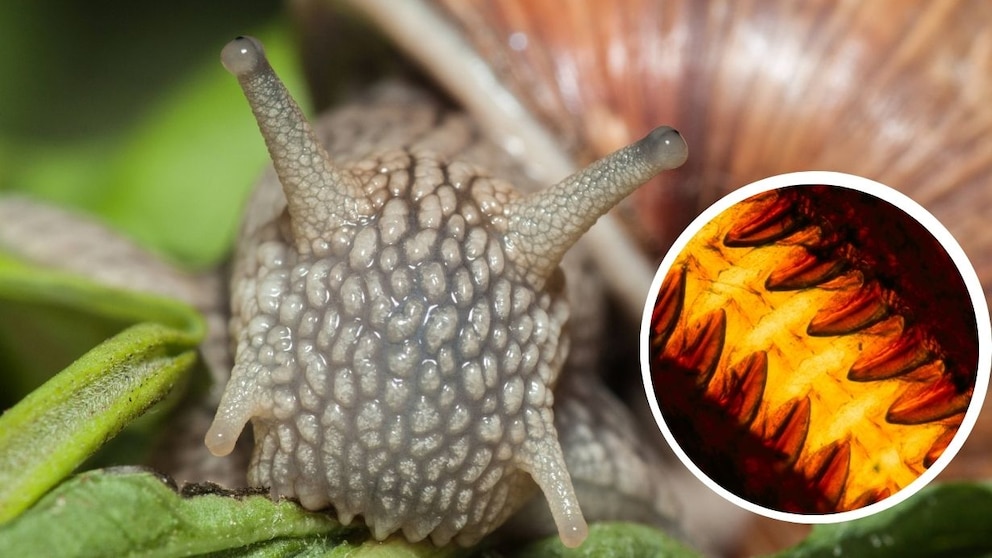
Few people probably know that snails have teeth—and quite a few of them. They can not only rasp food but also cut with enormous force. PETBOOK explains why the native Roman snail performs such remarkable feats.
Why Do Snails Have Teeth?
Teeth in snails—that sounds surprising at first. After all, most people picture a soft body, a slime trail, and a delicate lettuce leaf. But snails are true eating specialists. They need their “teeth” to rasp, crush, and ingest food. Unlike us, they don’t chew but work with a highly specialized mouth tool: the so-called radula, scientifically known as the radula.1
This radula is a central secret to the success of snails. It allows them to exploit a wide range of food sources—from tender plants and algae coatings to hard sponges or shells in marine species. This adaptability has made snails one of the most species-rich animal groups on Earth.
How the Snail’s Radula Works
The radula is not a tongue in the traditional sense but a movable chitin band studded with thousands of tiny teeth. These teeth are arranged in longitudinal and transverse rows, forming a kind of biological sandpaper. When feeding, the snail pushes the radula forward out of its mouth, presses it against the food, and pulls it back—abrading, scraping, or even cutting the food.
This process is supported by a firm “jaw” in the mouth, against which the food is pressed. This allows a Roman snail to efficiently break down even a crunchy lettuce leaf or carrot. As the teeth wear down constantly, the radula grows continuously from the back—in some land snails, even several rows of teeth per day. A perfect biological assembly line.
Also interesting: Is It Really Forbidden to Pick Up Snails by Their Shells?
Roman Snail Has 40,000 Teeth with Astonishing Performance
The native Roman snail (Helix pomatia) boasts around 40,000 teeth. But it’s not just the quantity that’s impressive; it’s also the performance of these mini-teeth.
A research team from the universities of Hamburg and Kiel closely examined the radula of the spotted Roman snail (Cornu aspersum) and discovered something astonishing: The tips of the individual teeth experience forces of up to 4,700 bar when feeding. For comparison, an espresso machine operates at about ten bar, and industrial water jet cutting at several thousand bar.2
Yet, the teeth of the Roman snail are not extremely hard—their material properties are more akin to wood. The trick lies in the combination of movement, friction, and the sheer number of teeth. Together, they create an effect you would never expect from this inconspicuous garden creature.3

What Happens When a Grass Snake Bites?

Blackbird or Thrush? How to Tell the Difference
Record Holder! This Snail Has the Most Teeth in the World
As impressive as the Roman snail is, the absolute tooth record is held by another species: the umbrella snail (Umbraculum umbraculum), a large marine snail from tropical waters. Over its lifetime, it produces an incredible up to 750,000 teeth.4
It doesn’t carry them all in its mouth at once, as its radula is also continuously renewed. This flood of teeth is needed to rasp hard food like sponges, shells, and other solid marine organisms. Under a microscope, the inside of its mouth looks like a dense forest of thorns—a sight more reminiscent of science fiction than a mollusk.5
For comparison, the land-dwelling animal with the most teeth, a gecko from Madagascar, has “only” about 300. Snails play in a league of their own.
Conclusion: Snail Teeth Are a Biomechanical Wonder
The Roman snail is much more than a beneficial garden helper that eats slug eggs. With its highly developed radula, tens of thousands of teeth, and enormous mechanical power, it is a small biomechanical wonder. Its teeth impressively demonstrate how sophisticated evolution can be—quiet, slow, but extremely effective.
Next time you spot a Roman snail in the garden, you might see it differently: not as a slimy crawler but as a fascinating wild animal with one of the most remarkable sets of teeth in our native wildlife. And if you’re lucky, after a summer rain, you might even hear the rasping of snail tongues, as they come out in large numbers to start feeding.