

July 19, 2026, 2:47 pm | Read time: 4 minutes
Cheetahs are the fastest land animals in the world, accelerating from 0 to 60 mph in just a few seconds. But these endangered big cats have much more to offer than their breathtaking speed. Discover why cheetah cubs look like they have wild hairstyles, the function of their distinctive tear stripes, and more surprising facts about these elegant hunters here.
1. For Cheetahs, It’s All About Speed
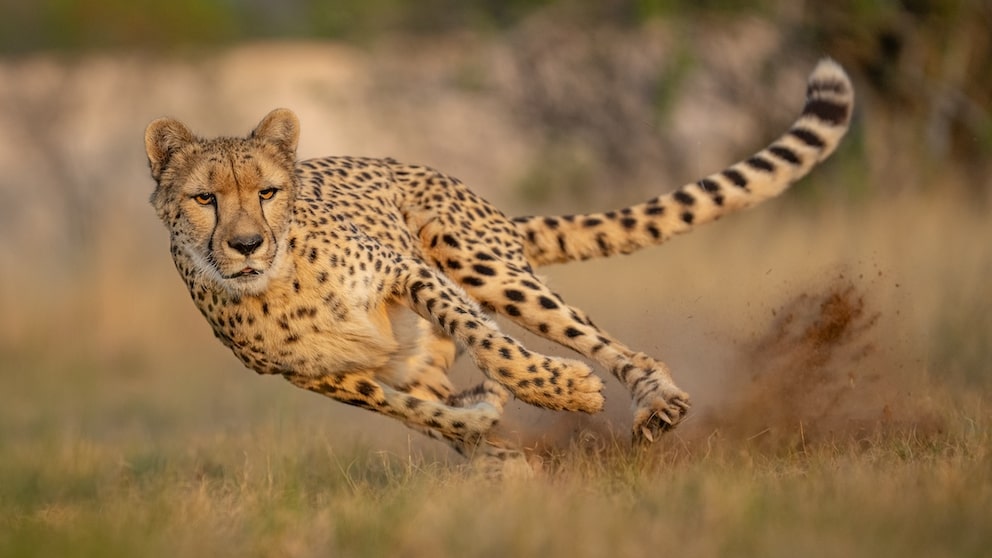
Over short distances, the cheetah can reach top speeds of about 60 mph—and in just a few seconds. Its slender, aerodynamic body with long legs and muscle structure, reminiscent of a greyhound, is perfectly designed for this. Even though it maintains only about 33 mph over longer distances, prey animals have little chance. Thus, it rightfully holds the crown as the “fastest land animal in the world.”1
2. Cheetahs Can’t Roar
While lions and other big cats like tigers or leopards roar loudly, you won’t hear this from cheetahs. They are classified as small cats and can hiss, purr, growl, meow, chirp, bark, and even make a chirping sound, but they do not roar.
The chirping has several meanings: Female cheetahs use it to attract potential mates during estrus. Both males and females chirp when they are distressed. Additionally, mothers use this sound to call their cubs, likely because the chirping noise is less noticeable to other predators. During mating, biologists have described a stuttering sound that resembles a combination of purring and a growling stomach.

3. Cheetahs Use Claws Like Spikes
The cheetah is also the only member of the cat family that cannot retract its claws. They function like spikes on running shoes during its maneuvers. Relative to its body size, its lungs and bronchi are also significantly enlarged, providing enough oxygen during its sprints. On average, a cheetah’s attack is over in just 38 seconds.
4. Fur with Sun Protection
While other big cats hunt at dusk, cheetahs are active during the day. This helps them avoid encounters with competitors like hyenas, lions, or leopards, which could challenge them for their prey due to their size and strength. Notably, their faces feature two dark stripes running from the eyes to the mouth. These so-called tear stripes prevent the reflection of bright sunlight, which would otherwise impair their vision.
Also interesting: Can tigers and other big cats meow?
5. Spots as Unique as a Fingerprint
About 2,000 to 3,000 spots cover a cheetah’s golden fur. These serve as camouflage during the day and gave them their English name “Cheetah,” derived from the Hindi word “Chita,” meaning “spotted.” The spot pattern is as unique as a human fingerprint, allowing researchers to identify individual animals from camera trap images.
6. Cheetahs Are More Social Than You Think
Many cats are solitary, and for a long time, this was also thought to be true of cheetahs. However, there are increasing recordings not only of a mother cheetah with her cubs but also reports of groups of 14 to 19 animals living together. The notion that male cheetahs are always solitary is also being challenged. At least three cheetahs have been observed and filmed hunting together, likely brothers.
Up to 200 Miles Per Hour! The Fastest Animals in the World
Can Tigers and Other Big Cats Meow?
7. Young Cheetahs Sport a Striped Mane
In the first three months of life, cheetah cubs have a grayish mane running from the neck to the tail, resembling a bad haircut. This trendy accessory helps them survive, as the long, light hairs blend visually with the tall grass, providing excellent camouflage.
8. Cheetahs Live Outside Africa Too—But for How Long?
Cheetahs are most commonly associated with the African savannas. However, this is not entirely accurate. Today, the last of these endangered animals primarily live south of the Sahara. Historically, there were also Asiatic cheetahs in the Middle East, parts of Central Asia, the Arabian Peninsula, and East India.2
Today, an estimated 30 Asiatic cheetahs still live in northeastern Iran. This subspecies, with its thick fur, can survive the snowy highlands in winter. However, due to the tiny population in such an isolated location, this subspecies is unlikely to survive in the long term.
Additionally, the shrinking habitat is a challenge for the small cat. It now occupies only about 10 percent of its original range and is listed as “vulnerable” on the IUCN Red List (International Union for Conservation of Nature). Many cheetahs have been illegally sold worldwide. In the Gulf states, they are particularly popular as extravagant pets among wealthy individuals, making them a sought-after commodity for smugglers.