

September 28, 2026, 3:16 pm | Read time: 4 minutes
The question keeps popping up online: Could a well-trained man take on a bear in a real-life scenario? Anyone who looks at the numbers quickly realizes that the comparison is quite one-sided. PETBOOK has compared bears and humans in several disciplines and explains why raw muscle power alone is not decisive in the end.
Bear and Human by the Numbers
Even in terms of body weight, there are vast differences between the two. A brown bear can grow up to 2.8 meters tall and weigh up to 550 kilograms. The polar bear, the largest living bear today, can weigh up to 1,000 kilograms.
For comparison: Usain Bolt, the fastest man in the world, was 1.96 meters tall and weighed 86 kilograms at his world record. Even a well-trained top athlete only has a fraction of the mass of a fully grown brown bear.
Also interesting: Do you know all 8 real bears?
How Strong Is a Bear Really?
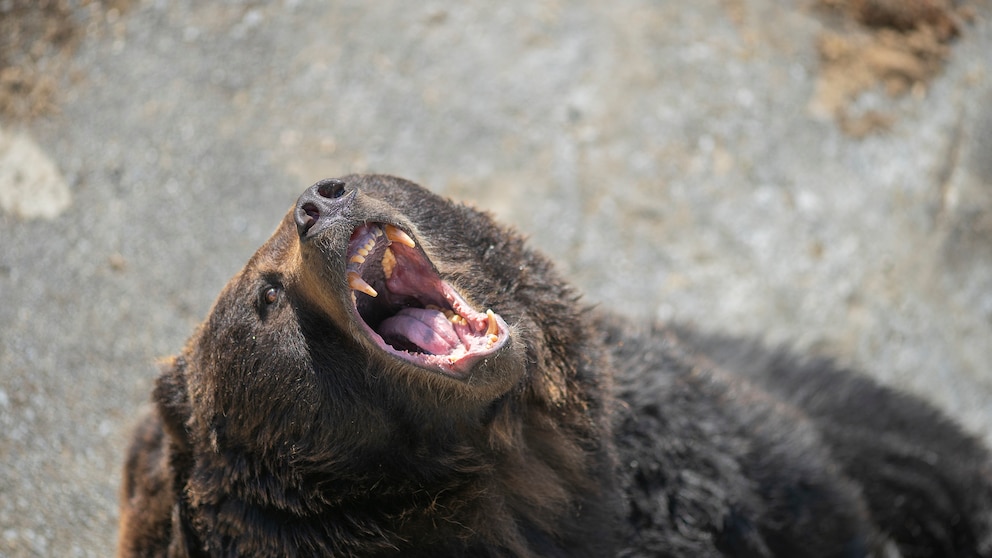
Bears are built for strength. The brown bear has a particularly muscular shoulder hump, short but very powerful legs, and huge paws with claws that are four to ten centimeters long and sharp. With them, bears dig dens in the forest floor, root for food, and scavenge.1
Also interesting: Do you know all 8 real bears?
However, it’s difficult to quantify exactly how much strength a bear develops. Online, there are claims like “a grizzly lifts 300 kilograms with one paw,” but reliable scientific measurements are scarce. What is certain is that the bear is physically superior to humans in terms of weight, claws, and teeth.
How Strong Are the Strongest People in the World?
Strength athletes achieve amazing feats with the human body. Iceland’s Hafþór Björnsson, winner of the “World’s Strongest Man” title in 2018, set a world record in May 2020 by deadlifting 501 kilograms, roughly the weight of a large brown bear.
However, this record is a single, carefully prepared movement with a barbell lifted from the ground to the hips. It has little to do with the strength needed in a fight against a predator.2
Who Is Faster?
In terms of speed, humans stand no chance. Brown bears can run up to 40 to 50 kilometers per hour. Usain Bolt reached a top speed of 44.72 kilometers per hour during his 9.58-second world record in Berlin in 2009.
But he maintained that speed only for a few seconds and under ideal conditions on the track.3 In contrast, a bear can cover up to 30 kilometers a day in its daily routine. Running away over short or long distances is not really an option.4
Also interesting: Will bears soon return to Germany?
Why Strength Isn’t Everything
It’s one thing that the bear leads in size, weight, weapons, and speed. Additionally, bears act instinctively in the wild. They are survival experts who use their strength strategically. Bears typically attack humans only when they feel threatened, such as when surprised or defending their young.
It’s also important to know that when a bear stands on its hind legs, according to the Welttierschutzgesellschaft, it’s usually not in attack mode but trying to see and smell better.

Jaws Poster Features Different Shark Species

Will Bears Soon Return to Germany?
What the Social Media Trend “Man or Bear” Has to Do With It
Anyone who has pondered the question might be familiar with the trend that went viral on TikTok in spring 2024. A man asked women on the street whether they would prefer to be alone with a man or a bear in the woods. Many women chose the bear. Whether one could win against a bear wasn’t the question.
The answers revolved around fear and uncertainty. Many women explained that with a bear, they at least knew what to expect, or they would be believed after a bear attack. The trend is mainly seen as an expression of how insecure many women feel when alone with a stranger in a remote location.5, 6
Conclusion: What to Do If You Encounter a Bear?
One should not even attempt a showdown. The fact is, in a physical confrontation, a human would be clearly inferior to a bear. Therefore, it’s crucial to avoid them.
Those traveling in bear regions such as the Carpathians, Scandinavia, or parts of the Alps should remain calm and not run away, according to expert recommendations. If an attack occurs, the WWF advises lying on the ground and placing hands protectively on the neck. One should play dead and wait until the bear has moved a safe distance away.
Also interesting: What you should do if you encounter a bear
Even in Europe, the number of bears is increasing. According to WWF, there are currently around 17,000 brown bears living here, and individual animals are now appearing again in border areas with Germany.