

October 31, 2025, 12:36 pm | Read time: 4 minutes
Chimpanzees are considered particularly intelligent animals. In the animal kingdom, they are known for their deliberate use of tools—almost like nature’s craftsmen. But do all individuals possess equally developed cognitive abilities? A recent study examines whether young chimpanzees might surpass their parents in terms of intelligence. PETBOOK reports on the surprising findings.
History is full of useful inventions and discoveries. Time and again, people come together with exciting, innovative, and new ideas. But did you know that not only humans have an inventive spirit? A study investigates how new behaviors emerge in animal circles. The research group led by Iulia Bădescu from the Université de Montréal studied how young chimpanzees in Uganda used various objects over 15 months.
The researchers wanted to find out how young chimpanzees invent new things. To do this, they developed an “exploration index” that shows how often and creatively the animals play with objects. The result: Innovation often arises in play, and some young animals are particularly inventive. The findings were published in the journal Scientific Reports. 1
Play Behavior Under the Microscope
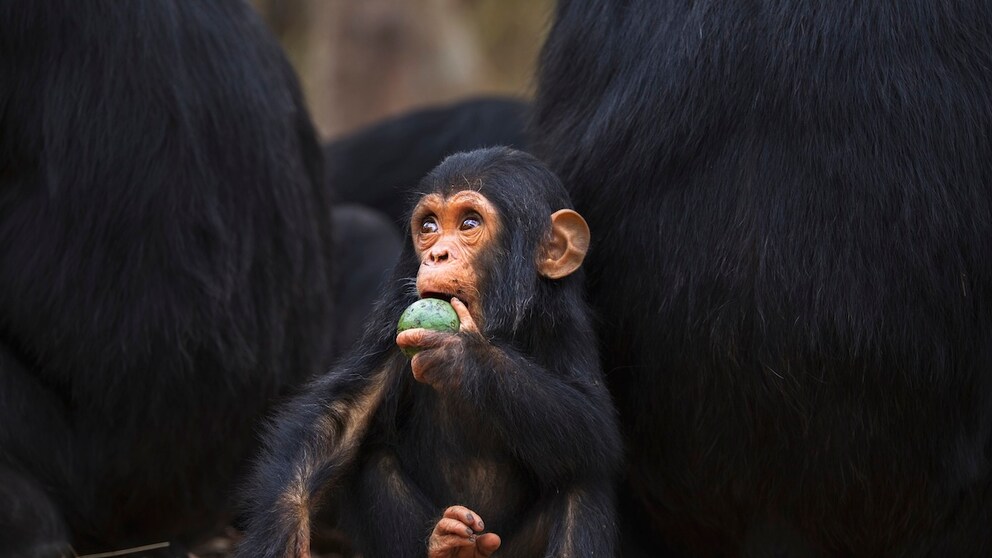
Over 15 months, the researchers observed 36 young chimpanzees aged 6 months to 13 years in Kibale National Park in Uganda. They documented 67 situations in which the animals handled natural objects like branches, leaves, or moss—sometimes as tools, sometimes during play, and sometimes in small scuffles.
The behaviors were carefully analyzed. Depending on whether they corresponded to typical adult behavior or deviated from it, they were classified as “typical” or “atypical.” The study was conducted strictly according to international wildlife protection standards and was approved by the Ugandan authorities.
What the Data Show: Little Chimpanzees, Big Ideas
After the evaluation, the researchers found that almost half of the observed object uses were “atypical”—meaning different from adult chimpanzees. This means that the young chimpanzees actively tried new things in most cases, such as using sticks or leaves in unfamiliar situations.
The researchers even considered three of these behaviors as genuine innovations: One female carried a tree stump like a baby for hours—like playing with a doll. Another female used moss like a sponge to drink water—a clever shortcut to the known leaf method. And a male used a courtship signal unexpectedly to be carried by his mother—successfully. Younger animals, especially females and offspring of experienced mothers, were particularly creative.
Also interesting: Orangutans Treat Their Wounds With Self-Made Remedies
Are Chimpanzee Children Smarter Than Their Parents?
The study clearly shows: When young chimpanzees playfully experiment with objects, it can lead to more than just entertainment. Sometimes, it results in new, genuine innovations. Curious animals with a high “exploration index” developed new and especially functional behaviors in handling objects, without the example of an adult.
Females and the young of experienced mothers were among the most successful. Conversely, this means that a social environment that provides ample room for experimentation encourages creative behavior. When creativity and curiosity lead to small inventions, they can be adopted and contribute to the development of the animal group.

Chimpanzees use leaves to wipe themselves and clean up after sex

Even Chimpanzees Enjoy Their “After-work Beer”
Long-Term Observations Still Open
The study’s results provide insights into the dynamics within chimpanzee groups. It highlights the role of chimpanzee children—how the group can benefit from their curiosity. However, there are currently no studies that have conducted such observations over a longer period. As a result, there is no data on how chimpanzee children develop further. Do they become uncreative as they age and leave the play to the next generation? In the long run, this question could reveal further exciting insights.
Creative Children Are Everywhere–Even in the Animal World
The inventive spirit is often found in children—and according to the study, also in chimpanzee children. When they play, explore, and experiment, they develop new ideas. Doesn’t that also remind you of human children? They too learn to solve problems or invent new things while playing.
Although many of the chimpanzee children’s ideas did not catch on, they still show the potential inherent in childlike curiosity.