

September 15, 2026, 2:53 pm | Read time: 5 minutes
Many know the line from the children’s song, but few know if it’s true: Can earthworms cough? The answer delves deep into the fascinating biology of these creatures and explains why you often see them after a rain shower. Together with experts from Wildtierschutz Deutschland e. V., PETBOOK clarifies how earthworms breathe and whether they can actually cough.
Can Earthworms Cough?
For decades, this children’s song has been in the minds of various generations. The refrain often sticks and becomes a persistent earworm. But what’s the truth? Can earthworms really cough? PETBOOK asked Wildtierschutz Deutschland e. V. They have a clear answer, which most probably already suspected: Earthworms cannot cough. The reason is quite simple: “They lack the lungs and airways that we need for that.”
If earthworms cannot cough because they don’t have lungs, how do they breathe to get the necessary oxygen? “They breathe through their skin,” says Wildtierschutz Deutschland e. V. For this, they need a thin film of moisture on their body surface. “Oxygen dissolves in it before passing through the skin into the blood,” explains the animal and nature conservation organization. Carbon dioxide is released in the reverse process.
What feels a bit slimy to us is essential for the earthworm’s survival. “If their skin dries out, they also lose the ability to breathe adequately,” explains Wildtierschutz Deutschland e. V.
Do Earthworms Have a Mouth?
Have you ever looked closely at an earthworm? It almost seems as if the creature has no mouth. But that’s misleading, according to the animal and nature conservation organization: “At the front end, under a small, movable head flap, is the mouth opening.”
The earthworm primarily needs its mouth for feeding. It takes in dead plant material and organic matter from the soil. “The underground dweller doesn’t need teeth for this,” explains Wildtierschutz Deutschland e. V. “Its gizzard, aided by tiny mineral grains it swallows with its food, handles the grinding,” they elaborate.
Can Earthworms Suffocate Underground?
Earthworms primarily live underground, yet they don’t suffocate there. The soil is not an airless space. “Between soil particles and in small cavities, there is usually enough oxygen for its inhabitants,” explains the organization. However, there is a certain risk: “If these spaces are filled with water for an extended period, oxygen can become scarce.” Then the creatures could indeed suffocate.
A flooded tunnel doesn’t automatically mean life-threatening danger. Wildtierschutz Deutschland e. V. explains: “Earthworms can absorb the oxygen dissolved in water through their skin.” Furthermore, “How well they survive a flood depends, among other things, on the species and the availability of oxygen.”
Can Earthworms Get Sick?
“Earthworms are not immune to diseases and parasites,” notes the animal and nature conservation organization. “Tiny single-celled parasites can live in their bodies,” they further explain. Not every infestation makes them seriously ill, but even a creature with such an unassuming exterior is vulnerable to health issues. However, a cold, as we know it, is ruled out due to the lack of lungs.

Do Sharks Really Need to Keep Swimming Constantly to Avoid Suffocating?

Why Do Sharks Have Nostrils Even Though They Don’t Have Lungs?
Why Do Swollen Earthworms Lie by Puddles After Rain?
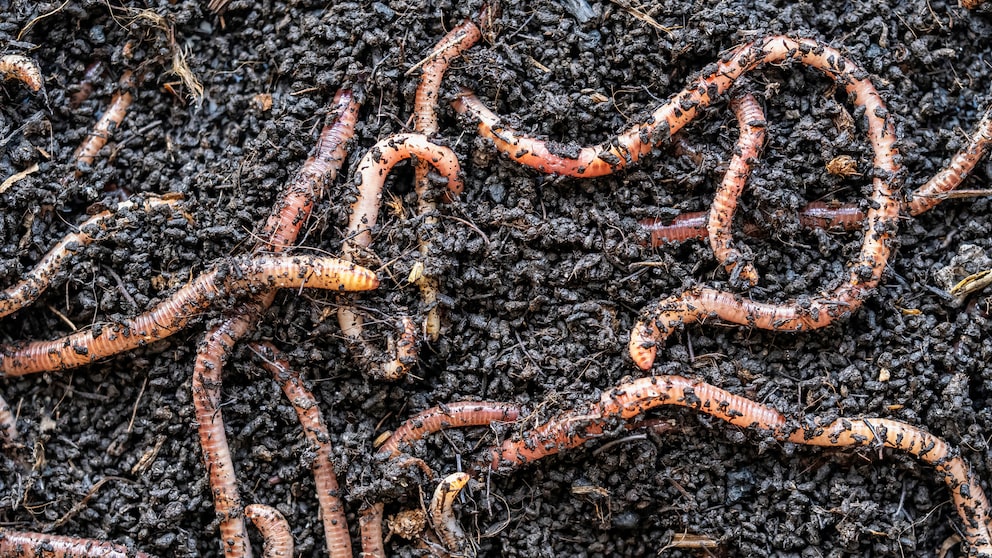
After it rains, you might see earthworms lying on roads or paths. Initially, they can move well through the resulting mud. But when it dries and the wild animals end up on compacted surfaces like cobblestones or asphalt, they can’t return to the soil.
“If an earthworm appears swollen and barely moves, you can’t tell just from that what happened,” explains Wildtierschutz Deutschland e. V. Oxygen deficiency in the water or injuries could be the cause of its poor condition. Important: “Not every motionless creature is already dead—and not every earthworm next to a puddle has drowned,” emphasizes the organization.
In such a situation, they advise: “If you want to help, you can gently pick up the creature with a leaf or clean, moistened hands and place it on moist, loose soil in the shade nearby.” Some leaves offer additional protection. Particularly important: “Do not pull, squeeze, or bury deeply.”
A single, clearly defined thickening in the front body area is quite normal. “This so-called clitellum is part of the reproduction of adult earthworms,” says Wildtierschutz Deutschland e. V.
Which Myths About Earthworms Persist the Most?
According to Wildtierschutz Deutschland e. V., the statement persists: “A cut earthworm does not become two new creatures.” While the front part can regenerate a lost rear end under certain conditions, the severed rear part will not become a complete earthworm.
“The idea that all earthworms live deep underground is also incorrect,” says the organization. What is a suitable habitat for one species may not be for another.
Another myth revolves around the diet of the small creature. They don’t just eat soil. “They extract the organic components from it, consuming plant debris and microorganisms,” the organization explains. So, leaving leaves in the garden and protecting the soil from drying out and compaction helps a small, diverse community hidden beneath our feet.