

May 8, 2026, 12:00 pm | Read time: 3 minutes
Are you familiar with the “Dracula Parrot”? The reason for the bird’s name is likely obvious due to its appearance. What else distinguishes this unique “Goth” bird can be found in this article.
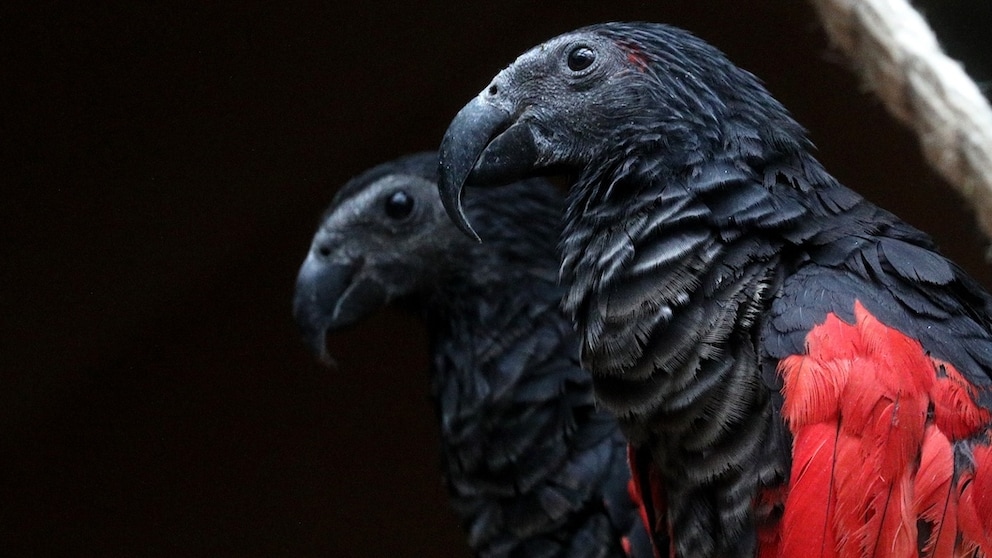
It looks as if the main character from Bram Stoker’s “Dracula” has transformed directly into a bird. However, the Dracula Parrot with its jet-black plumage does not feed on innocent victims. Its bone-chilling scream only claims figs as its victims.
Distinctive Appearance and Loud Vocal Organ
The Dracula Parrot (Psittrichas fulgidus), named after the famous vampire character, lives up to its name: With jet-black feathers accented with blood-red, it looks almost eerie. Particularly striking are the red areas on its belly, tail, and wings. Males can also be identified by red spots behind their eyes—a feature that distinguishes them from females.
With its scream that sends shivers down your spine, the Dracula Parrot seems as if it flew straight out of a horror film. The bird’s sounds are as extraordinary as its appearance. Instead of typical parrot calls, the Dracula Parrot emits a rough, croaking screech. This sound is more reminiscent of a predator than a fruit-eating bird. Experts believe this scream developed as a means of communication over long distances in the dense rainforest—and possibly also serves to deter potential enemies.
Native to the rainforests of New Guinea, the parrot, also known as the Bristlehead Parrot or Pesquet’s Parrot, is fascinating not only because of these features. Another striking characteristic is its largely bald head. In this regard, it resembles vultures, where the bald spots prevent blood from matting their feathers. The Dracula Parrot, however, is more concerned with nectar, flowers, and especially its favorite figs. The bird named after the most famous vampire of all time is entirely vegan. 1
The Coolest Vampire Animals–From Real Bloodsuckers to Eerie Namesakes
Origin, Husbandry, and Care of the Nectar-Feeding Coconut Lorikeets
Can You Keep the “Goth” Parrot at Home?
For many animals, a fascinating appearance and an attention-grabbing name are not always positive. As with the Black Rain Frog, which resembles a grumpy avocado, this has also led to the Dracula Parrot being poached for the pet market.
Why you shouldn’t keep the parrot, which can grow up to 50 centimeters, as a pet becomes clear when you consider its habitat and lifestyle. Bristleheads are exclusively native to New Guinea. Their preferred habitat is the mid and high altitudes of tropical mountain and hill landscapes. There, they rely on intact, expansive rainforest areas.
The Dracula Parrot fertilizes the area when it metabolizes the native fig species. The remnants, along with the seeds, fall to the ground as it consumes the ripe fruits. Thus, it is a keystone species for its habitat, continually giving rise to new fig trees. Due to this specialized diet, the Dracula Parrot also relies on a nomadic lifestyle—following the seasonal food supply.
Dracula Parrot Increasingly Threatened
But not only for this reason is the species listed as “vulnerable” on the IUCN Red List, and international trade is now prohibited under the Washington Convention (CITES). One of its main threats is the destruction of its natural habitat. Additionally, there is targeted hunting: The local population uses the birds’ meat, and the red feathers fetch high prices on local markets as bridal gifts.
Unfortunately, too little is known about this special parrot to protect it effectively. For example, its breeding habits have not yet been observed. Researchers suspect that breeding mainly occurs during the rainy season and that the birds incubate one to two eggs in tree cavities. Bristlehead colonies of up to 20 birds have also been observed. The lifespan of these birds is also unknown, with estimates ranging from 20 to 40 years. 2