

July 21, 2026, 4:19 pm | Read time: 6 minutes
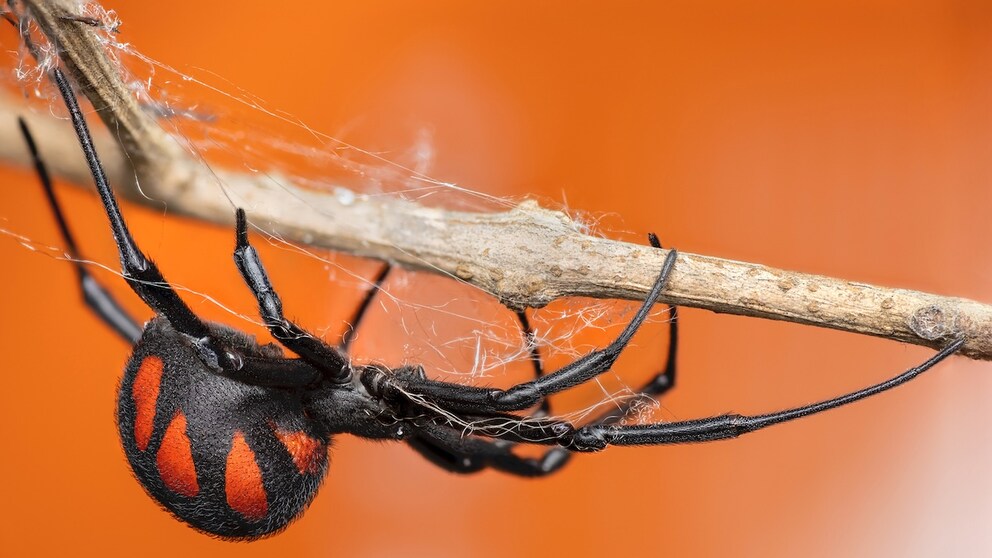
How exactly do male black widows find their mates? New research shows that female Latrodectus hesperus strategically use sex pheromones, adjusting them seasonally depending on the availability of males. Particularly intriguing: A previously unknown scent of the black widow, which emits a breathtaking smell reminiscent of cheese feet, attracts males more strongly than the previously known one. And: Spider webs are more than just threads–they serve as chemical traps.
Aromatic Cheese Feet Scent Makes Black Widow Irresistible
Sex pheromones are crucial for many animals in mate selection. While they are extensively studied in insects, their use in spiders is far less known. Female spiders often emit chemical signals that attract males and encourage courtship.
In black widows–a subgroup of cobweb spiders now also found in Germany–only one component had been identified that triggers male courtship behavior on female webs. The substance, with the somewhat cumbersome name N-3-Methylbutanoyl-O-methylpropanoyl-L-serinmethylester, is simply called “1” as the first known pheromone. However, it explains only a small part of the attraction, suggesting the presence of other unknown components.
Additionally, it was unclear whether spiders adjust their pheromone production seasonally. Previous studies showed that related spider species secrete contact pheromones that decompose on the web, releasing volatile attractants–but such evidence was lacking for L. hesperus.
Isobutyric Acid Causes Cheese Feet Smell in Mating-Ready Black Widows
Researchers led by first author Andreas Fischer analyzed which chemical substances female, unmated Latrodectus hesperus deposit on their webs and how their quantities change throughout the year. They collected spiders between 2018 and 2022 at a coastal site in Canada and kept them under controlled conditions. Webs were also regularly chemically extracted and analyzed for pheromones using gas and liquid chromatography. The team discovered a new olfactory component that significantly contributes to attraction, and it is quite remarkable.
Additionally, the researchers conducted behavioral tests with males to measure the effect of synthetically produced scents. In a field experiment, they also tested whether a hydrolytic breakdown product of the pheromones–isobutyric acid–attracts males in nature.
A particular focus was on seasonal differences: For a year, the team quantified the pheromone amounts on webs in the field monthly. The study was conducted according to ethical guidelines for animal experiments and received approvals for field trials in a protected habitat.
Black Widows Emit Breathtaking Scent Mainly in Summer
As researchers from the University of Greifswald and Canada report in the “Journal of Chemical Ecology,” female black widows rely on a complex and long-term scent strategy in mate selection. Unlike many insects that release their pheromones only during specific time windows, the spiders also turn their web into a permanent scent source.
The chemical messengers on the web serve a dual function: Upon direct contact, they specifically trigger mating behavior in males. Simultaneously, the substances gradually decompose, releasing volatile scents that remind humans of “cheese feet”–male black widows, however, find this smell highly attractive.
“What I found particularly exciting about the results was that the females adjust the intensity of their scent signals to the season. They attract males year-round, but they are most attractive when most males are searching for a mate,” explains first author Dr. Andreas Fischer from the University of Greifswald. Before starting his research in Mecklenburg-Vorpommern, he worked at Simon Fraser University in Canada, where the field experiments were also conducted on a beach.
Complex Chemistry of Communication
In the lab, the team chemically analyzed the spider webs and identified the involved messengers. Additionally, the researchers conducted behavioral studies with male spiders using specially developed experimental setups, showing that even artificially produced scents reliably attract males. The year-long field study with monthly measurements also demonstrated that females seasonally control their attractiveness–apparently, the length of the day signals the onset of the mating season.
Besides the known component 1, the researchers identified a similarly complexly named new pheromone substance: N-3-Methylbutanoyl-O-methylpropanoyl-L-serin, briefly called “7.” Both substances trigger courtship behavior in males. The combination of 1 and 7 elicited as many courtship reactions as web extracts from real females, with the natural extract leading to longer courtship behavior.
“The black widows demonstrate remarkably sophisticated communication skills: With a complex chemical interplay of aromas and scents, the females significantly increase their chances of successful mating,” says biologist Fischer. 1

The Strange World of Giraffe Mating

Why Thousands of Tarantulas Swarm in the U.S. in Late Summer
Web-Building Spider Must Get Creative to Attract Males
The hydrolytic breakdown products of 1 and 7–including isobutyric acid (referred to as “10” in the study)–act as volatile attractants. In a field experiment, traps prepared with 10 were significantly more frequently visited by males than control traps.
The study shows for the first time that L. hesperus females not only emit multiple olfactory signals for courtship but also control them seasonally. The identified component 7 is not only new but even more effective–and more intense in smell–than the previously known one. Pheromone production peaks in summer, synchronized with male activity. This suggests a targeted investment by females in sexual communication–depending on environmental conditions and mating opportunities.
The study also confirms a two-stage signaling mechanism. Females initially deposit contact-active substances on the web, which over time transform into volatile attractants. This slow release allows females to remain attractive over extended periods. This is an evolutionary advantage for sedentary, web-building species. No wonder black widows rely on such intense smells as that of cheese feet.
Study Context and Possible Limitations
The investigation combines modern analytical chemistry with solid behavioral biology and field tests. The results are robust and methodologically sound. However, there are limitations: The number of field trials was limited for conservation reasons, which reduces the significance of long-term effects.
Some substances could only be discovered after the behavioral experiments were completed and were therefore not tested. A potential conflict of interest exists in the industrial co-financing by BASF Canada and Scotts Canada Ltd., which was transparently disclosed. Overall, the study is carefully planned, well-executed, and highly significant in its findings.
Further investigations could show how black widows adjust their signals to environmental stimuli such as temperature and day length. Particularly fascinating for animal lovers: The webs are not only hunting instruments but also sophisticated scent traps. For science, this means a new approach to understanding sexual communication in spiders. 2