


May 8, 2026, 3:04 pm | Read time: 4 minutes
What appears to be a fascinating natural spectacle could become a trap for the animals themselves: Thousands of isopods suddenly move in perfectly coordinated circles—triggered by a common element of modern cities. A new study shows how artificial light induces previously unknown behavior and what consequences this may have.
Chance Discovery in the Golan Heights
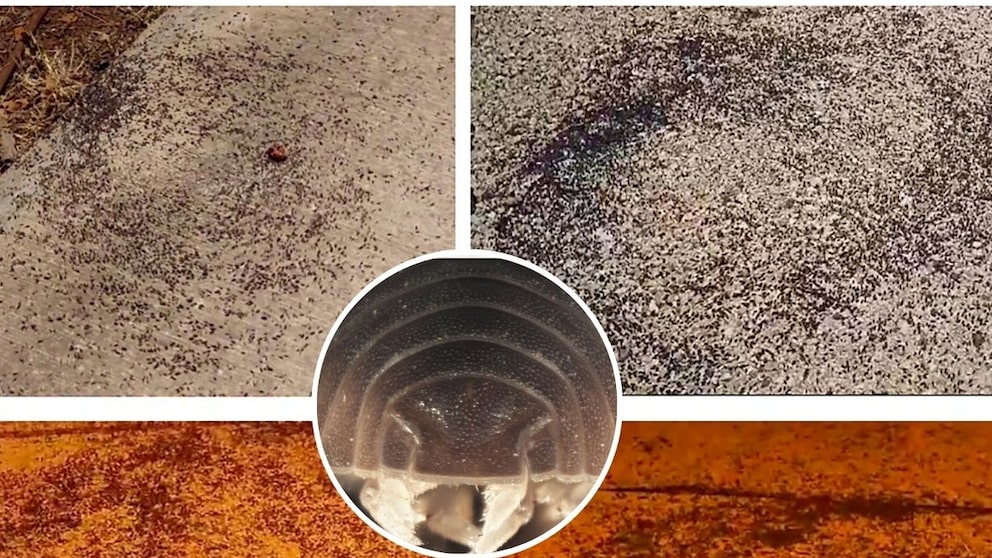
The starting point of the investigation was an observation by amateur naturalist Eviatar Itzkovich, who encountered unusual gatherings in the Golan Heights during summer nights. The Armadillo sordidus species, typically reclusive under stones and in moist environments, suddenly gathered in large groups and moved in circular formations.
Death Spiral Previously Known Only in Insects

The phenomenon was previously known only in insects like ants. In these cases, several hundred ants run endlessly in a circle, which is why these formations are also called ant mills or circular mills. This mainly occurs in army ants when they follow the pheromone trail of their predecessor. If the trails cross, it leads to more ants following the scent and running endlessly in circles. This further strengthens the pheromone trail and draws more ants into the vortex, often running to exhaustion.1
Phenomenon in Isopods Hardly Researched
While the spectacle in ants can be explained by their form as a small social state, the reason for the land isopods is unknown. They are actually solitary creatures. Moreover, contrary to popular belief, they are not insects. Isopods are distant relatives of crabs and shrimp. Although it is known that they occasionally gather to retain moisture, such a coordinated mass movement has rarely been documented.
Why Do Isopods Run Endlessly in Circles?
To understand the triggers of the behavior, the research team led by doctoral student Idan Sheizaf tested various environmental factors, including:
- Magnetic fields
- Ultraviolet light
- White light
While even strong magnets did not alter the movement patterns and ultraviolet light attracted only a few animals, white light had an astonishing effect: When a light source was directed perpendicular to the ground, the isopods reliably began to move in large groups in circular patterns.
The shape of the light cone is crucial. It creates a clearly defined, circular zone on the ground. The animals orient themselves along this boundary and follow it. Once a certain density is reached, a stable, self-sustaining rotation emerges.2
Black widows use the smell of cheese feet to attract males
Why Large Flocks of Crows Are Now Perching in Trees
Light as a Deadly Trap
Idan Sheizaf explains in the science magazine “Phys.org“: “Although collective movements are common in the animal kingdom, it was completely unexpected to see them in this form in isopods.” The researcher further explains that human-created lighting conditions—especially the circular light cones of streetlights—interact with the animals’ natural instincts, triggering this striking, potentially harmful behavior.
As impressive as the “isopod mills” appear, they could have significant disadvantages for the animals. The researchers found that the groups were predominantly female, many carrying eggs. Therefore, reproductive behavior can be ruled out.
Instead, everything suggests that artificial light at night disrupts the animals’ natural instincts. The isopods leave their protected habitats and get caught in a kind of endless loop.
Small Cause, Big Effect
This behavior makes them vulnerable. In one case, a centipede was observed exploiting the circling group. Besides the increased danger from predators, the animals also lose valuable energy needed for survival. Depending on how long the light shines, it is possible that the isopods could run in circles to the point of deadly exhaustion.
The study, published in the journal “Ecology and Evolution,” vividly demonstrates how even seemingly minor interventions—like a streetlight—can influence animal behavior. Such changes can have far-reaching consequences, especially for small, often overlooked species.