

October 26, 2026, 4:01 pm | Read time: 3 minutes
An urban legend that sounds like something out of a horror film: A squirrel is said to attack deer, bite their jugular vein, and later eat their heart and liver. In Borneo, this rare animal is called the “vampire squirrel.” But what is really behind the myth? Scientific observations have taken a closer look at the supposed deer killer.
The Legend of the “Vampire Squirrel”
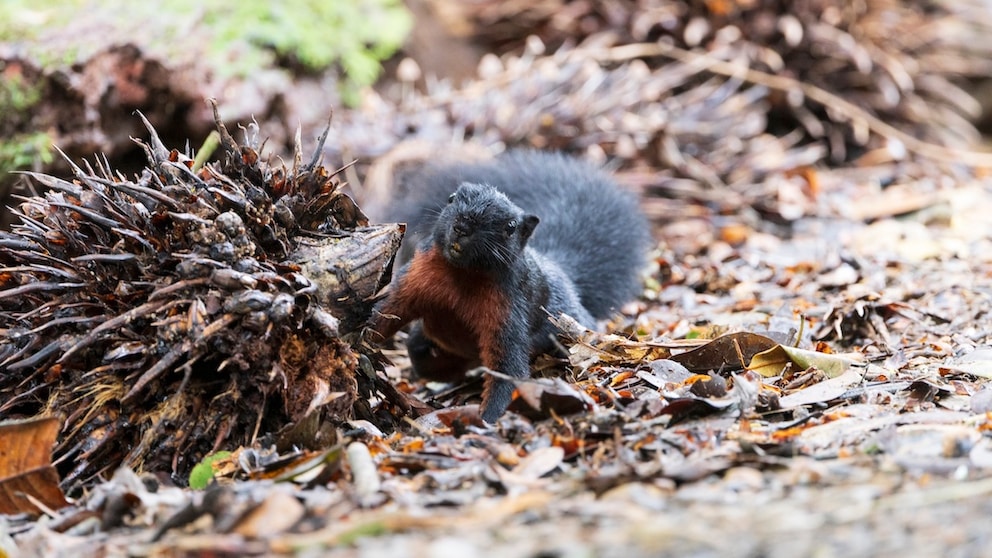
Deep in the rainforests of Borneo lives an animal surrounded by one of the bloodiest legends in the animal kingdom. The Borneo squirrel (Rheithrosciurus macrotis) is said to attack deer as a native hunter. Allegedly, it jumps on their backs, injures them with its powerful incisors at the jugular vein, and waits for them to bleed out.1
Afterward, as the locals tell it, the squirrel returns to the carcass and eats the heart, liver, and stomach contents. It is also said to have killed and gutted chickens in villages on the edge of the rainforest. No wonder this animal earned the eerie nickname “vampire squirrel.”
Evidence of the Bloody Attacks?
As impressive as the stories of the small rodent sound, there is no scientific evidence to support them. The reports are mainly based on local lore and discovered animal carcasses, whose injuries were likely mistakenly attributed to the Borneo squirrel.
In 2015, researchers managed to film the rare animal in the wild for the first time. The footage from Gunung Palung National Park in the Indonesian part of Borneo, however, showed no attack on a deer. Instead, the squirrel moved along the forest floor, apparently searching for food. Generally, little is known about the lifestyle of these wild animals, and photos are rare compared to other squirrel species. The Borneo squirrel lives reclusively in the rainforest and rarely appears in camera traps.2

Its Teeth Are Made for Hard Seeds
A scientific study on the diet of the Borneo squirrel finally provided a much less bloodthirsty explanation for its unusual teeth. The particularly strong incisors have deep grooves and an almost saw-like edge. With them, the squirrel cracks extremely hard seeds that few other animals can access. It is especially specialized in the seeds of Canarium decumanum. Of 79 documented meals, all consisted of seeds. Researchers found no evidence that the squirrels eat deer, chickens, or other vertebrates.3
Also interesting: Why many squirrels don’t even live to be a year old
The Coolest Vampire Animals–From Real Bloodsuckers to Eerie Namesakes

Orcas Tear Apart Giant Sunfish Into Thousands of Pieces
A Tail Larger Than the Rest of the Body
Not only are the teeth of the Borneo squirrel extraordinary. Its bushy tail has a volume about 30 percent larger than the rest of its body. This could make the animal’s tail one of the most voluminous among mammals relative to its size.4
The purpose of the conspicuous fur is unclear. It is unlikely to serve as thermal protection in Borneo’s tropical climate. Possible explanations include camouflage, mate selection, or distraction from predators. If an attacker grabs the huge tail, the actual animal might be harder to catch.
Only the Legend of the Deer Killer Remains
The idea of a squirrel that kills deer and eats their organs is spectacular, but according to current research, it’s a myth. The rodent is actually more of a highly specialized seed eater than a bloodthirsty hunter. Yet, the mysterious animal is not entirely debunked. Researchers still know little about its behavior and the function of its enormous tail.