


November 9, 2026, 12:02 pm | Read time: 8 minutes
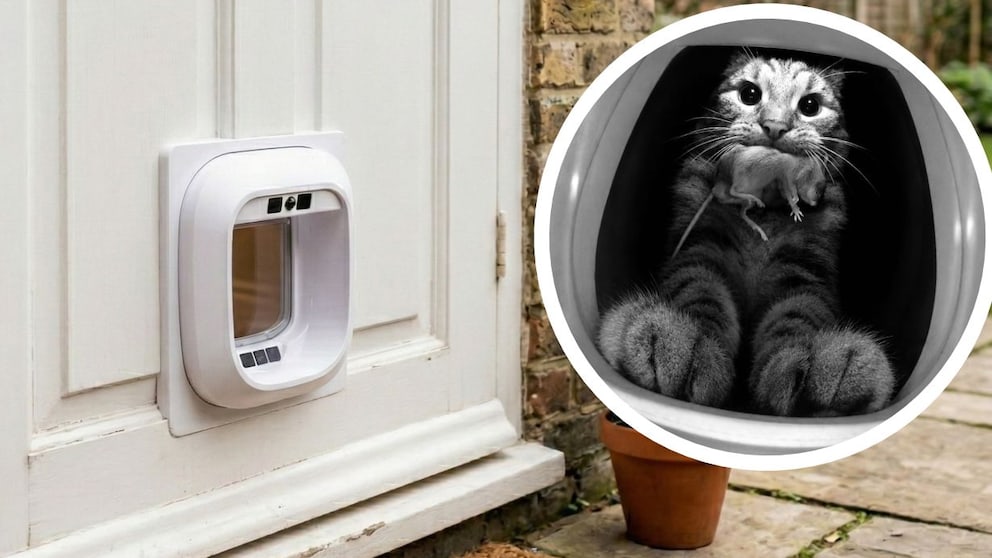
According to the manufacturer, “Flappie” is the world’s first AI cat flap that can distinguish cats using facial recognition. The intelligent cat flap is designed to prevent cats from bringing mice and other prey into the house. However, the developers apparently didn’t anticipate the cleverness of some animals: Some cats quickly figured out how to bypass the lock.
AI detects if a cat is carrying prey in its mouth
Every cat owner knows the scenario: You get up in the morning and almost step on a dead mouse in the living room while having your first coffee. It’s even more unpleasant if the mouse isn’t dead and suddenly scurries under the sofa, while the cat stands by, seemingly not understanding why we humans don’t appreciate its great gift.
For those with outdoor cats, such “gifts” are hard to prevent. But now a new cat flap aims to do just that. “Flappie” can use artificial intelligence to detect if a cat is carrying something in its mouth and then deny entry. At least most of the time–since some cats have even learned to outsmart the technology. PETBOOK spoke with Denis Widler, co-founder and CEO of Flappie Technologies, about the exciting insights gained during the development of the clever cat flap.
Cats simply pried open the flap with their claws
The idea behind Flappie sounds simple at first: A camera observes the cat as it comes home. If the AI detects that the cat is carrying something in its mouth, the flap remains closed. So, the cat can’t stroll into the house with a mouse. But the developers apparently didn’t anticipate the persistence of some cats.
“Initially, the flap was only locked from one side when blocked,” Denis Widler tells PETBOOK. “Some cats quickly figured out that they could reach into the flap with their claws and pull it open. Cats are the best testers you can imagine.”
This probably doesn’t surprise most cat owners. Anyone who has ever seen how quickly cats learn to open doors, drawers, or food containers knows how inventive they can be when something stands between them and their goal. The developers had to come up with a solution. Today, according to Flappie, the flap locks from both sides when prey or a foreign cat is detected.
Even a sausage ended up in front of the cat flap
And apparently, cats present the AI with entirely different challenges. Not everything they bring home was once alive. For instance, recordings have shown cats appearing with stuffed animals–one even tried to bring home a sausage.
The AI doesn’t specifically look for mice or birds. Instead, it is designed to generally recognize if the cat is carrying something in its mouth. This could be mice, birds, or lizards, but according to the manufacturer, also fish, snakes, or insects. This is supposed to work even at night, thanks to an infrared camera with infrared light.
Also interesting: Your cat brings you prey? It’s probably not a gift
How reliably does the AI detect prey?
But can you really rely on Flappie to ensure you won’t find a mouse in your bed in the morning? The manufacturer currently states the prey detection accuracy at 99 percent. There are situations where detection becomes more challenging, such as in heavy rain, with a new collar, or with a fly screen in front of the cat flap. If a cat quickly darts through the opening from below, the camera may have little time for analysis.1
This is particularly important for cats. Anyone with a pet that typically sprints through cat flaps knows how fast that can happen. For such cases, the company says the flap can be set to remain locked briefly until the check is complete.
What do cats do when they can’t get back inside?
But how do cats react to this sudden restriction? Those with an outdoor cat used to bringing in all sorts of “gifts” might wonder if the cat might not return. If the flap detects prey, the entrance remains locked for about a minute. If the cat waits with a mouse at the door, the flap locks again. However, the cat can always go outside.
Meanwhile, the owner receives a notification on their smartphone and can view the corresponding video. And there’s an observation that is truly fascinating from a cat behavior perspective. Some owners report that their cats gradually bring home less prey over time.
“Maybe they realize it’s not worth it anymore,” Denis speculates. However, Flappie hasn’t systematically evaluated this–so for now, it’s just an observation. It would be interesting to study whether cats can actually make a connection.
Do cats learn not to bring mice anymore?
Cats can indeed learn from the consequences of their behavior. But whether they understand in this specific case that the prey is why the cat flap remains closed cannot be deduced from individual owner reports.
Moreover, the AI flap doesn’t prevent the cat from hunting less. This motivation arises independently of whether the catch is allowed inside. After all, they could just as well eat their prey outside or leave it behind.
The cat flap can even recognize individual cats
Now, the technology also tries to determine who is at the door. This is particularly interesting for cat owners who know another problem: Their own cat doesn’t come through the cat flap alone, but suddenly the neighbor’s cat is in the kitchen.
Interestingly, according to Widler, this distinction was much harder to develop than prey detection. “Prey in the mouth looks similar in every household,” he explains. For the owner’s cat, the system must first learn what this specific animal looks like and how it differs from a possibly almost identical-looking neighbor’s cat.
AI recognizes cats better than their own owners
Since September 2026, the “Cat ID” feature has been available, according to the company. The camera is supposed to recognize the owner’s cat by its face and appearance. It doesn’t require a chip or collar, unlike other cat flaps.
To do this, the system must first get to know the owner’s cats. The owner assigns recordings to each animal in the app. The flap should then be able to distinguish between the owner’s and a foreign cat. Apparently with success: According to the company, Flappie correctly identifies 97 out of 100 owner’s cats and keeps 96 out of 100 foreign cats out. Some customers even reported that Flappie could tell their cats apart, “even though they sometimes have to look twice themselves,” Widler adds.
What happens to the recordings of my cat?
With a cat flap equipped with a camera, the question naturally arises: Where do the recordings end up? According to the company, prey detection and “Cat ID” run directly on the device. The camera also doesn’t film continuously but is activated when something moves in front of the flap.
Videos of relevant events, such as when the cat comes home, can appear in the app. According to Flappie, they are encrypted and automatically deleted after 30 days unless the user keeps them.
Does the AI cat flap work without the internet?
Setting up “Cat ID” initially requires an internet connection. Later, recognition should work without the internet. In the event of an internet outage, the flap continues to function according to the manufacturer, but notifications and new videos in the app are temporarily unavailable.
There’s also a solution for a power outage: By default, the flap remains open. After all, it would be disastrous if the technology suddenly prevented the owner’s cat from coming home.
For very large cats, it might be a tight fit
There is a limitation to the intelligent cat flap–and it has nothing to do with artificial intelligence: Some cats are simply too large. Especially with very large breeds like Maine Coons, it might be a tight fit, according to the manufacturer.
A simple test is recommended: Cut the dimensions of the opening into a cardboard box and let the cat try to pass through comfortably. “Better to lose a sale than have a cat that has to squeeze through,” says Widler.

Lab Buses for Dogs? Pet Trends from Interzoo

Trainer on AI in Dog Training: “Technology Doesn’t Replace Intuition”
How quickly do cats adapt to the flap?
Cats, of course, need to get used to the flap itself. Some animals might stroll through on the first day as if nothing happened. Others can be extremely skeptical of new things.
The same rule applies as with almost any training with cats: Please don’t just push them through. It’s better to lure them with food or a particularly good treat on the other side and give the cat time to explore the new flap on its own. Most animals quickly grasp the concept–especially if their desire for freedom is strong.
Conclusion: AI cat flap can be a good solution
Whether you really need a cat flap with artificial intelligence and facial recognition is something every cat owner must decide for themselves. Currently, “Flappie” costs 479 euros. How reliably the technology works in the long term in your own daily life is hard to judge based solely on manufacturer information.
But if you have a pet that regularly distributes half-dead mice in the house or occasionally brings “breakfast” to your bed, you’re likely willing to invest the money. Because you can’t train cats out of this prey behavior–it’s part of their nature.