

March 7, 2026, 12:14 pm | Read time: 6 minutes
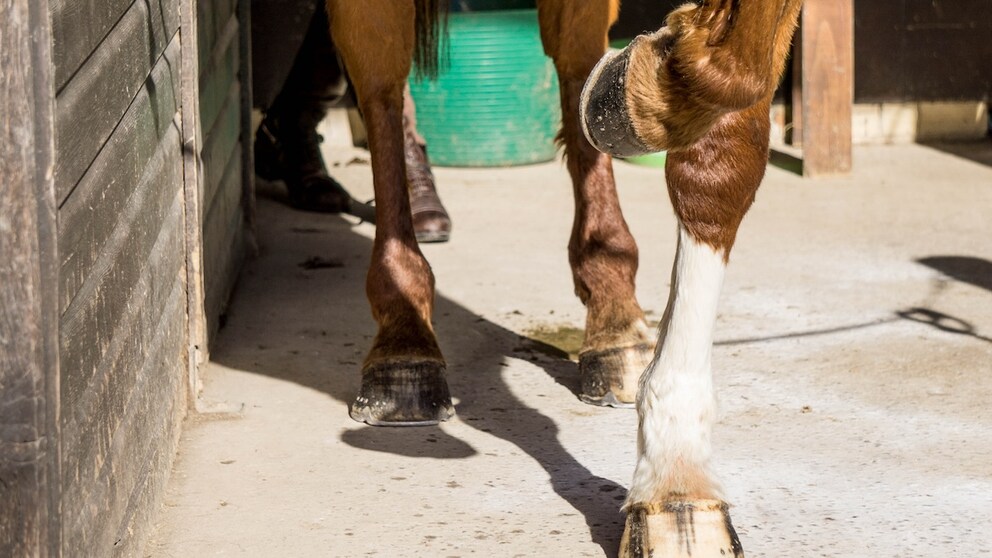
A brief moment of inattention at the grooming area—and suddenly it echoes through the stable aisle: a hoof on concrete. Many horse owners know this sound all too well—the horse is pawing. But what really lies behind the hoof pawing? Is it mere impatience, a bad habit—or a serious signal?
While grooming, you just want to quickly dash back to the tack room, and you already hear a familiar sound. A scrape and a sharp bang. Half annoyed and half worried, you rush back to the horse, which looks at you innocently with big eyes. It was similar for a long time with my pony mare, Little Princess. And for a long time, I also didn’t know why the horse was pawing.
This is also the case for many others, as can be seen from horse forums. But after many users have shared their woes and asked for tips and tricks, a plethora of advice follows, which couldn’t be more different. From “It just wants attention” to “Just groom the leg it’s pawing with,” everything is included. But does that help, or is the root of the problem somewhere else?
Why Hoof Pawing Doesn’t Start at the Grooming Area
People who might not be deeply involved with horses rightly ask: “Horses paw in nature, too, so why is it a problem now?” And they’re not entirely wrong. Horses haven’t just started pawing since they’ve been groomed at the grooming area. In fact, hoof pawing is even natural, explains a research team led by Christina L. Butler and Katherine A. Houpt from the College of Veterinary Medicine at Cornell University in a study titled “Pawing in Standardbred Racehorses: Occurrence and Behavioral Patterns.” The study examined the pawing behavior of racehorses throughout the day.
It was initially stated that horses frequently paw in nature. Often, hoof tapping serves as a means of communication, helps in foraging, or loosens the ground before horses roll. Hoof pawing is therefore not inherently bad. So what distinguishes this pawing from that in the stable aisle, in the stall, or at the grooming area? When a horse drags its hoof over the hard concrete floor, it is often perceived as unruly. But most of the time, that’s not the case, and there are entirely different reasons behind it. 1
Why Pawing Can Become Problematic
As natural as pawing is in general, it depends greatly on the extent and context. Individual, situational movements on soft ground, such as in straw, on the pasture, or even in lake water, are usually harmless. However, it becomes critical when a horse regularly and over a long period paws on hard surfaces, such as concrete in the stable aisle or at the grooming area.
In doing so, hooves can become particularly worn down. If the movements also occur conspicuously often in tense situations or are a permanent part of everyday life, closer observation is worthwhile. The key is less the movement itself than its intensity, frequency, and the context in which it is shown. 2
“He Just Wants Attention!”
In my active riding life, I’ve indeed experienced that some horse owners blamed their animal and even unconsciously reinforced the behavior negatively. Because horses learn quickly: If they paw—and the person reacts immediately, whether with attention, speaking, or by hastening with food or taking them out—they associate the two. The behavior is thus unintentionally reinforced. In such cases, pawing has nothing to do with “being bad” but is simply a result of learning processes. Horses are masters at recognizing patterns. Sometimes, pawing says less about the horse’s character than about the routines in the stable.
However, you shouldn’t just ignore the animal. I’ve repeatedly found it helpful to look closely and take the horse’s signals seriously to get to the root of the actual problem.
Horses communicate differently from us humans. While we can often verbalize our needs, horses tend to communicate through body language. They also occasionally hum to themselves, neigh, or squeal. When the animals paw with their hooves, it can also be a kind of signal. 3
Recognizing and Treating Laminitis in Horses
How the Trakehner Evolved from Military Horse to Dressage Star
When the Horse Paws in the Stall
If a horse paws in the stall, it’s worth taking a closer look at the circumstances. In a study by Cornell University, 41 Standardbred racehorses were observed twice daily over 62 days in their 3.3 × 3 meter stall boxes. More than half of the animals—58.5 percent—exhibited pawing behavior at least once. It was noticeable that the horses pawed significantly more often in the afternoon, several hours after training, than in the morning before training. On days without training, this difference disappeared. This suggests that pawing in the stall doesn’t automatically mean impatience or attention-seeking. 4
The researchers suspect that physical exertion might play a role—for instance, when horses try to redistribute their weight or create a more comfortable standing position by slightly altering the ground. Instead of hastily judging the behavior as “bad manners,” one should also consider possible physical causes. However, the researchers also concluded that these questions require further scientific clarification.
When Pawing Says More Than a Thousand Words
Pawing can also be an expression of excitement, nervousness, or anticipation. Perhaps you know this: On the neighboring paddock, there’s suddenly movement, training is about to start, or a new situation draws attention—and your horse begins to restlessly scrape its hoof over the ground. In such moments, the internal tension rises, and pawing becomes a visible sign of it.
Often, it doesn’t stop with just this one movement. The neck tenses, the posture becomes slightly more upright, the gaze is focused forward, and sometimes a soft hum or neigh can be heard. The horse is alert and attentive, and its ears are perked. Instead of quickly labeling it as a bad habit, it’s worth considering the overall picture: Often, the behavior is simply a result of felt tension.
In serious cases, however, such behavior can also indicate possible pain. It is often advisable to have the horse examined by a veterinarian, especially if other symptoms, such as tail swishing or kicking at the belly, are present.