

April 11, 2026, 9:48 am | Read time: 4 minutes
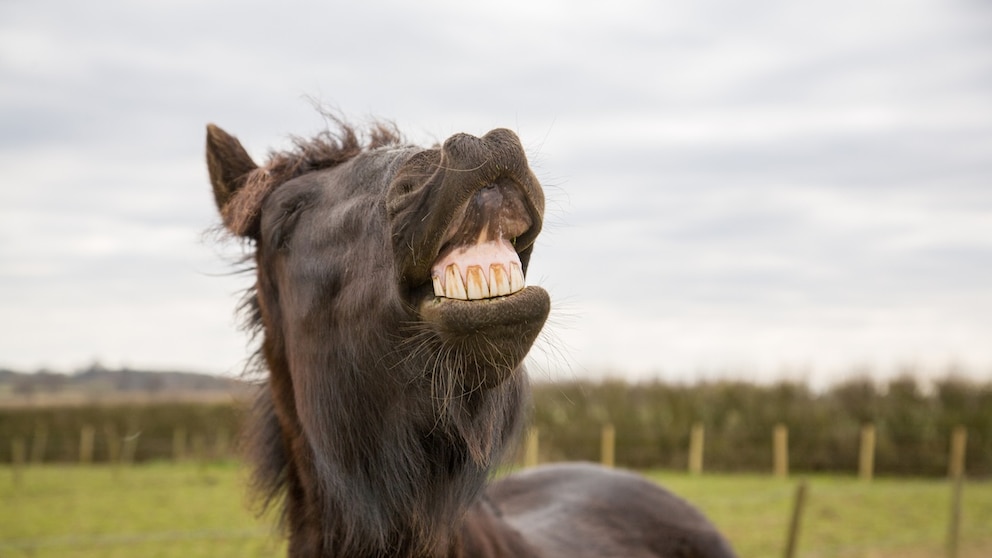
The sight has surely brought a smile to your face as well. The horse lifts its upper lip and stretches its head forward. Horse owners are well acquainted with this behavior, known as the flehmen response. But why do horses exhibit this behavior–is there more to it, or is it just “showing teeth”?
Why Horses Exhibit the Flehmen Response
Many owners are familiar with their horses’ raised lip. This behavior can be observed both in the pasture and in the stall or grooming area. A distinct body posture is typical: The horse raises its upper lip, slightly lifts its head, and often pauses for a moment.
This raises the question of why horses exhibit the flehmen response at all. A look into their anatomy provides the explanation: A horse’s nose is designed to detect even the faintest odors.
This is due to an anatomical feature, the Jacobson’s organ (vomeronasal organ). Located in the nasal septum, it allows the horse to detect pheromones. Through the flehmen response, scent particles are directed to this organ for more detailed analysis. Pheromones are chemical messengers that convey information. The flehmen response is not about threatening or “showing teeth.” It is a specific behavior for scent analysis. Incidentally, not only horses use this organ: Many other animals, such as cats and dogs, also use it to evaluate scents more precisely.1

Did You Know? How Horses Really Say “Hello”

Decoding Horse Expressions: What Their Faces Reveal About Play, Conflict, and Friendship
When the Stallion Exhibits the Flehmen Response
A particularly typical scenario is the behavior of stallions near mares in heat. Mares release pheromones during estrus, signaling to stallions that they are ready to mate. This is especially advantageous in the wild to ensure offspring. When a stallion exhibits the flehmen response, it can use the Jacobson’s organ to determine if such pheromones are present in the air–and thus, if the mare is in heat.2, 3
Besides reproduction, the flehmen response is also frequently observed in a horse’s everyday life. Many horses begin to exhibit this behavior after sniffing urine or feces–whether from other horses or themselves. This way, they can gather important information about other horses, such as gender or social status. The behavior can also be observed with new or unfamiliar smells, such as unknown horses, new objects in the stable, or even certain feeds and medications. In all these situations, the flehmen response serves to analyze and better categorize scent particles.
It is important to always consider the flehmen response in the context of the horse’s overall body language. If the horse appears relaxed, the behavior is usually harmless. However, if it also shows signs of restlessness or tension, a closer look is warranted.
Why the Flehmen Response Can Also Be a Warning Signal
The flehmen response is usually not directly associated with discomfort in horses. This is mainly because horse owners can often immediately identify or deduce why a horse is exhibiting this behavior. However, if a horse frequently exhibits the flehmen response without an apparent trigger, there may be more to it.
Horses communicate a lot through body language. Of course, they also communicate through sounds like whinnying or squealing signals in conflict situations, but most communication is silent. For horse owners, this means paying close attention. Increased flehmen response can also indicate pain. For example, it could be a sign of colic. Therefore, a veterinarian should be contacted as soon as possible if such behavior is observed–especially if symptoms like kicking at the belly are present.
In most cases, the flehmen response is a completely normal behavior that horses use to analyze their environment. Those who observe their horse closely not only gain fascinating insights into its perception but also recognize early on when something is amiss.