

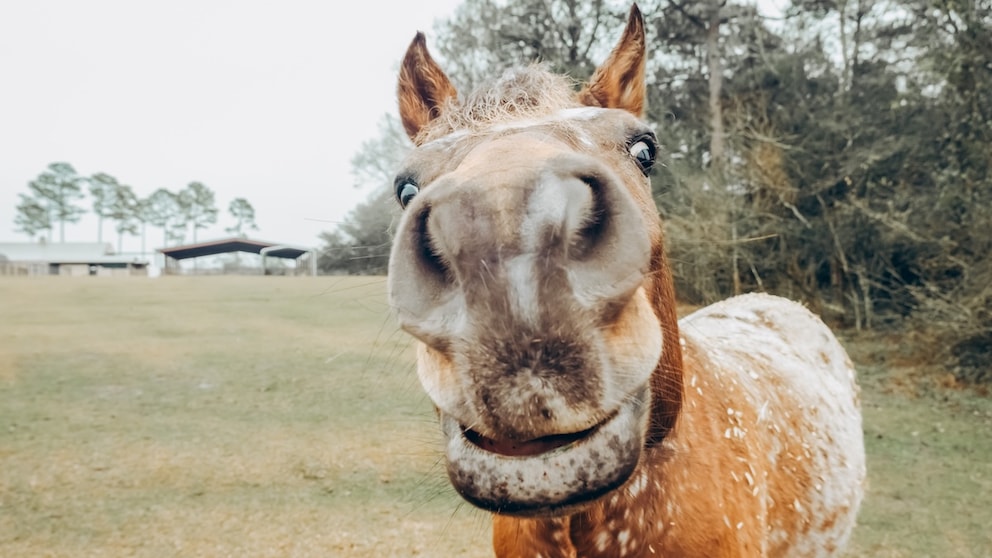
November 24, 2025, 5:04 am | Read time: 4 minutes
Do you know how horses say “hello”? Not with a neigh or a nod—but with looks, movements, and subtle gestures. Horses communicate with their entire bodies. Those who can interpret these signs can significantly strengthen the relationship between humans and animals. PETBOOK shows what matters in this process.
Horses Communicate Through Body Language
Horses communicate in remarkably subtle ways—primarily through body language. They are considered highly sensitive animals, capable of perceiving and interpreting even the smallest signals from their peers. Those who do not understand this nonverbal language can easily overlook important messages. Of course, horses sometimes neigh or hum softly, but the real communication happens silently—through their mouths, eyes, ears, and tails.
I learned how important it is to pay attention to these signs from my pony mare. She was attentive, lively, and always alert—typical for a prey animal. While walking, she noticed every movement and sound in her surroundings. Even when she seemed calm, her ears revealed that she was constantly “listening.” If there was rustling in the bushes or a mouse scurried by, she would tense up—evident from her tightened upper lip. In such moments, a gentle word or a calm gesture often helped to show her: Everything is fine, no danger. However, punishing a horse for stopping or starting to prance can damage the bond with the animal.
How Horses Greet Each Other
When two horses meet, a very typical behavior can be observed. First, they approach each other slowly and cautiously—with pricked ears and attentive eyes. They want to find out if the other horse is friendly and poses no threat. Then they begin to sniff each other—not just anywhere, but specifically at each other’s nostrils. Horses can perceive smells particularly well there. Through their sense of smell, they recognize whether the other animal is familiar or a stranger.
Often, you hear a soft snort, indicating that the horses are relaxed. If they like each other, it doesn’t stop at sniffing: Some horses gently touch each other with their noses or start grooming each other on the neck or withers. However, during a first encounter, a horse may briefly back away or raise its head to better assess the situation. This is part of the process and doesn’t necessarily mean the animals dislike each other. A sense of security and mutual respect doesn’t develop overnight, but rather step by step with small approaches.
Why You Shouldn’t Just Touch Horses
Horses, like humans, have their own personal space. As prey animals, they are constantly busy observing their surroundings attentively. If something turns out to be dangerous, they can react immediately—usually by fleeing. When horses encounter new objects or beings, they do so at their own pace and in their own way.
Approaching a strange horse and touching it immediately can easily cross its boundaries. For the animal, it feels like an intrusion. It becomes startled or withdraws internally. Such experiences often negatively impact the relationship between humans and horses, making it tense rather than trusting. Respect and patience are, therefore, the most important foundations for a harmonious connection.

This is how even beginners may understand the body language of horses

5 tips to get your horse to like you
How to Properly Say “Hello” to Your Horse
For many horse owners, it’s the best moment of the day: finally seeing their own horse. Even if it requires a long walk across the pasture or a muddy paddock, every step is worth it. When I called my mare, I was often lucky—and could save myself a few steps. She would trot over leisurely, usually with a tuft of grass or hay in her mouth. But on some days, she would suddenly pick up speed, trotting or galloping toward me joyfully.
Our greeting ritual always remained the same: I would hold out the back of my hand for her to sniff. She would briefly check my scent, snort contentedly—and the mood was set. Then came the first little cuddle session. I would scratch her withers, just as horses do when they like each other. She would become completely relaxed, let her lower lip hang, and enjoy the moment. Sometimes I would forgo the halter and simply head toward the pasture exit. My mare would follow me on her own—a silent sign of trust and connection.
Build Trust with the Right Greeting
Horses communicate in their own quiet way. Those who learn to understand this nonverbal communication can build a deep bond with their horse. A calm and gentle greeting with respectful distance shows the horse: “I see you, I respect you, I pose no threat.” On such a basis, lasting trust can develop, and the bond between animal and human can be strengthened.