

December 11, 2025, 5:03 am | Read time: 4 minutes
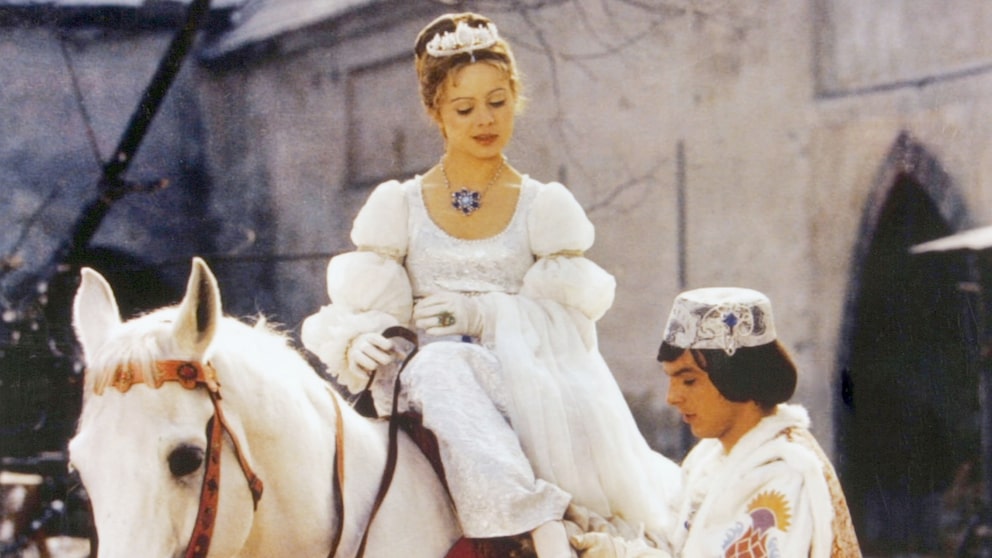
For over 50 years, “Three Wishes for Cinderella” has enchanted millions of viewers every Christmas season. But alongside the prince, owl, and ball gown, another secret star plays a significant role: Nikolaus, the legendary white horse. What many don’t know is that behind the famous film horse lies a storied history and two different actors.
A Winter Classic That Touches Generations
Watching “Three Wishes for Cinderella” is a cherished Christmas ritual for many. The German-Czechoslovak fairy tale film, produced in 1973, quickly became a staple on East German television. By the 1990s, it was considered a pan-European cult film, now a fixture in the Christmas programming of several countries.
The film is full of iconic moments: the first meeting between the prince and Cinderella, the unforgettable theme music, the wise owl, and of course, the ball. But there’s something else that makes this winter classic so special. Nikolaus, the white horse, gallops with Cinderella over hill and dale to the castle. The horse is now as famous as its rider. But who actually played him, and if so, how many? 1
Kalif and Ibrahim–the Horses of Cinderella
Nikolaus was played by two horses: the Czech white horse Ibrahim and the horse Kalif. The reason for needing two horses is quite simple. The Czech horse Ibrahim had to stay in the Czech Republic and could not be transported to the filming location at Moritzburg Castle. He took on the winter scenes in the Czech forests.
Unfortunately, not much is known about Ibrahim, but much more is known about Kalif: Kalif was originally a talented film horse that impressed for many years in the East German State Circus Busch. There, he jumped through flaming hoops and mastered challenging tricks. His origins were likely in Israel–how he eventually ended up in East Germany is lost in the mists of time. After being sold to stuntmen, he was left behind during the filming of “The Sons of Great Bear.” DEFA took care of the abandoned horses and brought Kalif to Potsdam-Babelsberg.2
Controversial Methods on the Film Set
In the DEFA equestrian community, Kalif finally found a new home. There, he was used both as a school and vaulting horse and was brought in front of the camera for various film productions. Although Kalif was an experienced film horse, methods were occasionally used in “Three Wishes for Cinderella” that are viewed critically today. For instance, a gentle pressure or pinch on his side was used to make him nod in agreement. For another scene, a handler hid under his belly and lured him with a carrot to make Kalif turn his head toward Cinderella. Nowadays, such behaviors would be trained differently in horses.
The 16 Most Famous Animals in World Literature

11 Mythical Creatures That Actually Exist
Cinderella and Nikolaus Had a Deep Bond Beyond the Film
When films involve horses, stunt doubles are often not far behind. In many films, it’s not a requirement for actors to hold their own in the saddle in every situation. Accordingly, difficult riding scenes are often performed by professionals. In “Three Wishes for Cinderella,” it was different. The actress playing Cinderella, Libuše Šafránková, was familiar with horses and could perform many scenes herself. She was able to build a good bond and establish trust, especially with Kalif. Nevertheless, a professional rider was used in some scenes–mainly in fast galloping scenes.
How Fishmeal Saved the Filming
Many viewers have the image in mind: Cinderella gallops up the hill to the castle on her Nikolaus. She wears a pink coat, under which her iconic ball gown is hidden. The setting is particularly enchanting: the fairy-tale castle lies deep in snow. And the best part is, fans can even visit this castle. Near Dresden stands Moritzburg Castle. Every year, the Cinderella exhibition takes place there, as Travelbook reveals in the article “The Filming Locations of the Cult Christmas Film ‘Three Wishes for Cinderella.” However, what is missing is the dreamy snow from the film. Even during the 1972/73 filming, there was unexpectedly very little real snow.
The film crew needed a snow alternative for the winter charm. This was made from fishmeal. It worked for the camera but smelled very unpleasant. In the forests and fields, they had more luck. There, scenes could be shot in a real winter landscape. But perhaps not as fairy-tale-like as one might think.3