

May 29, 2026, 11:19 am | Read time: 4 minutes
Digestive issues are among the most common health complaints in horses. Sand in the intestines, fecal water, or constipation colic can be particularly uncomfortable for animals and, in the worst case, have serious consequences. Many horse owners therefore rely on psyllium husks as a natural support for the digestive tract. But how exactly do psyllium husks work in horses? And what should be considered when feeding them?
What are Psyllium Husks?
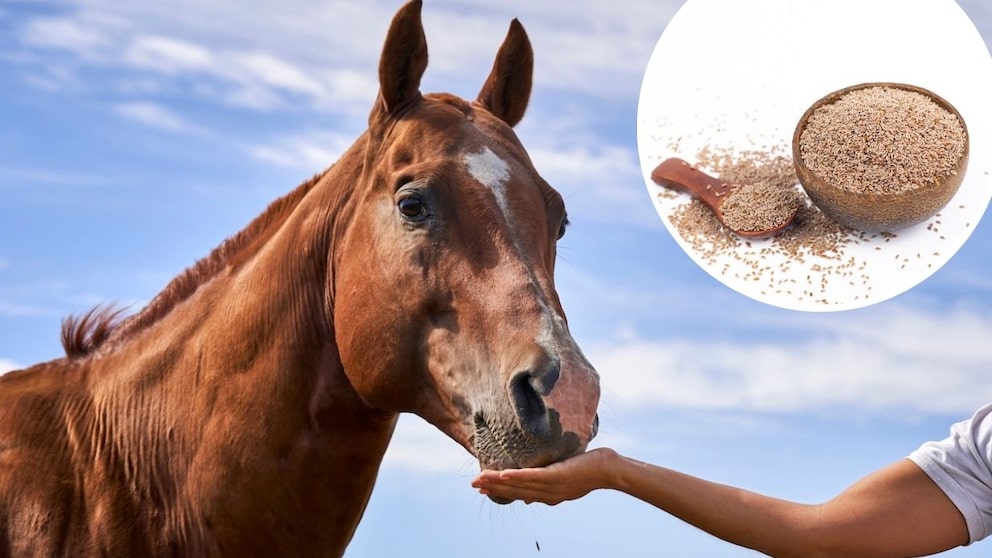
Psyllium husks come from the plantain Plantago ovata. The seeds owe their name to their appearance and behavior when ripening: They jump out of the pods, resembling small fleas.
Particularly interesting for horse feeding is their strong swelling capacity. The husks can absorb many times their weight in water, forming a gel-like, mucilaginous mass. 1
Psyllium Seeds or Psyllium Husks–What’s the Difference?
Psyllium seeds are the complete seed, including the husk. Psyllium husks, on the other hand, consist solely of the outer shell. This contains particularly high levels of soluble and mucilage-forming fibers and can bind significantly more liquid than the whole seed.2
While whole psyllium seeds are more energy-rich and contain more fats, psyllium husks are considered particularly useful for fecal water or diarrhea. Whole seeds are often used for general digestive support.
How Do Psyllium Husks Work in Horses?
Psyllium husks are primarily valued for their swelling and mucilage-forming properties. The resulting mass can support the digestive tract and stimulate bowel activity.
Additionally, psyllium husks can help transport sand or soil out of the intestines. Horses on sand paddocks or heavily grazed pastures often unintentionally ingest larger amounts of sand. If this accumulates in the intestines, digestive problems can arise.
Psyllium husks are also frequently used to support irritated stomach or intestinal mucosa. The mucilage substances form a film over the mucous membranes and can soothe them.
When Are Psyllium Husks Used in Horses?
Psyllium husks are used for various digestive problems. They are particularly often used for:
- Sand in the intestines
- Fecal water
- Diarrhea
- Constipation colic
- Irritated stomach or intestinal mucosa
Many horse owners also use psyllium husks preventively.
Whether there is sand in the intestines can be checked with a simple trick: A fresh horse apple is placed in a container with water and stirred. If sand settles at the bottom after some time, this can indicate sand deposits in the intestines.
In case of persistent complaints or suspicion of colic, a veterinarian should always be consulted.
How Are Psyllium Husks Fed?
Psyllium husks should be soaked before feeding. A swelling time of about 30 to 40 minutes in sufficient water is recommended. The resulting mash can then be mixed with mash or concentrate feed.
Not every horse readily accepts the slimy consistency. In such cases, it may help to divide the daily amount into two portions. The dosage mainly depends on the horse’s body weight. It often helps to discuss the optimal individual dosage with a veterinarian.
Psyllium Husks Must Be Given Individually
Not every horse responds equally well to psyllium husks. In some cases, bloating or intolerances may occur. Therefore, horse owners should closely monitor their animal’s digestion during feeding.
It is also particularly important to ensure adequate water intake. Since psyllium husks swell significantly in the intestines and bind large amounts of liquid, horses must drink enough to ensure digestion continues to function smoothly.
If the horse shows increased bloating or passes noticeably dry horse apples, a veterinarian should be consulted as a precaution.

How Healthy Psyllium Husks Really Are for Dogs
Why Colic in Horses Can Become a Major Threat
What Are the Alternatives to Psyllium Husks?
In addition to psyllium husks, other feeds are used to support digestion. These include flaxseed, mash, or healing clay.
Flaxseed also has mucilage-forming properties and can have a soothing effect on the intestinal mucosa. Mash is considered particularly easy to digest, but does not achieve the same sand-binding effect as psyllium husks.
Support for Digestion
Psyllium husks can effectively support horses with various digestive problems. They are often used for sand in the intestines, fecal water, or sensitive digestion. However, proper application is crucial: adequate soaking, sufficient water intake, and appropriate dosage play an important role.
In cases of severe complaints or recurring problems, the cause should always be clarified by a veterinarian.