

August 15, 2026, 9:44 am | Read time: 5 minutes
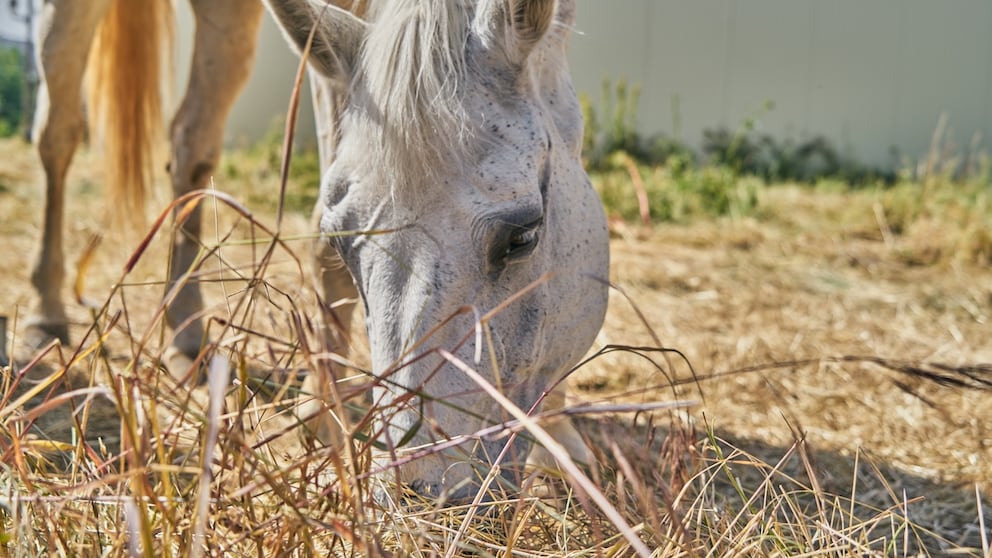
The ongoing heat wave is taking a toll not only on us but also on our horses. Pastures have turned into brown, dust-dry areas that no longer provide enough food. Yet, horses often spend many hours there. PETBOOK explains the dangerous consequences this can have and when owners need to supplement feed.
Horses are adapted to consume small amounts of high-fiber feed over many hours. This is their “job,” as their stomachs continuously produce gastric acid. Chewing generates saliva, which helps buffer this acid.
If the stomach remains empty for too long, part of this protection is missing. This can lead to severe damage to the stomach lining in a short time. Feeding breaks of more than four hours should therefore be avoided.
How Much Hay Should Be Supplemented When Grass Is Dried Out?
If pastures can no longer meet the feed requirements because they are too dry and burnt, the missing grass must be replaced with hay.
The German Agricultural Society recommends at least 1.5 kilograms of hay per 100 kilograms of body weight per day. For a 600-kilogram horse, that’s at least nine kilograms, and for a 700-kilogram horse, at least 10.5 kilograms daily. 1
The exact ration depends not only on weight but also on age, health, housing, and activity. 2,3
Sudden Feed Changes Stress the Digestive System
However, be cautious, as a sudden change in feed can stress the sensitive digestive system. Horses that have previously consumed a large portion of their feed from grass should be gradually accustomed to the changed hay ration. 4
In both small and large herds, all animals must have access to hay. This is especially true for lower-ranking horses. Slow feeders or suitable tightly meshed hay nets can help extend feeding time. They must be securely installed and available in sufficient numbers. 5
These Questions Horse Owners Should Ask Themselves Daily
In prolonged dry conditions, the feed supply can quickly deteriorate further. Therefore, it’s not enough to just glance at the pasture from the fence. 6, 7
Horse owners should check daily:
- Are the horses still finding enough grass, or are they just searching for individual blades?
- How many hours can they actually graze?
- Is enough hay being offered in time?
- Can all animals access the feed without conflict and displacement?
- Are weight and physical condition stable?
- Are the horses unusually eager for the hay?
An additional health risk arises: If grass becomes scarce, horses may also eat less palatable plants. This increases the risk of them nibbling on toxic pasture plants. Fences should also be carefully checked now, as hungry horses may try harder to reach grass outside the area. 8
Water and Shade Become Even More Important in Heat
When grass dries out, part of the moisture that horses usually get from fresh pasture grass is lost. For a horse, approximately five liters of water per 100 kilograms of body weight per day are needed. A 600 to 700-kilogram horse requires about 30 to 35 liters under normal conditions. In heat, with activity or heavy sweating, the need can significantly increase, sometimes to 60 liters or more. 9
A regular water bucket for several horses can quickly become insufficient. The key factors are its capacity and how often it is checked and refilled. The water should be clean and fresh; buckets and troughs should be placed in the shade if possible.
If a horse sweats heavily, its sodium needs increase along with its water needs. It should then be checked whether the salt and electrolyte supply matches the actual stress and the rest of the feeding.
Protection from direct sunlight is also essential. If horses are on the pasture for extended periods during the day, there must be sufficient natural or artificial weather protection available that all animals can use simultaneously.
How Much Hay a Horse Consumes Per Day
How Much Water Do Horses Need to Drink Daily?
What Can Concerned Passersby Do?
Those who repeatedly observe horses on an almost bare pasture without visible hay, sufficient water, or shade for many hours should not judge hastily but also not look away. For example, it is not visible from the outside when the horses are fed before and after pasture time or how often water buckets are refilled.
It is sensible to observe the situation over several days at different times. Location, date, time, and visible conditions can be noted objectively. If possible, a calm conversation with the owner should be attempted first.
If the supply remains obviously inadequate, the responsible veterinary office is the right contact. The German Animal Welfare Federation recommends documenting observations as precisely as possible. In an acute emergency, the police should be contacted immediately. 10
Also interesting: Dog Injured, Cat Found, Deer Hit – What Am I Allowed to Do in an Emergency?
Conclusion
When heat and drought have destroyed the grass, a horse pasture eventually becomes just an exercise area. Then owners must adjust feeding and provide hay. Not just in the evening, but in a way that prevents long feeding breaks during pasture time.
What matters is not how many hours a horse is outside. What matters is whether it actually has enough to eat and drink during that time and can avoid the sun. Especially now, horse owners must pay close attention daily.