

May 6, 2026, 4:05 am | Read time: 3 minutes
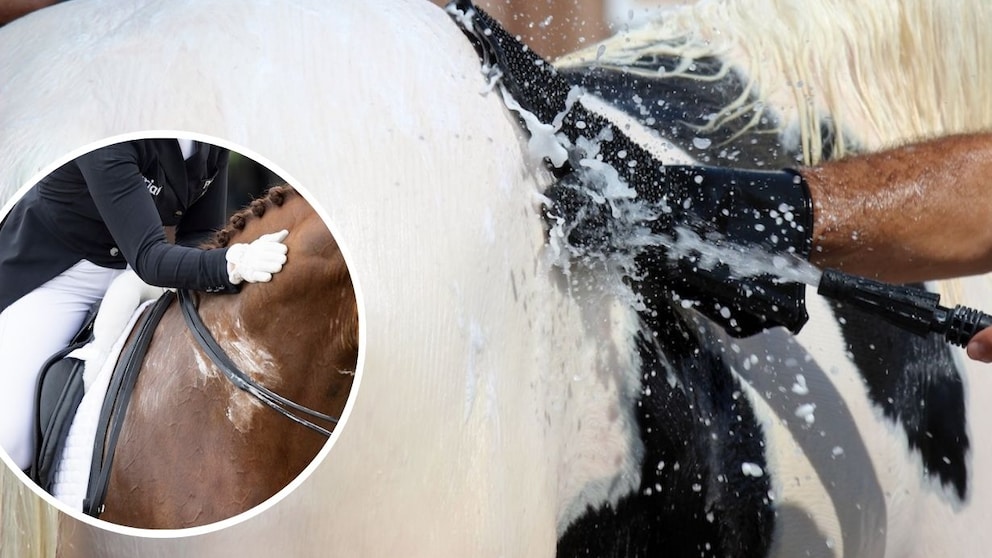
Have you ever seen a horse sweat? When horses perspire, it can quickly look like they’ve been soaped up. This is because when they produce sweat, a white foam forms. Horse enthusiasts know this from particularly warm days when it appears between their horse’s hind legs.
Why do horses sweat foam?
The noticeable foam that forms when horses sweat has a very specific cause. It’s due to a phenomenon that even some horse fans aren’t fully aware of. The culprit is a special protein in the animals’ sweat called latherin. It acts like a mild foaming detergent, helping the sweat spread across the slightly oily, naturally water-repellent coat instead of just beading off.
At the same time, this substance has soap-like properties. When movement and friction occur, the sweat begins to foam. That’s why the white foam primarily appears at typical friction points–such as between the hind legs, on the chest, or where the saddle and reins rest. This is why a heavily sweating horse can quickly look as if it’s been soaped up.
Why do horses produce so much sweat?
Horses sweat not only quickly depending on movement but also quite a lot. Sweating is their most important and effective form of temperature regulation–especially during exertion, it reliably protects the body from overheating. This ability is also a crucial advantage in nature. As prey animals, horses rely on endurance and can remain efficient over long periods thanks to their efficient cooling system.1
Since the animals’ coat is slightly oily, the sweat must cover the body extensively to have a cooling effect. This way, heat is effectively released through evaporation. From certain angles, this process can even be observed: The horse seems to steam as the moisture rises from its warm body.

How Much Water Do Horses Need to Drink Daily?

Little Grass Left for Horses–Owners Must Act Now
How many liters does a horse sweat?
How much a horse sweats depends greatly on temperature, exertion, and training condition–but the amounts can be impressive. Even with light work, a horse loses several liters of sweat, while with intense exertion, it can quickly be between seven and twelve liters.
In extreme cases, such as in high heat or strenuous training, up to 15 liters or more are possible. It’s not just about water: With sweat, the horse also loses important electrolytes like sodium, chloride, and potassium, which need to be replenished afterward.
How much a horse has sweated can often be seen on its coat–from slightly damp spots to dripping wet skin and visible foam formation at typical friction points.2
What should owners do when a horse sweats a lot?
If a horse sweats heavily, it loses not only water but also important electrolytes like sodium and chloride. These are essential for muscles and nerves. A deficiency can quickly lead to a drop in performance or exhaustion.
Therefore, it’s essential: Fresh water must always be available, and a salt lick is a basic necessity. For horses that regularly sweat heavily, adding extra salt to their feed can be beneficial to compensate for the losses. Horses usually get enough potassium from hay or grass.
Additionally, owners should adjust training during hot weather, avoid intense sessions, and ensure plenty of shade. If fluid and electrolyte loss isn’t compensated, dehydration and overheating can occur.
However, if a horse becomes unusually foamy or sweats without apparent exertion, it could also indicate stress or overexertion.