

August 25, 2025, 8:58 am | Read time: 10 minutes
These are enchanting images that captivate social media: miniature cows so small they roam the house like cats and even lie on the bed. The photos come from India, where the Punganur breed is native. It is considered the smallest cow breed in the world, but despite its cute appearance, it is endangered. PETBOOK introduces the mini cows.
What Makes the World’s Smallest Cows Unique
Are they still livestock or already pets? With images from India that have been captivating many people on social media for some time, it’s not entirely clear: Tiny cows are seen that barely reach an adult’s knees. They roam the living room, can be led on leashes, and curl up like a kitten sleeping on a bed.
Nevertheless, the small cows are not just companions and playmates for children but also provide milk, as shown online. These small cows are not calves but a distinct, albeit tiny, breed: In their homeland of India, they are called Punganur. The cows have been known for centuries there and are valued as a small livestock variant. However, finding information about the breed is not easy, especially in Europe, where these dwarf cows are hardly known. Besides India, they are also kept in Malaysia, Indonesia, and Australia.
Mini Cows Were Endangered for a Long Time
Even in their homeland of India, there were not many Punganur cows for a long time—they were considered endangered for many years. According to the Indian dairy and poultry industry in 2020, there were only about 300 animals left worldwide at that time. The breed was endangered partly because farmers who kept these animals repeatedly crossbred them with other cattle breeds, as reported by the Indian dairy and poultry industry. This was intended to breed more productive cattle. However, the Punganur breed almost disappeared from India as a result.
In 2020, the district government of Andhra Pradesh launched a program, according to media reports, to prevent the extinction of the animals and strengthen the population. The aim was to improve reproductive efficiency. The goal was to achieve an average of eight offspring from each Punganur cow within five years. Apparently, the program was successful: In 2024, Punganur cows were no longer classified as endangered by the Food and Agriculture Organization of the United Nations.1,2
Good Luck Charm and Status Symbol
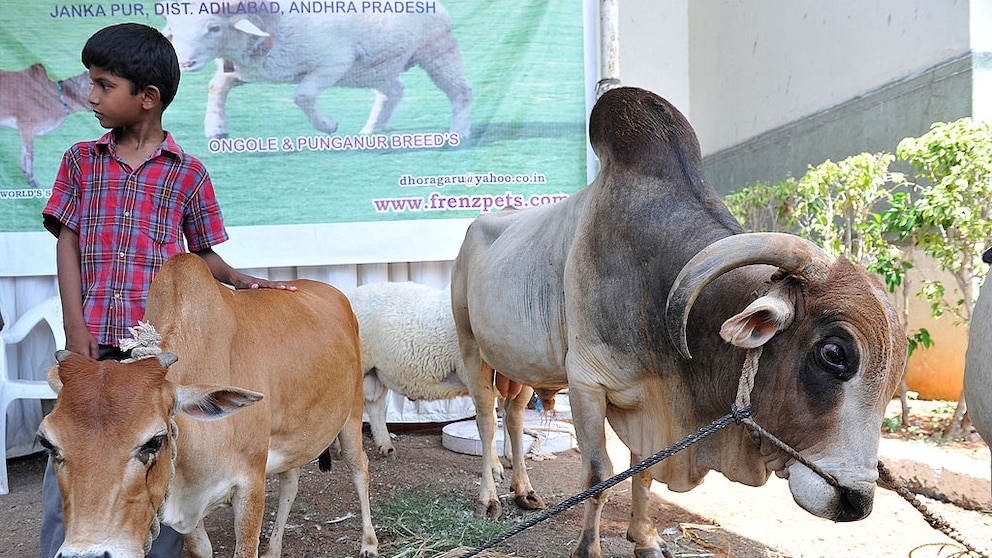
According to Indian sources, Punganur cows belong to the zebu family (Bos indicus). They originally come from the city of Punganur in the northern Indian state of Andhra Pradesh, which gives them their name. Today, most of the few hundred remaining animals are kept there. Punganur cows reach only 70 to 90 centimeters in height. Bulls weigh about 200 kilograms, while females weigh around 115 kilograms. Their coat is white to light gray, and their back slopes slightly downward. The tail usually touches the ground, and the horns are flat and crescent-shaped, sloping backward. The animals are considered calm and gentle and are resistant to numerous diseases.3,4
In their homeland of India, they are loved not only for their cute appearance. Like all cows, Punganur cattle are considered sacred animals in Hinduism, the predominant religion in India, giving them cultural significance. They are also seen as a status symbol. Wealthy Indians buy them as good luck charms, as noted in a breed portrait of the cows.
High-Quality Milk Despite Small Size
However, the cute mini cattle are not only of ideal value but are also kept as livestock. Their dung is used as a natural fertilizer, and their urine is said to be effective against numerous plant pests. Despite their small size, the cows are considered reliable suppliers of high-quality, relatively rich milk with a fat content of about eight percent—compared to the three to three and a half percent of average dairy cow breeds. Punganur cows produce up to three liters of milk per day. Among other things, the special fat ghee (similar to clarified butter) is made from it to be offered later in religious ceremonies.
Cows of this breed are considered frugal and can manage with sparse food such as dry grass and hay. They require about five kilograms of feed per day. This makes them particularly interesting for small farms and organic agriculture.
Small, Smaller, Dahomey Cattle
With its compact size, the Punganur cattle are not alone. Although often referred to as the world’s smallest cattle breed, Dahomey cows challenge them for the title. In numerous publications, the mostly black Dahomeys are described as “the smallest cattle breed in the world.” “They are to cattle what ponies are to horses—the smallest of their kind,” shares Swiss Dahomey breeder Sandra Henzer on her website. The German Dahomey Association also states that the animals are “the smallest cattle in the world.”
When fully grown, they also reach only about 80 to 100 centimeters in height and weigh between 150 and about 250 kilograms. However, Dahomey cattle did not achieve their small size through selective breeding, as was the case with Indian Punganur cattle. Dahomeys are naturally small, and their small size is the result of centuries of natural development. In the barren landscape of their region of origin, frugality in food selection and smaller size provide a crucial survival advantage: Dahomeys originally come from the dry savannas of West Africa.
Dahomey (also called Dahome) was a kingdom located on the Bay of Benin. The name Dahomey thus stands for the region of origin of the small cattle. The kingdom, founded in the 17th century, existed for only about 260 years, but the cattle named after it now exist in Germany and neighboring countries. The animals first came to Europe in the early 20th century when a zoo from Antwerp, Netherlands, took them as feed animals for transporting predators from Africa.5,6,7
Suitable for Landscape Maintenance
Dahomeys, like their Indian relatives, the Punganur cattle, are extremely robust against heat and cold and frugal. They have few demands on their food or environment. However, they are not high-performance cattle, as the website dahomeyschweiz.ch reports. The milk of the mother cows is “just enough for calf rearing,” and the meat yield is low, especially compared to the time Dahomeys take to mature. Therefore, the animals are mostly used in landscape maintenance and kept as a hobby.
The German Dahomey Association reports that the mini cattle were initially of interest mainly to zoos and private owners because of their small size. However, the good “livestock qualities of the breed” now convince people. The cattle are particularly suitable for small areas or fallow land in landscape maintenance, as they cause hardly any trampling damage. “No damage to trees, including fruit trees, is caused by bark peeling, as with sheep and goats,” the German Dahomey Association further reports. The meat of the animals is also very tasty and low in fat.
The animals are described as trusting and can even become tame. However, in danger, the herd stays close together, and Dahomey cows have a pronounced maternal instinct. Dahomeys are mostly black, sometimes gray, and occasionally have white spots on their bellies. Dahomey calves are born with their later coat color. Black calves show a peculiarity: They initially change color during growth and become lighter. Finally, they change their coat color back to black. All cattle of the breed also have another peculiarity: The tongue and throat of the animals are blue.
Mini Cows Also Exist in Europe: The Irish Dexter Cattle
While Punganur cows and Dahomey cattle vie for the title of the world’s smallest cattle breed, it is clear who takes third place in the mini cattle ranking: Dexter cattle are also considered small cattle. Bulls grow to just under 120 centimeters and can weigh around 530 kilograms. Females are slightly smaller and lighter.
The animals originally came from County Kerry in Ireland. They emerged around 1840 when, according to legend, a farmer named Dexter bred the small breed, later named after him, from black mountain cattle and Kerry cows. This distinguishes Dexter cattle from their small relatives, the Dahomeys: Dexter cows were selectively bred to be as small as possible. The Irish farmer Dexter aimed to produce cattle that, despite harsh climates and sometimes sparse food supplies, provided good meat and rich milk. He succeeded. Dexter cows can produce milk up to 15 to 20 times their body weight per year. This breed is also used for meat production. Like their distant relatives from India, they are content with sparse food that other livestock would leave behind. They do not require concentrated feed.
The calves of Dexter cattle grow quickly and are about the size of their parents after about a year. The meat of the animals is also described as high-quality and tasty. It is usually available through direct sales, as Dexter cattle play little economic role in Germany and Switzerland.8 9 10 11
When the Tail Ensures Survival–The Curious Story of Fat-Tailed Sheep

7 “Cool” Facts About Cows
Endangered
Despite these specially bred traits, Dexter cattle were also endangered from the 1960s. Modern high-performance cows, bred primarily for milk or meat production, had competed with Dexter cows. Their population has since recovered, and the animals, also considered robust and frugal, are kept on a few farms here. They are also preferred for landscape maintenance, such as on sensitive soils and nature conservation areas. Since they remain small and some animals weigh only about 300 kilograms, they can graze on steep mountain slopes, causing little trampling damage to the soil.
Like their distant relatives from India, they are content with sparse food that other livestock would leave behind. They do not require concentrated feed. The calves of Dexter cattle grow quickly and are about the size of their parents after about a year. The meat of the animals is also described as high-quality and tasty. It is usually available through direct sales, as Dexter cattle play little economic role in Germany and Switzerland.
Mini Cattle Increasingly Popular Here
Mini cows are becoming increasingly popular with small farms and hobby cattle keepers here. The reasons are obvious: They require less feed than their larger relatives, are generally not very demanding regarding weather, food, and terrain, need less space, and are considered gentle and agreeable.
Some animals can even become tame, as breeders describe. Mini cattle not only look appealing but are also full-fledged livestock. Depending on the breed and size, they provide considerable amounts of milk and are valued as suppliers of good meat. There are now numerous mini cattle breeds in Europe.
In addition to Dexter and Dahomey cows, Mini Highlands and Lowline Angus cattle are also characterized by a compact size. Lowline Angus cattle have been bred selectively in Australia since the 1970s. Mature bulls grow to about 110 centimeters and can weigh up to 600 kilograms. The animals are described as calm and are primarily bred as meat suppliers. Like almost all small cattle, they are considered frugal regarding food and environment.
Mini Highlands are “the miniature version of Scottish Highland cattle,” as the trade magazine Agrar today reports. Like their larger relatives, the mini version of the Highland cattle has long-haired fur and large, curved horns. However, Mini Highlands reach only a hip height of about 96 centimeters. Snow, cold, and rough terrain do not bother the animals, which is why they are also used for landscape maintenance on slopes and orchards. Cachena cattle from Portugal are known to be only about a meter tall and are kept as meat and milk suppliers and draft animals. Mini cattle are no longer a rarity, and with a bit of luck, they can even be discovered here.12 13 14 15