

March 24, 2023, 4:13 pm | Read time: 5 minutes
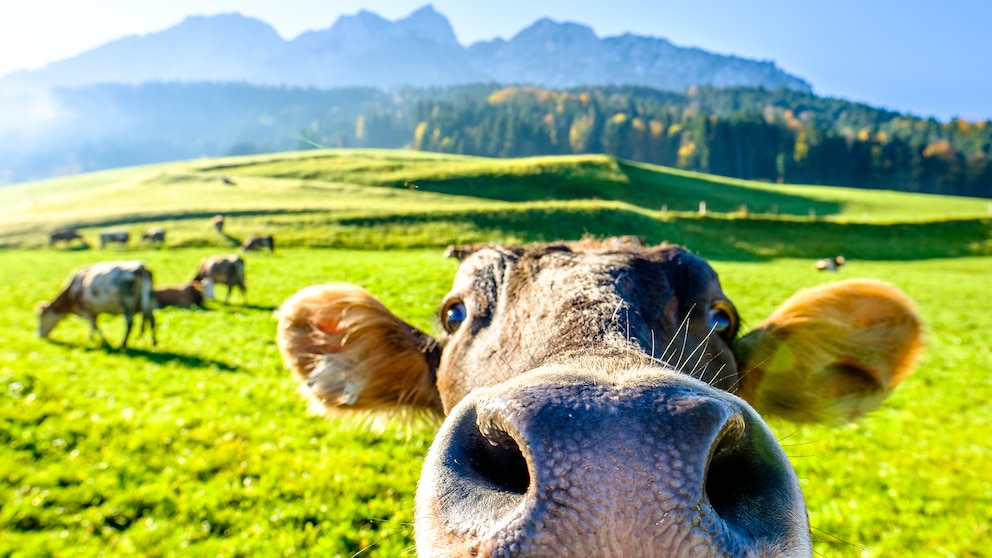
They produce milk, eat grass, and look very cute: cows. Unless you’re a farmer, you probably don’t have much to do with cattle. Yet these animals are quite “cool.” PETBOOK has compiled some of the most fascinating facts about cows.
Cows are anything but boring. These pasture animals have some surprises in store, but today they are unfortunately seen merely as milk and meat providers and are quite underestimated. However, if you take the time to watch a few cows in a pasture, you’ll quickly realize: cows are pretty “cool” animals. And if that doesn’t convince you, we’ve put together six “cool” facts about cows. Enough with the puns. But beware: we’ve hidden one more in the text. Can you find it? Let’s get started!
1) Cows Can Get High
Yes, you read that right! Just like humans with cannabis, cows can get high from industrial hemp. A research team led by the German Federal Institute for Risk Assessment discovered this. The scientists fed so-called industrial hemp silage–a fermented feed–to ten dairy cows and observed the animals afterward. They published their findings in November 2022 in the journal “Nature Food.”
Typically, industrial hemp varieties contain only small amounts of psychoactive cannabinoids, such as tetrahydrocannabinol, better known as THC. However, the study showed that if the industrial hemp silage contained a relatively high concentration of cannabinoids, the cows’ breathing and heart rate slowed down.
Additionally, the cows’ behavior changed. The ruminants became sleepy and unsteady, ate less, and produced less milk. The study authors were even able to detect cannabinoids in the milk–drug test failed.
2) Cows Have (Almost) Everything in View
Cows have an almost complete field of vision: they can see horizontally between 300 and 330 degrees. This is due to their eyes being located on the sides of their heads–a common trait in prey animals. They need to have (almost) everything in view to detect lurking predators as early as possible.
In contrast, animals that hunt prey usually have forward-facing eyes to judge distances while hunting. This results in a narrower field of vision–humans, for example, can only see about 214 degrees around us–but sharper sight. For cows, visual acuity decreases significantly beyond 1.5 meters. It seems everything has its pros and cons.
3) Little-Known Fact: Cows Love Music
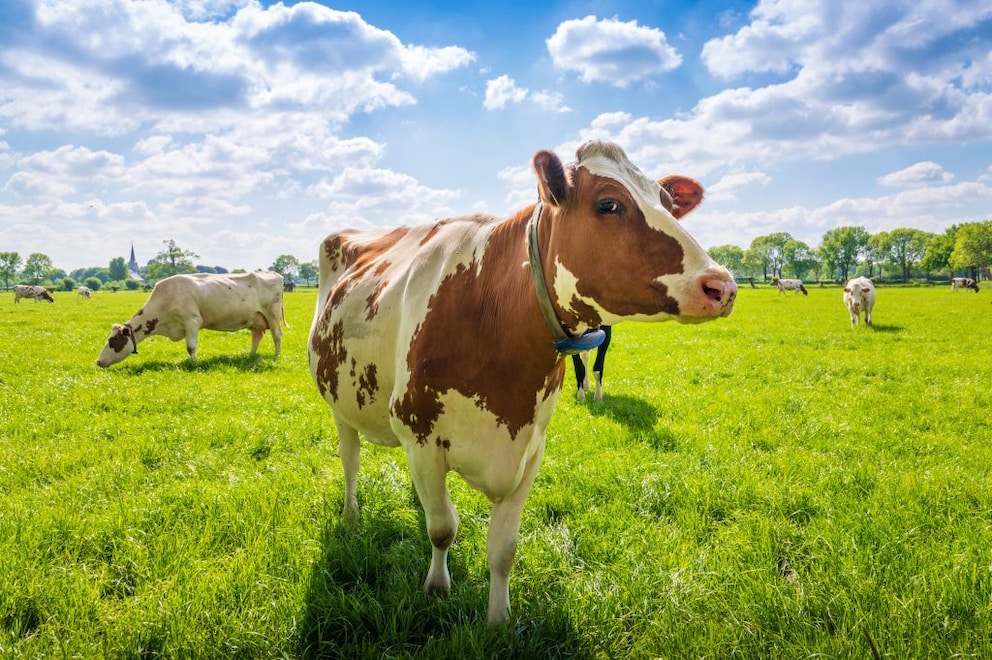
Is there a music connoisseur in every cow? The results of a study from 2001 suggest so. Researchers from the University of Leicester in the UK played various music genres to hundreds of dairy cows for nine weeks, 12 hours a day. Their finding: the cows produced three percent more milk per day when slow music was played instead of fast music. For example, “Everybody Hurts” by R.E.M. or “Bridge over Troubled Water” by Simon & Garfunkel.
But why? When cows are stressed, they produce less of the happiness hormone oxytocin–an important component for milk production. Slow music might help the animals relax and thus stimulate oxytocin production. However, since the study has not yet been replicated, this cannot be stated with certainty.
4) Cow’s Milk Varies Like Day and Night
While it’s still unclear how certain music affects cow milk production, one thing is certain: cows milked at night produce different milk than during the day. The so-called night milk contains significantly more tryptophan and melatonin–a hormone that regulates our day-night rhythm and promotes sleep.
Night milk has a calming effect on mice, according to the results of a 2015 experiment. Night milk crystals are already available as a sleep aid in stores. However, there are no conclusive studies on its effects on humans yet.

5) Cow Fact: Not Every Moo Means the Same
Cows moo, every child knows that. But not every “moo” sounds the same, says Gerhard Jahns. The agricultural researcher from Braunschweig has identified dozens of sounds that cows use to express different needs. In 2010, he documented these sounds in a dictionary. Jahns also developed a speech analysis program for farmers to quickly interpret cow sounds. Or in other words: to make farmers’ work less “moo-some.” (There it was, the pun!)

The Smallest Cows in the World Even Sleep in Bed With Their Owners

Cows Can’t Swim? The Truth Behind the Myth
6) Cows Have an Internal Compass
Birds, dogs, ants: many animals have a proven magnetic sense. This means they can perceive the Earth’s magnetic field and orient themselves accordingly. This apparently applies to cows as well. Scientists from the University of Duisburg-Essen found in 2008 that cattle–whether in the barn or in the pasture–prefer to align themselves in a north-south direction.
Also interesting: Keeping dairy cows humanely–what does that actually mean?
7) Myth: Can Cows Swim?
In 2001, the newspaper “taz” allegedly reported a tragic news: cows couldn’t swim! A series of tests with 400 cattle supposedly showed that the animals’ sphincter muscles were too weak. As soon as a cow entered the water, it filled up from behind–and eventually sank.
The article was titled “German Cows Go Under.” The catch: it was published in the newspaper’s satire section. However, this seems to have been lost in popular knowledge. Instead, the misconception that cows can’t swim took hold.
Admittedly, the animals are a bit water-shy. But they can indeed swim–so this fact about cows is not true.