

June 1, 2026, 3:16 pm | Read time: 5 minutes
It’s a feeling you know, even if you rarely admit it: You’re sitting by a mountain lake in Bavaria or on a vacation home porch in Tuscany, feet dangling, coffee steaming, and suddenly the dog by your side is different: more relaxed, attentive, playful. Or conversely: more anxious, clingy, restless into the night. Anyone who regularly takes their pet on vacation has likely experienced this phenomenon. But why is that? Dog trainer and PETBOOK author Katharina Marioth knows the answer and reveals how this behavior is connected to you as the owner.
Dogs Sense What We Project
Dogs are not mirrors in a metaphorical sense. They are literally, neurobiologically, and evolutionarily. Their entire socialization over millennia has tuned them to read their human’s state. Heartbeat, breathing rate, muscle tension, scent—a dog perceives what you suppress. That’s why their behavior changes on vacation, not just because of the new environment, but also because of their owner’s behavior.
If someone goes on vacation after weeks of stress and work, their dog senses this tension. The animal paces restlessly on the new floor, sleeps poorly, and reacts more sensitively than at home. Not because the unfamiliar apartment bothers them. But because the person next to them hasn’t arrived on vacation yet.
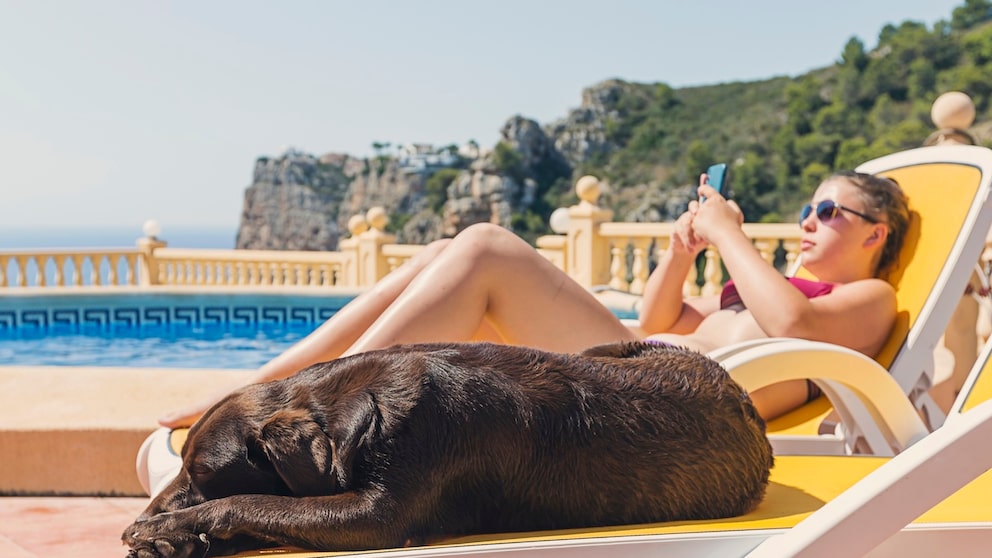
Three days later, the dog is lying relaxed on the balcony, sleeping. Because you are finally sleeping too. Because your shoulders have dropped. Because you’ve stopped looking at your phone and started actually being present.
What the Vacation Dog Really Shows
Researchers at Linköping University in Sweden demonstrated in a study published in 2019 in the journal Scientific Reports that the long-term stress levels of dogs and their owners synchronize. This is measurable by the cortisol content in the hair of both owner and pet.
People with high stress levels often had dogs with high stress levels and vice versa. It wasn’t the personality of the animal that was decisive, but that of the owner. “The owner’s personality had a strong influence,” said study leader Lina Roth, which is why the researchers conclude that the dog mirrors the stress of its human, not the other way around.
On vacation, this cycle breaks. For some dogs, this means noticeable relief. They become more playful, curious, and friendly toward strangers. For others, the change itself is the problem: An animal that has been tuned to the high-frequency energy of a hectic everyday life all its life initially doesn’t know what to do with the new slowness. Affected dogs bark for no reason or pull on the leash. They can’t let go because they’ve never learned what that means.
The First Week: Withdrawal for Two-Legged and Four-Legged
Vacation days one to three are the hardest for many dog-human teams. The dog tests the new environment, checks corners, sleeps restlessly, and eats less. The human scrolls through emails, worries if everything is running smoothly at home, and simultaneously wonders why they can’t relax even though they’re on vacation.
This is not failure, but physiology. The body needs time to exit stress mode. The sympathetic nervous system doesn’t just switch off because you’ve unpacked your bags.
Many pet owners report that their dog behaves on vacation as they wish it would at home: calm on long walks, unresponsive to other dogs, and relaxed in restaurants. What many don’t consider is that the dog may react differently at home because their owners behave differently too.
What the Leash Tells
One of the most revealing vacation phenomena concerns the leash. Those who walk stressed at home lead differently. The dog senses this tension through the leash.
On vacation, however, you walk more slowly, breathe more calmly, look around, and are generally more relaxed. And suddenly, the dog walks calmly and without pulling. It stops, sniffs, and comes back. As if it were a different animal. But it’s the same animal. Only you are a different person right now.
Why This Is Not a Reproach
It would be too simple and wrong to conclude that stressed dog owners are bad dog owners. They are not. Those who have to take the dog out at seven in the morning before sitting in the first call at eight do it out of love. Not out of indifference. But the dog’s vacation behavior is honest feedback. What does everyday life do to you? And what does what it does to you do to your pet?
Dogs can’t explain what they perceive. However, their behavior makes this influence visible. Especially on vacation, it is often observed how closely the well-being of the dog is connected to the inner state of its owner.

Is It OK to Sometimes Find My Dog Annoying?

Why Your Dog Suddenly Freaks Out on the Leash
What You Can Do With This Insight
The good news: You don’t have to go on vacation to do good for your dog and yourself. You just have to start creating moments that feel like vacation. These can be ten minutes in the morning, sitting outside with the dog, or a walk without headphones, where you really notice what the dog is doing.
Animal behavior researchers call this “shared presence,” the conscious togetherness in the here and now. It is the opposite of parallel existence, where dog and owner live next to each other instead of with each other.
A Dog as the Most Honest Therapist
Dogs don’t seek us out because we’re perfect. They seek our proximity because we are important reference persons for them. They react sensitively to whether we are attentive and present or mentally occupied with other things.
The more relaxed behavior of many dogs on vacation often has less to do with the destination than with their people. When everyday stress subsides, and there is more time for shared calm and attention, many dogs respond immediately. The vacation thus makes visible how closely the well-being of humans and dogs is connected.