

January 7, 2026, 2:13 pm | Read time: 6 minutes
The White Swiss Shepherd captivates with its elegance and versatility. Originally used as a working dog, the white variant of the shepherd dog evolved into a distinct breed, known for its gentle nature and healthy physique.
The White Swiss Shepherd, also known as the Berger Blanc Suisse, is considered a loyal companion, distinguished by its intelligence, peacefulness, and willingness to work. Despite its pure white coat, it is easy to care for and, compared to other shepherd dog breeds, is quite robust health-wise. But how does the White Swiss Shepherd differ from the German Shepherd, and what unique traits does it have? Learn everything you need to know about the origin, care, and health of this impressive breed.
Origin
The origin of shepherd dogs lies in their use as working dogs for shepherds. As early as the 7th century, they were responsible for herding and driving sheep flocks and also protected their shepherd’s property. However, the official breeding of shepherd dogs did not begin until the late 19th century. Initially, the focus was on the dogs’ performance rather than their appearance. Therefore, no distinction was made between short-haired, long-haired, white, or brown-black shepherd dogs.
In the early 20th century, white shepherd dogs fell into disrepute. This was due to scientific findings that linked a high proportion of white in the coat to an increased risk of deafness and other genetically inherited diseases. As a result, the color white was removed from the German Shepherd breed standard in 1933, and the animals became increasingly rare in Europe. However, some white shepherd dogs were exported to the U.S. and Canada, where they established a breeding base. The dogs quickly gained popularity. The American Kennel Club (AKC) and Canadian Kennel Club (CKC) did not recognize them as a separate breed, referring to them only as White German Shepherds.
In 1986, the color white was also removed from the standard of the Shepherd Dog Club of America. Consequently, the AKC refused to register white puppies in the studbook. From that point on, white was considered a disqualifying color for the German Shepherd. Only the CKC continued to recognize white as an acceptable coat color. Nevertheless, there were breeders of the white coat color in the U.S. who formed various breeding clubs.
In the 1970s, the white shepherd dog returned to Europe. A male from the U.S. came to Switzerland and became the progenitor of the breed in Switzerland. Through breeding with other imported dogs from the U.S. and Canada, the White Shepherd gradually spread in Europe. In June 1991, the White Swiss Shepherd was listed as a new breed in the appendix of the Swiss Stud Book and thus received its name. However, international recognition of the breed did not occur until 2011 by the FCI.
Appearance & Coat
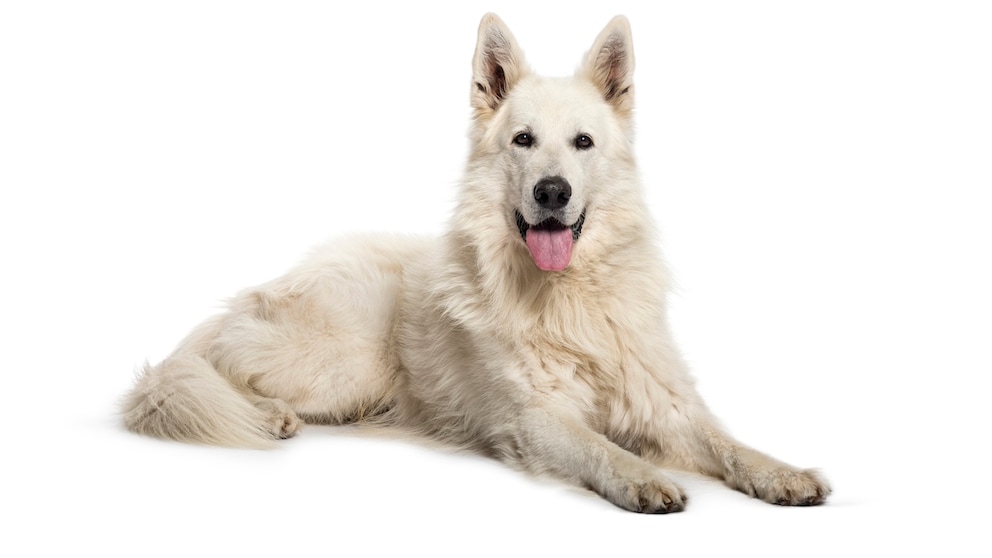
The White Swiss Shepherd owes its name in part to its pure white coat, which can be either short-haired or long-haired with a dense undercoat. In contrast to this are its brown to dark brown eyes, dark eyelids, and black nose. Its ears are triangular, erect, and its long tail is densely furred. The body of the White Swiss Shepherd is strong and muscular, and unlike the German Shepherd, it has a natural and healthy build with a straight backline and normally angled hindquarters. In terms of size and weight, it does not differ from the German Shepherd. It is also among the medium to large dog breeds.
Character & Temperament
The White Swiss Shepherd is very similar in character to the German Shepherd. The intelligent and ambitious canine has a strong desire to work and forms a close bond with its owner due to its social nature. It is friendly and balanced, never appearing nervous or fearful. Aggressiveness is foreign to it. Instead, it stands loyally by its owner’s side and is suitable as a family dog due to its peaceful and child-friendly nature. It is important to meet its desire and willingness to work, allowing it to be helpful and physically active.
Training
For owning a White Swiss Shepherd, it is advisable to have prior dog experience to be assertive enough and to represent a pack leader for the intelligent dog. Due to its eagerness to please, willingness to work, and good communication skills, it can be well-trained and educated. The foundation for its training should be trust, an emotional bond with its owner, and early socialization.
Proper Care & Maintenance
As a former working dog, the White Swiss Shepherd wants to be sufficiently occupied and needed. Therefore, it is often used as a guard, service, or rescue dog. If you decide to keep it solely as a family dog, you should ensure it is adequately occupied and exercised. Extensive and long daily walks and dog sports, such as agility, are particularly important. It is also well-suited as a companion for riding, jogging, or cycling. Due to its high activity needs, it is only somewhat suitable for pure apartment living in the city. When both physically and mentally challenged, it can fully develop its personality and become a loyal partner by its owner’s side.
Contrary to what one might expect from the white coat, it does not attract dirt particularly strongly. To support the shedding process, it should be brushed daily to remove loose undercoat.
Nutrition
The White Swiss Shepherd is suitable for both raw feeding and feeding with dry or wet food. It is important that the nutrient composition of the food is adapted to its size, weight, age, and activity level.

Newfoundland – the Dog with Webbed Feet

What Owners Should Know About the Croatian Shepherd Dog
Susceptibility to Certain Diseases
In general, the White Swiss Shepherd is considered a robust and healthy dog breed. However, certain hereditary diseases can also occur more frequently in this breed. These include hip dysplasia, degenerative myelopathy, malignant hyperthermia, and MDR1. Dogs from reputable breeding are subjected to a genetic test that determines the likelihood of the animal passing on one of the hereditary diseases.
The health risk of the steeply sloping backline found in the German Shepherd does not occur in the White Swiss Shepherd, as its breeding places particular emphasis on a natural physique.
The White Swiss Shepherd at a Glance
- Character: intelligent, child-friendly, playful
- Size: 55–66 cm
- Weight: 22–40 kg
- Coat: short-haired or long-haired with a dense undercoat
- Exercise Needs: very high
- Average Lifespan: 12–14 years
- Special Features: well-suited as a guard dog