

August 6, 2025, 1:46 pm | Read time: 5 minutes
The Croatian Shepherd Dog, also known as the Hrvatski Ovčar, is a true natural talent among herding dogs: intelligent, tireless, and loyally devoted to its owner. Its centuries-old history and fox-like appearance make it not only a fascinating cultural asset of Croatia but also a loyal companion for experienced dog owners.
Origin
The roots of the Croatian Shepherd Dog go far back in history. As early as 1374, Bishop Petar of Đakovo mentioned a “Canis Pastoralis Croaticus” in a document, which the Croatians had brought with them when settling in their new homeland. This makes the breed one of the oldest documented herding dogs in Europe. In a later manuscript from 1719, Bishop Peter Bakić confirmed that the dog’s appearance had changed little since the 14th century.
However, the actual breeding development only began in 1935 by veterinary professor Dr. Stjepan Romić, who worked specifically with existing specimens in Đakovo. After more than three decades of selective breeding, the FCI officially recognized the Croatian Shepherd Dog in 1969. Despite its long history, the Hrvatski Ovčar remained relatively unknown outside the Balkans and continues to be primarily used as a working dog for herding in its homeland.
Appearance & Coat
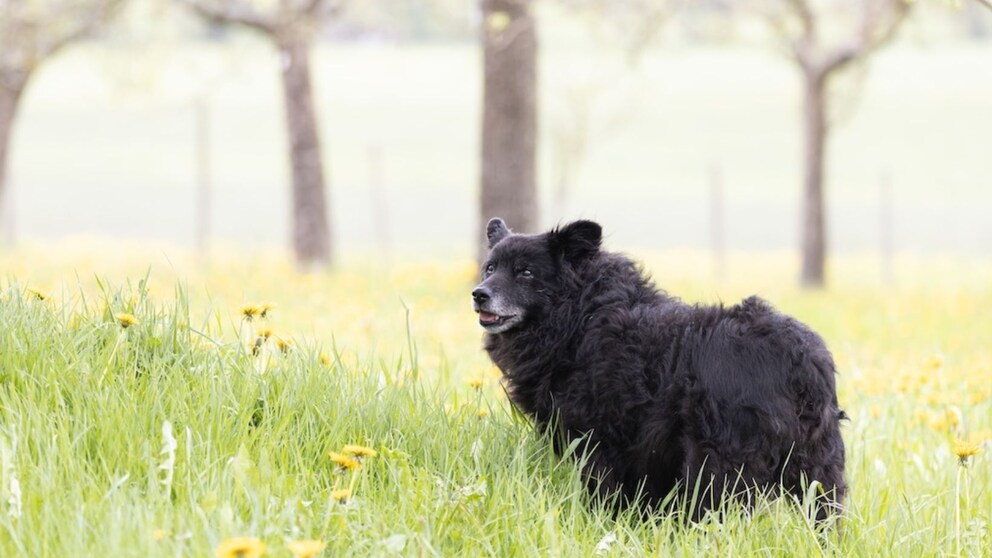
The Croatian Shepherd Dog is a medium-sized, compactly built dog with a rectangular body shape and a rustic, spitz-like overall appearance. Males appear more robust and typically have a more abundant coat than females. The shoulder height is up to 50 cm, and the weight is up to 16 kg.
Characteristic is the consistently black coat, consisting of a dense undercoat and a soft, wavy to curly topcoat. This can grow up to 14 cm long. The longest hairs are found on the neck, back, croup, and legs, as well as on the so-called “culotte” at the base of the tail. The hair is significantly shorter on the head, ears, muzzle, and forelegs. White markings are only permissible to a small extent, such as on the chest.
Its face, with a pointed muzzle and alert, oval eyes, resembles a fox. The ears are triangular with rounded tips and can be carried erect or semi-erect. The tail is strong at the base, tapers to the tip, and lies over the backline when the dog is alert.
Character & Temperament
The Croatian Shepherd Dog is considered intelligent, brave, and willing to work. Its high intelligence and endurance make it an ideal helper in herding work. At the same time, it is characterized by patience, composure, and a close bond with its owner. It often shows a strong one-person orientation but is friendly towards the entire family.
Its energy demands daily exercise—both mentally and physically. Indoors, it behaves calmly, while outdoors, it is lively and always ready for new tasks. It gets along well with children and usually integrates other pets, such as dogs or cats, into its “pack” without issue. It is rather reserved and watchful towards strangers, without being aggressive—an excellent watchdog with a keen sense of situations.
Training
Training the Croatian Shepherd Dog requires consistency, empathy, and experience. Its high learning ability and desire to please its owner make training significantly easier. However, repetitions should be avoided as it quickly becomes bored. Positive reinforcement through praise and rewards is the key to sustainable learning success.
Early socialization in a good dog school is recommended so that it learns to handle other dogs and various everyday situations confidently. With appropriate guidance, the Hrvatski Ovčar develops into a reliable family member.
Proper Care & Maintenance
As an active working dog, the Croatian Shepherd Dog is not suited for a life on the couch. It needs plenty of exercise, mental stimulation, and a close bond with its primary person. Ideally, it lives in a house with a securely fenced yard—since this agile climber easily overcomes low fences.
Its medium-length coat is easy to care for but should be brushed once or twice a week to prevent matting. After walks, it is advisable to check for dirt, twigs, and ticks. Ears, teeth, and claws also require regular care. Bathing is only necessary in exceptional cases and should be done with mild dog shampoo.
Nutrition
The diet of the Croatian Shepherd Dog should be adjusted to its age, activity level, and health condition. High-quality food with a balanced protein content forms the basis. Special food varieties for active breeds can be helpful.
Portion sizes should be measured with a measuring cup, and treats should be given only in moderation—no more than 10% of the daily ration. Fresh drinking water must be available at all times. Puppies need up to six meals a day, which are reduced to two as they age.
The Karst Shepherd Dog even stands up to bears and wolves.

Portuguese Water Dogs Are Only for Active Owners
Susceptibility to Certain Diseases
The Croatian Shepherd Dog is generally considered a robust and healthy breed. Breed-specific diseases are rare. However, hip dysplasia (HD) or eye problems can occasionally occur, which is why responsible breeders conduct appropriate health tests.
Owners must have their dogs regularly examined by a veterinarian, vaccinated, and protected against parasites to maintain long-term health. A balanced diet and sufficient exercise also contribute to prevention.
The Croatian Shepherd Dog at a Glance
- Temperament: Intelligent, loyal, eager to work, good with children, watchful
- Size: Up to 50 cm shoulder height
- Weight: Up to 16 kg
- Coat & Colors: Medium-length, wavy to curly, pure black with possible white chest markings
- Grooming Needs: Moderate—regular brushing required
- Special Features: Very agile, requires a lot of exercise and mental stimulation