

August 16, 2025, 1:55 pm | Read time: 5 minutes
The Tornjak combines ancient origins with an impressive appearance: A proud guardian born from the wilderness of the Balkan region, who has maintained his independence and self-reliance to this day. Anyone who considers him just a fluffy family dog is gravely mistaken—this livestock guardian dog demands respect, expertise, and a natural environment. Yet for experienced owners, he offers a fascinating blend of loyalty, intelligence, and calm presence.
Origin
The Tornjak hails from the mountainous regions of present-day Bosnia-Herzegovina and Croatia, where it has been used as a livestock guardian dog for centuries. The first written mention of this primitive breed can be found in manuscripts from the 11th century. Its primary task was to independently protect herds from predators such as wolves or bears—even without the constant presence of a shepherd.
For many centuries, the Tornjak was part of a shared heritage of Eastern European livestock guardian dogs, which also includes breeds like the Kuvasz and Komondor. It wasn’t until the 20th century that a targeted separation and pure breeding began. After almost complete displacement with the decline of migratory sheep farming, an organized population survey started in 1972, which eventually led to the establishment of the first standard in 1978.
Official recognition by the Fédération Cynologique Internationale (FCI) occurred in 2007, followed by a standard revision in 2017. In Germany, the breed is overseen by the VDH, but breeding activities are rare and limited to a few litters every four to five years.
Appearance & Coat
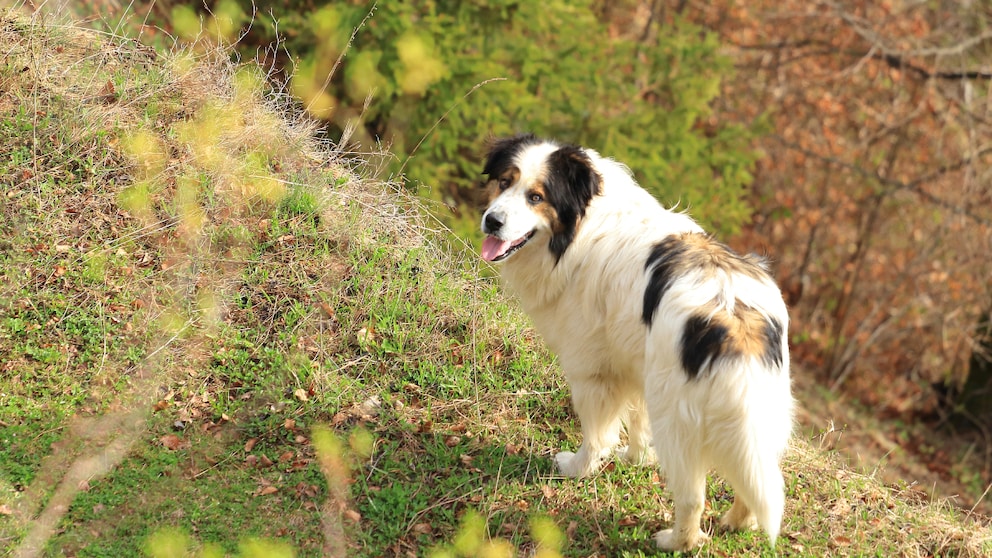
The Tornjak is a large, muscular yet elegant dog with an almost square body shape. Males reach a height at the withers of 65 to 70 cm, females 60 to 65 cm. The weight varies by gender between about 35 and 50 kg. Notable is his long, weather-resistant coat, which underscores an impressive appearance without seeming bulky. The topcoat is long, straight to slightly wavy, coarse in texture, and underlaid with dense undercoat, which is particularly pronounced in winter.
Many males display a distinctive mane at the neck. The fur is shorter on the face and legs, particularly long on the croup, back, and shoulders. The preferred gait is the trot, which is accompanied by expansive, smooth movement. Also typical is the long-haired tail with a flag, carried above the backline when in motion.
The base color is often white with variously sized and colored markings in brown, black, gray, yellow, or red. Solid-colored or tricolored specimens also occur. The almond-shaped eyes are predominantly brown, with blue eyes being rare.
Character & Temperament
The Tornjak embodies the classic livestock guardian dog: brave, self-assured, independent—and equipped with a pronounced protective instinct. Its demeanor is calm, vigilant, and self-contained. It meets strangers with suspicion, though not aggressively. Within its territory, it acts as an unwavering guardian, yet it cannot be bribed or manipulated.
It is loyal, affectionate, and composed toward its person of reference. Despite its independence, it is considered intelligent and willing to learn—provided the leadership is clear and based on trust. Tornjaks enjoy the closeness of their family, but are not typical play dogs. Their basic mood is friendly, as long as they are kept appropriately. They are usually social with their peers, occasionally dominant with unfamiliar dogs. The Tornjak’s stubbornness requires experienced owners who can balance freedom and leadership.
Training
Training a Tornjak requires consistent, calm, and experienced leadership. The dog reacts sensitively to uncertainties and makes its own decisions in case of doubt. Early socialization is essential to control excessive territorial behavior. Especially in densely populated areas, training must start early to prevent barking at every passerby as an intruder.
Despite its independence, the Tornjak is well trainable—it learns quickly, retains learned information permanently, and reliably takes on assigned tasks. A non-violent, trusting bond forms the basis for successful training. Beginners should rather avoid this breed.
Proper Care & Maintenance
The Tornjak needs plenty of space and mental freedom. Keeping it in the city or even in a small apartment is completely unsuitable. Ideally, it should have a large, fenced property or a rural environment with access to nature. The Tornjak enjoys living outdoors year-round, provided there is a suitable, well-insulated shelter available. Kennel keeping or chaining is absolutely to be avoided. This dog needs freedom of movement, territory control, and human closeness—only then does it remain balanced. Maintenance effort is moderate: weekly brushing is sufficient. Shearing should be avoided to preserve the protective coat structure. Special attention should be paid to ear and claw care.
Nutrition
In terms of nutrition, the Tornjak is uncomplicated. High-quality, balanced food—whether dry, wet, or BARF—is crucial for his health. Portions should be adjusted to its size and activity level. Since some Tornjaks tend to be overweight, regular weight control is recommended. It is important to ensure adequate protein and joint-friendly nutrients, especially during the growth phase and in advanced age.
Why This Livestock Guardian Dog Doesn’t Belong in Private Hands

This Is Why the Aïdi Is Neither Suitable as a City Dog Nor as a Family Dog
Susceptibility to Certain Diseases
The Tornjak is considered a very robust breed with stable health. Breed-specific diseases have not been documented so far. Nevertheless, owners should watch for possible joint problems, as large breeds are generally prone to arthritis or hip dysplasia—especially with overweight. Regular veterinary visits for health care, dental checks, and parasite prevention are naturally part of responsible ownership.
The Tornjak at a Glance
- Character: Independent, calm, brave, territorial, friendly in family settings
- Size (Shoulder Height): Males 65–70 cm, Females 60–65 cm
- Weight: Males approx. 40–50 kg, Females approx. 35–45 kg
- Coat: Long, dense, weather-resistant, with plenty of undercoat
- Exercise Needs: fairly high
- Average Life Expectancy: 10–14 years
- Special Features: Not suitable for beginners or city apartments; ideal in the countryside with plenty of space and experienced leadership