

November 6, 2025, 5:09 am | Read time: 5 minutes
Despite its small size, the Pekingese is far from a typical lapdog: proud, independent, and full of history. Its roots run deep into the Chinese imperial era, where it once guarded temples and was reserved only for the nobility. Today, it is one of the most striking small dog breeds–with lush fur, an alert gaze, and a distinctive personality. However, its beauty also has downsides, as decades of overbreeding have led to health challenges. What makes this special dog unique–and who is it really suited for?
Origin
The Pekingese hails from imperial China and has an exceptionally long cultural history. Early on, it was considered a symbol of imperial power and was kept exclusively at the court–particularly in the Forbidden City. The dog was referred to as the “Lion Dog,” an allusion to its characteristic appearance, which, according to legend, resulted from a mystical union between a lion and a monkey. In fact, Pekingese were highly valued companions of the Chinese upper class and symbolically took on protective roles, such as temple guardians.
Especially under the Qing Dynasty (1644–1912), the breed experienced its heyday, as evidenced by numerous depictions and writings. In 1860, the fate of the Pekingese changed dramatically: British soldiers took five specimens as war booty to Europe after the capture of Beijing. One of these dogs–”Looty”–found its way to Queen Victoria. This marked the beginning of the international breeding history, albeit with negative consequences: In Europe, extreme breeding traits were emphasized, particularly an oversized head, flat muzzle, and overly long coat. This led to significant health problems. It wasn’t until 2010 that new breed standards were introduced to counteract the increasing animal suffering.
Appearance & Coat
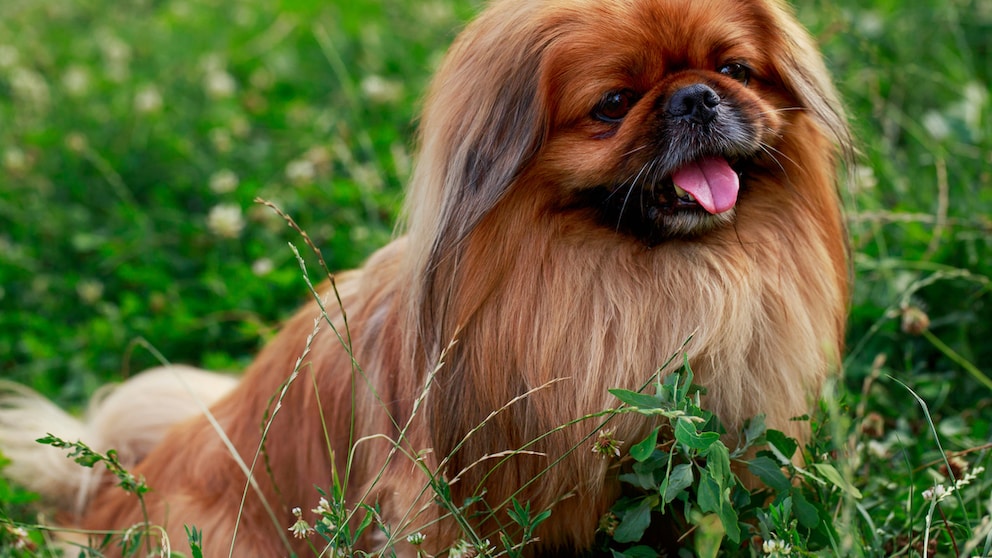
The Pekingese is a distinctively built small dog with a compact body and a disproportionately large, broad head. The nose is extremely short, giving it the typical flat profile. Large, dark eyes and drooping, heart-shaped ears emphasize its expressive facial expression. The tail is set high over the back and often slightly curved to the side.
Particularly striking is the dense, double-layered coat. The topcoat is long, smooth, and slightly harsh in texture, while the undercoat is soft and very dense. According to the standard, a black mask–meaning dark pigmentation of the nose, lips, and eyelid edges–is desirable. The color palette is broad: All colors and patterns except albino and liver color are allowed. Multicolored variants like tricolor also occur, with the colors ideally distributed evenly. Overall, the appearance is lion-like–a nod to the breed’s mythical origins.
Character & Temperament
Pekingese are considered self-assured, proud, and independent dogs. Despite their small stature, they exhibit a remarkably fearless nature and often behave like large dogs in miniature form. They form a close bond with their primary caregiver but are not overly clingy. Instead, they seek closeness and affection on their own terms.
They usually greet strangers with caution, if not outright suspicion. Their alertness is pronounced, but they do not tend to bark incessantly. Rather, they signal when someone unfamiliar approaches. Their independent nature can easily be mistaken for stubbornness–but it is more a pronounced individuality that has earned them the reputation of “charismatic loners.”
Training
Training a Pekingese requires patience, consistency, and empathy. While these dogs are intelligent and capable of learning quickly, their individuality often hinders rapid training. They follow commands only when it suits their own agenda. Therefore, early socialization is as important as loving consistency.
Attending a dog school experienced with strong-willed small breeds is recommended. Clear structures in daily life and a dedicated caregiver support training. It’s important not to be deceived by their cute appearance: The Pekingese needs serious leadership and clear rules.
Proper Care & Maintenance
The Pekingese is not an endurance runner but rather a content apartment dog with moderate exercise needs. A quiet city apartment can be an ideal home for him–provided he gets daily walks and mental stimulation. Long hikes are unsuitable for him, but short sniffing rounds are very welcome.
He dislikes unrest and noise. Crowds, loud events, or hectic environments quickly stress him. Grooming is demanding: Daily brushing against the grain prevents matting, and bathing should only occur in exceptional cases. Since the dense undercoat dries slowly, the dog must be kept warm and draft-free after a bath. Eyes and ears should be regularly checked and gently cleaned.
Nutrition
Pekingese tend to be overweight and should therefore be fed in a controlled and needs-based manner. High-quality dry or wet food is suitable, as is a balanced BARF diet, provided it is implemented correctly. It is important that the food contains no sugar or wheat. The amount of food should always be adjusted to age, activity level, and weight. Regular weight checks help prevent health problems.
Why the Lhasa Apso Was Once Sacred–and What Owners Need to Know Today
The Sealyham Terrier is a Great Family Dog—if You Know What You’re Doing
Susceptibility to Certain Diseases
The breed is considered a torture breed, as many Pekingese suffer from significant health problems due to exaggerated breeding standards. The respiratory system is particularly affected: The severely shortened muzzle often leads to breathing difficulties and impairs body temperature regulation, especially in heat. These dogs are therefore highly sensitive to heat.
Their notably large, protruding eyes also pose risks. They are prone to injuries, such as when playing or sniffing in underbrush. Other typical issues involve births in females, as the head-to-pelvis ratio is unfavorable. Overall, these traits lead to frequent vet visits and sometimes high treatment costs. A critical examination of the breeding ethics of this breed is absolutely necessary.
The Pekingese at a Glance
- Character: self-assured, alert, independent
- Size: 20–30 cm shoulder height
- Weight: 5–7 kg (occasionally up to 5.4 kg)
- Coat: long, smooth topcoat with dense undercoat
- Colors: all colors allowed except albino and liver color
- Grooming needs: very high, daily coat care necessary
- Special features: considered a torture breed with health problems