


June 29, 2026, 8:45 am | Read time: 5 minutes
Dogs “talk” to us constantly–we just often don’t understand them. Through subtle movements and small gestures, they try to calm situations or reduce stress. Dog trainer Katharina Marioth explains what calming signals look like, what they mean, and why it’s so important to read them correctly.
Dogs communicate continuously–but mostly not with sounds, rather through their body language. “We humans often think dogs mainly bark or whine to express themselves,” says dog trainer Katharina Marioth. “But communication starts much earlier–very quietly, through small gestures.”
An important part of this silent language is the so-called calming signals. They help dogs defuse situations, reduce stress, and avoid misunderstandings. Yet many owners don’t notice these signals at all–or interpret them incorrectly.
“These Gestures Serve to Reduce Tension”
Calming signals are body language signs that dogs use to try to calm a situation. “With them, they essentially say: ‘I mean no harm, everything’s fine,'” explains Marioth.
Typical examples include lip licking, when the dog briefly licks its lips, or looking away–sometimes just for a moment. Even a slight turning of the body or a slightly lowered tail can be such signals. “These gestures serve to reduce tension or show: I’m uncomfortable right now.”
However, not every signal automatically means stress. “When a dog licks its lips, it can also simply mean that it’s expecting food or smells something tasty,” the trainer emphasizes. “You should always consider the situation in context.”
Play Invitation or Calming?
These signals are particularly evident in stressful moments–such as at the vet. “We often see the dog lowering its gaze, licking its lips, or slightly turning its body sideways,” says Marioth. “These subtle movements are stress-relief gestures–they show that the dog feels uncomfortable but isn’t seeking conflict.”
Even gestures that many people interpret as a play invitation, like the bowing of the front body, can be a relaxation gesture. “Especially in encounters with unfamiliar dogs, it’s often not an invitation to romp, but rather an attempt to reduce tension,” she explains.
What Owners Often Overlook
Many calming signals are so subtle that they quickly go unnoticed in everyday life. “A classic example is the slight lowering of the tail,” says Marioth. “I don’t mean it being tucked between the legs, but simply held a bit lower–often combined with a gentle sideways movement.”
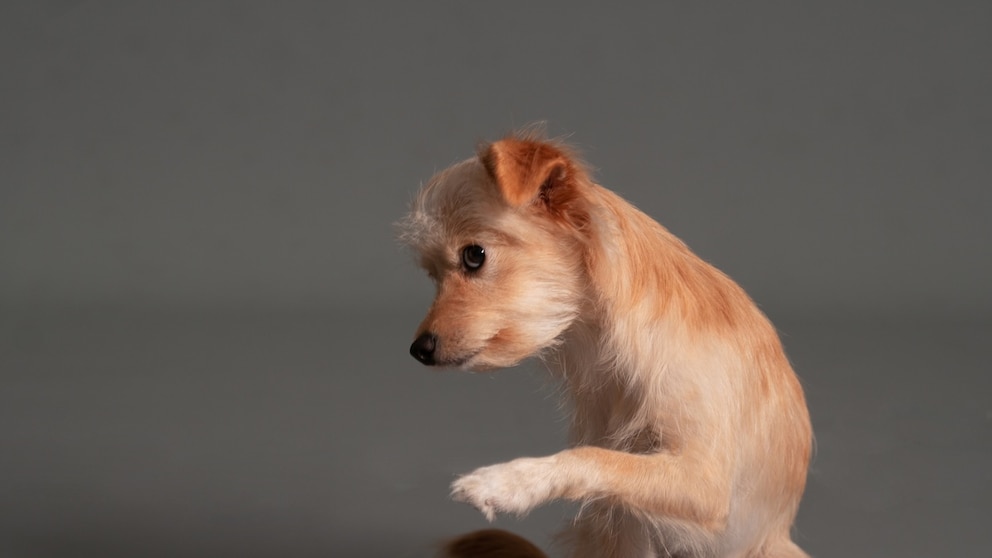
Even paw lifting, the brief raising of a paw, often goes unnoticed. “Yet it’s often a clear sign that the dog wants to relieve some pressure from the situation at that moment.”
How Owners Should React
How to react to such signals depends greatly on the context. “The most important thing is: to notice them at all,” emphasizes Marioth. “And then briefly ask yourself: What just happened?” Maybe the dog only reacted to a noise or smelled food–then there’s no need to worry.
If the dog really seems stressed, it helps to “reduce the pressure, such as by creating distance or briefly leaving the situation.” It’s important not to overreact. “Sometimes people want to immediately comfort or protect the dog, but often it’s enough to simply give it some space.”
Calming Signals in Dogs as a Training Aid
The dog’s body language can also provide valuable insights into its training status. “When I bring out the nail clippers and the dog smacks its lips or turns its head away, it’s saying: ‘I’m uncomfortable with this,'” explains Marioth. “That’s not misbehavior, but communication–and for me, it’s a great feedback on where I can start.”
In the so-called medical training, dogs learn to get used to unpleasant grooming measures. “I show the item, like the brush or scissors, and nothing happens at first. The dog can look at it and gets a reward for it,” says Marioth.
It’s important to reward directly at the item, not away from it. “Then I take it away again, present it later, and gradually increase the interaction–maybe I just lightly stroke the dog’s fur and reward afterward. This way, it learns: It’s not bad.”

Dog Shows Belly? Expert Explains What It Really Means

Why Dogs Never Bite “Suddenly”
Calming Signals Among Dogs
Calming signals also play an important role in encounters with other dogs–though owners can hardly influence them there. “In the park or on the field, you just have to trust that both dogs are socially well-adjusted,” says Marioth. “Ideally, the dog learns to handle such signals as a puppy or young dog–accompanied by a good trainer.” This way, the dog develops the ability to read body language correctly and react in a de-escalating manner. “That’s real social competence,” the expert emphasizes.
Mindfulness Builds Trust
In the end, it’s all about being attentive. “If we learn to see and correctly interpret these small gestures, we understand our dogs much better,” says Katharina Marioth. “And we can help them feel safe and comfortable.”
Because those who understand their dog’s quiet language not only create more harmony in everyday life–but also strengthen the trust between human and animal.
You can watch the entire interview with dog trainer Katharina Marioth in the video.

About the Expert
Katharina Marioth is the founder of the Stadthundetraining brand and the KEML principle. She is an IHK- and government-certified dog trainer and behavioral assessor for dangerous dogs in the state of Berlin. In her daily business, she works closely with veterinarians, scientists, and other specialists on dog-related topics. With her knowledge and skills, she secured the title of Dog Trainer of the Year 2023 in the Sat.1 show “The Dog Trainer Champion.”