

August 11, 2025, 4:18 pm | Read time: 5 minutes
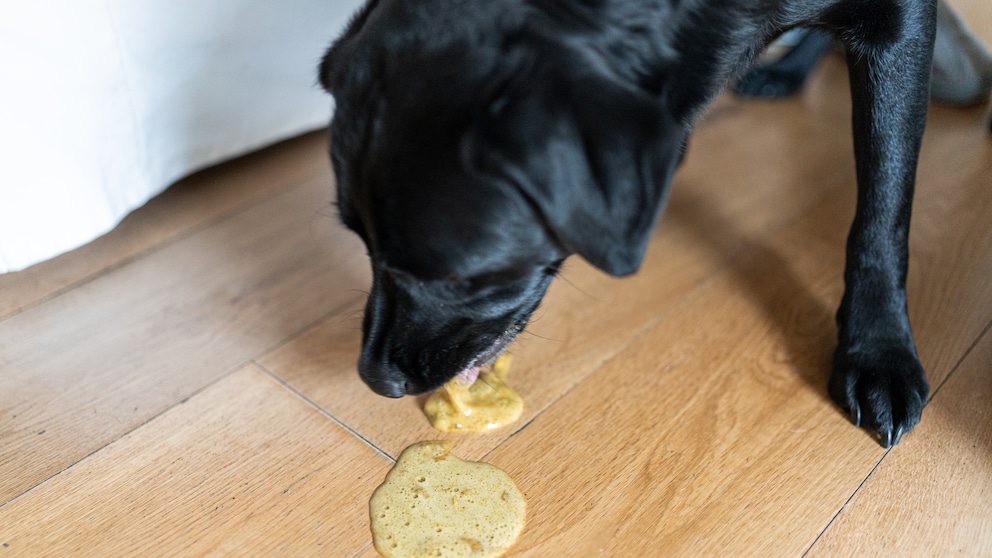
Many pet owners are familiar with this: Dogs occasionally eat their own vomit–a behavior that many find puzzling or even disgusting. However, from the dog’s perspective, this is less unusual than it seems. PETBOOK asked experts about this behavior and what owners should consider.
Why Some Dogs Eat Their Vomit
Biologically speaking, when dogs eat their vomit, it is often an instinctive behavior rooted in evolution. In the wild–such as with wolves or wild dogs–it is normal for mother animals to pre-digest food and then regurgitate it for their pups. This makes it easier for the young to consume. This ability to reconsume food is deeply embedded in dogs’ genetic makeup.1
Additionally, dogs generally tend to utilize all edible resources to maximize food sources. Vomit often contains undigested food and still smells “edible” from a dog’s perspective. Because dogs can identify food through their superior sense of smell–even when it is no longer appetizing to humans–vomit is often seen as a recovery of lost food, not waste. “Dogs are not little humans–they have their own understanding of what is ‘normal,'” explains dog trainer Katharina Marioth.
Also interesting: Pets with drugs in their system–not uncommon in Germany!
Often Regurgitation Instead of True Vomiting
“When a dog vomits, it is often not true vomiting but rather regurgitation, for example, if it has eaten too quickly.” The regurgitated stomach contents are usually still quite “fresh” and are therefore instinctively eaten again by many dogs. “It’s like saying, ‘That’s still good,'” explains Marioth. In the wild, it would be wasteful not to eat it. “For us humans, this is hard to understand, but for dogs, it’s not unusual behavior.”
Owners should generally remain calm, advises the expert. Scolding is ineffective. “On the contrary!” It can even cause stress, which may reinforce the behavior. Instead, it helps to calmly but firmly lead the dog away from the vomit,” says Marioth. If possible, owners should quickly remove the vomit so the dog cannot eat it again. “Additionally, you can work on identifying the cause–is the dog eating too hastily? Was the food perhaps not well tolerated?”
The Cause of Vomiting Should Be Clarified
There are ways to address fast eating. If you know your dog eats quickly, you can use anti-gulping bowls or offer food in smaller portions. However, there are other reasons that owners should pay attention to, says dog trainer Simeon Faller.
“The most common reason I see in my work is that something is wrong with the gastrointestinal tract.” Often, it is due to the wrong feeding method. Not every dog tolerates every food–similar to humans, the dog trainer notes. There are indeed differences in digestion, especially specific to breeds.
Frequent Vomiting Is Not Normal
“This naturally leads to digestive problems, and the dog then tries to reabsorb its nutrients when it has just vomited and everything is still visible. Additionally, dogs often have heartburn, and an empty stomach is particularly painful.” Therefore, it is important to determine why the dog is vomiting–especially if it happens frequently.
Frequent vomiting is not normal behavior, emphasizes Faller. “Unfortunately, many people still believe it is normal. They think, ‘The dog is just cleaning its stomach,’ but that’s not the case.” This also applies to the widespread belief that eating their own vomit is a leftover from the wolf era to avoid showing weakness to other animals.
Is Eating Vomit Really a Remnant from the Wolf Era?
There is no scientific basis for this. Rather, it is a natural, partially instinctive behavior that is biologically and behaviorally ecologically explainable but not strategically socially motivated. The same applies to the widespread belief that dogs eat their vomit (or feces) to cover their tracks. This would prevent competitors, enemies, or larger predators from being attracted in the wild, which could be an advantage for wolves with young in the den. While this sounds plausible, it is also not scientifically proven.
However, it is possible that in some cases, dogs from shelters may reconsume their vomit. Sometimes, a survival instinct becomes a habit, explains Simeon Faller in a conversation with PETBOOK. “The problem is that dogs can re-ingest potential pathogens. Therefore, this should be prevented.” Owners should definitely consult a veterinarian if the dog vomits frequently–multiple times a week or over an extended period.

Why Many Dogs Eat Their Vomit and What Owners Should Do

Too Much Meat Can Lead to Problematic Behavior in Dogs
Owners Should Trust Their Instincts
If other symptoms such as loss of appetite, diarrhea, apathy, or unusual stomach noises occur, owners should be alarmed, emphasizes Katharina Marioth. “One-time vomiting can be harmless, but with repeated vomiting or changed behavior, caution is better than regret.” Therefore, owners should definitely trust their instincts. “Because you know your dog best!”
Nevertheless, she advises that in case of doubt, it’s better to visit the vet once too often than too late. “Dogs are masters at hiding pain.” Therefore, good observation skills are the best protection for dog owners. If the vet still certifies the dog as being in excellent health, the next step should be to consult a dog nutritionist, says Simeon Faller.
Training Tips to Prevent Dogs from Eating Vomit
Additionally, you can train your dog not to eat its own vomit, explains dog trainer Katharina Marioth. “In such cases, I like to use the command ‘Leave it’ or ‘Move on.’ This can be positively reinforced without pressure. The goal is for your dog to learn that it’s rewarding to move away from something rather than consume it.”