


March 26, 2026, 4:32 pm | Read time: 4 minutes
Many dog owners know the scenario: As soon as the treat bag rustles, the dog is immediately ready—and a “no” seems pointless. Breeds like Labradors or Beagles are considered real “vacuum cleaners” when it comes to eating. But is it really just about training, or is it simply genetic for some dogs? Dog trainer Katharina Marioth explains to PETBOOK why some dogs are always hungry, the role humans play, and which dog breeds are particularly gluttonous.
Some Dogs Have No “Off Switch” for Eating
Almost half of all dogs are overweight, according to the literature.1 This is a problem often linked to the appetite of certain breeds. Labradors, beagles, and pugs are particularly known for being “gluttonous.” But is this true, or are we anthropomorphizing this behavior too much?
“Basically, you can say that some breeds indeed have no so-called ‘off switch’ for eating,” explains dog trainer Katharina Marioth. While exceptions confirm the rule, there are clear tendencies. Whether this behavior was intentionally bred is hard to answer. Marioth suspects it’s more of a side effect: “I think every breeder would be happy if there were labradors or beagles with a better off switch for eating.”
These Dogs Would Eat Until They Burst
Theoretically, the behavior of some breeds can be historically traced. For retrievers, it might have been advantageous to have a high motivation to pick things up with their mouths. “For beagles as pack dogs, it makes less sense—and for pugs, it can’t really be explained,” says Marioth.
But what exactly is behind the lack of an off switch for eating? Ultimately, it’s about the feeling of satiety. “There are dogs where this feeling just doesn’t kick in properly,” says the expert. These animals would keep eating if allowed. Some even overeat to the point of vomiting—and would still continue eating afterward. Here, humans are called upon: “Then it’s clearly the owner’s responsibility to control it.”
A Big Appetite Doesn’t Mean Overweight
However, a strong appetite doesn’t automatically mean being overweight. “There are very energetic breeds with a strong metabolism that can compensate better,” explains Marioth. Still, many of these dogs are constantly hungry. It’s more accurate to speak of unfulfilled “appetite” rather than hunger: “There’s always room for one more cookie, another bowl too.”
This food fixation often shows up in everyday life. Larger dogs like Labradors seem to seize every opportunity to get food. “Then not only is the apple gone, but also the plastic bag,” Marioth describes typical scenarios. Trash cans are raided, or kitchen surfaces are searched. It’s important to distinguish whether the dog has learned that this behavior pays off or if stress is behind it. But one thing is clear: “With a Labrador, you often become very tidy automatically.”

Study Finds Main Reasons Why Many Dogs Are Overweight

Why Many Dogs Eat Their Vomit and What Owners Should Do
Humans Also Contribute to Dogs’ Gluttony
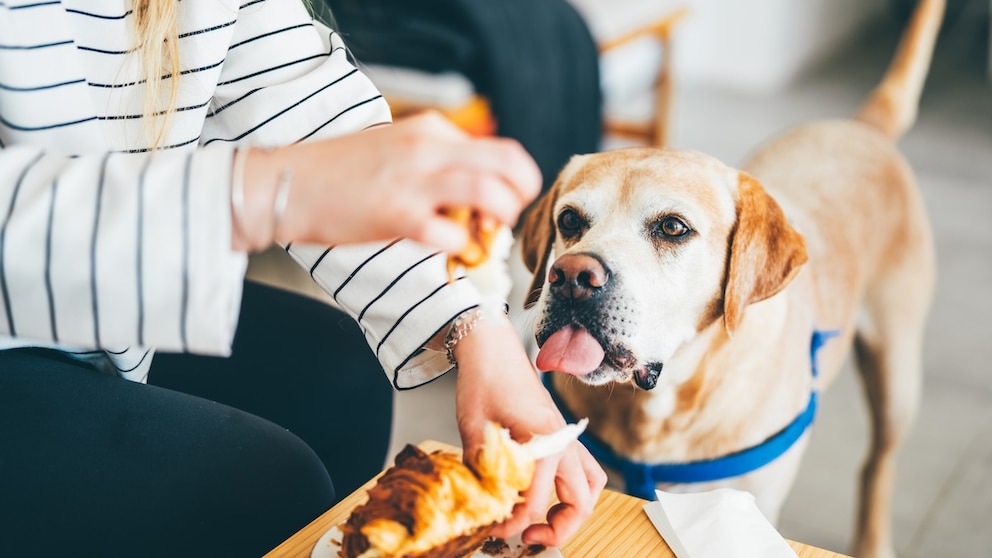
According to Marioth, some breeds are more prone to obesity not just because of metabolism but also behavior—and humans. “When the dog gives that typical look, something quickly ends up moving from the table into their mouth,” she says.
During walks or training, an extra treat is often given. Another factor is: “Neutered or spayed dogs gain weight much faster,” explains the trainer. Here, adjusted food is particularly important.
Gluttonous Dog Breeds Can Have Training Advantages
In training, a strong food motivation can also be advantageous. “I always say: Be happy if you have a food-motivated dog,” says Marioth. It makes many training processes significantly easier. Ideally, the cookie in the forest is more interesting than wild animals—a clear advantage for control. At the same time, she warns against relying too much on food as a lure: “Then the dog only follows the cookie but hasn’t really learned the behavior.” It’s crucial to use the reward strategically and gradually vary it.
In the end, it shows: Gluttony is indeed more pronounced in some dogs—but it’s not an unavoidable fate. With the right approach, clear rules, and some discipline on the part of the owners, even particularly food-motivated dogs can find a healthy balance.

About the Expert
Katharina Marioth is the founder of the brand Stadthundetraining and the KEML principle. She is an IHK- and government-certified dog trainer and behavioral assessor for dangerous dogs in Berlin. In her daily work, she collaborates closely with veterinarians, scientists, and other specialists on dog-related topics. With her knowledge and skills, she secured the title of Dog Trainer of the Year 2023 in the Sat.1 show “The Dog Trainer Champion.”