

February 11, 2026, 2:49 pm | Read time: 5 minutes
The question of whether dogs should be allowed to sleep in the bed is undoubtedly one of the great debates in modern pet ownership. The topic is passionately discussed in many places, and the number of dogs that occasionally slip under the covers is likely much higher than many owners would admit publicly. Behind the scenes, the reality often looks different—at least for PETBOOK author Nina Ponath.
The Morning Invasion
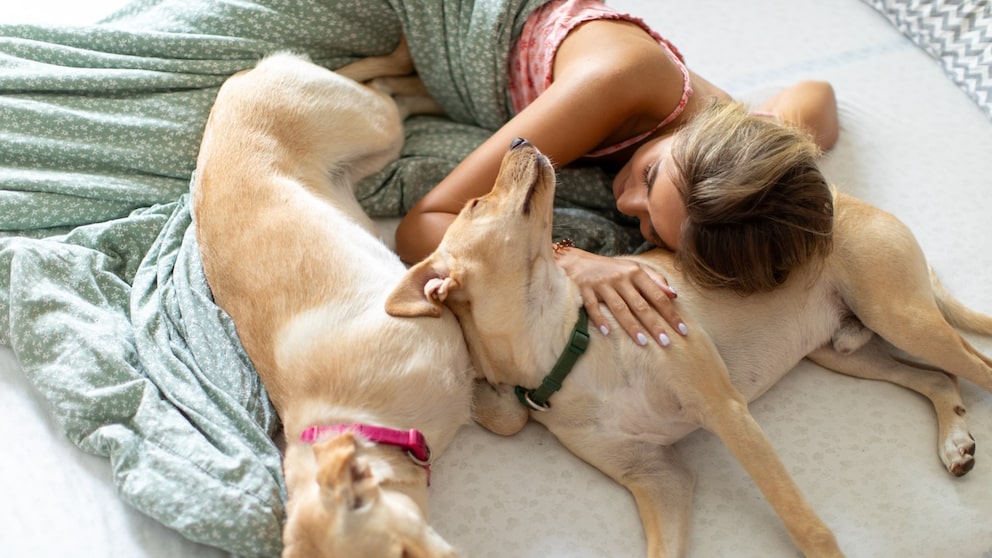
My dogs, Rudi and Pippa, officially do not sleep in the bed. This is somewhat true, but only somewhat: In the evenings, we all go our separate ways quite obediently and disciplined. The dogs retreat to their baskets, and my partner and I disappear into our bed. We are normal people, and no, the dogs are not substitutes for children. Yet, one day in the early morning hours, when deep sleep is at its deepest and human willpower is at its weakest, the quiet migration begins, and our bed becomes a family bed.
First, you hear a gentle tapping on the parquet, followed by a joyful leap onto the mattress. When I wake up in the morning, Rudi and Pippa are not lying obediently at the foot of the bed, as one might expect in a Disney movie, but sprawled out like two kings. How can two dogs, each barely 16 inches tall, take up so much space? Do they want to, or can they not make themselves a bit slimmer?
Why Dogs Want to Be in the Bed
For dogs, the bed is not just a soft surface. It is a place of absolute security and social affirmation. The intense smell of “their human” has an enormously calming effect on a scent-driven animal like a dog. It is warm, elevated, and the place where the pack is most vulnerable: in sleep. Choosing this spot is actually the greatest compliment a dog can give us.
Why Do Dogs Take Up So Much Space in the Bed?
When Rudi and Pippa lie in the bed like two hefty, stranded sea lions, one might think they are trying to tell me something. In the past, this would have been dismissed as “dominance”—the dog wanting to challenge the human for space to establish hierarchy. Today we know: This is mostly nonsense.
“The idea that a dog lying in the way or ‘occupying’ a space is constantly trying to demonstrate its social status is now considered outdated,” says veterinarian Dr. Joachim Hölter from Stade. “A truly secure, ‘high-ranking’ dog doesn’t need to constantly stand in the way physically.” The reasons are much simpler and at the same time much more endearing:
1. Security Through Maximum Contact
Dogs like to lie in a way that allows them to touch as much of their surroundings (or their human) as possible. This physical contact gives them a sense of control and protection. In the wild, feral dogs or wolves often sleep closely snuggled together to keep warm and protect each other. When a dog sprawls out, it maximizes the chance to immediately notice any movement from the human.
“Every dog has a concept of individual distance. This is the space around its own body where the dog feels safe,” explains veterinarian Dr. Hölter. “A dog seeking protection from its owner or practicing contact lying actively gives up space to show and strengthen the social bond.”
2. The Biological Air Conditioner
Another factor is temperature regulation. A dog that stretches out completely and extends all four limbs releases heat through the less hairy areas on its belly. Since it is often significantly warmer under a blanket or on a mattress than on the floor, spreading out is an effective method to avoid overheating. The famous “donut position,” where dogs curl up tightly, serves to retain warmth. So, if a dog is sprawled out, it simply means it’s comfortably warm.
3. The Trust of Deep Sleep
When dogs stretch out to their full length, they are in a state of deep relaxation. In this position, their vital organs are unprotected. A dog would never present itself this way if it didn’t feel absolutely safe. The sprawling position is not a sign of disrespect but a sign of boundless trust in its surroundings and in us.
4. The Lack of Spatial Etiquette
We humans have a very pronounced concept of “space rights” and spatial awareness. We know that a mattress has edges and that it is impolite to take up the partner’s space. Dogs simply do not have this concept. For them, the bed is an available surface. Where it is comfortable, they will lie. That a human slowly slides toward the edge is not perceived by the dog as malice but simply not registered. What is “in the way” for us is simply the perfect center of comfort for the dog.

Why Cats Sleep on Their Owners’ Heads–and What It Means

TV Star Jana Schölermann: “My Dog Knew About My Pregnancy Before I Did!”
Closeness Feels Good: Cuddling Relaxes Humans and Dogs
Studies have long confirmed what we dog owners already feel: Physical closeness to the dog lowers cortisol levels (our stress hormone) and boosts the release of oxytocin, the so-called bonding hormone. This applies to both sides. Especially sensitive or very social dogs benefit greatly from this nightly reassurance. It strengthens the bond and provides a sense of security that no expensive orthopedic dog basket can offer.
A Conclusion for the Back Pain
Dogs take up space in the bed because they feel most comfortable, safe, and relaxed there. They do not do it to annoy us or undermine our authority—even if it sometimes feels that way at five in the morning when you’re trying to bend your legs into an unnatural 90-degree angle to avoid waking the canine companion.
In the end, it’s a trade-off: We sacrifice a bit of sleep quality and space, but in return, we get the unconditional closeness and gentle snoring of a creature that considers us its absolute center. Sounds like a pretty good deal.