



April 2, 2026, 10:48 am | Read time: 4 minutes
Many dog bite incidents don’t happen outside but at home—often with the owner’s own pet. For owners, the behavior often comes as a complete surprise. But does a dog really bite “out of nowhere”? And what warning signs are overlooked in everyday life? PETBOOK spoke with dog trainer Katharina Marioth about why such situations occur—and how owners can better recognize and avoid them.
We Misinterpret Signals
“In the rarest cases does a dog actually bite out of nowhere,” says dog trainer Katharina Marioth. From her perspective, most incidents are preceded by a series of signals—only these are often not recognized or misinterpreted by people.
At the same time, she warns not to underestimate possible medical causes. Hormonal disorders such as thyroid problems, certain heart diseases, or even pain in the musculoskeletal system can cause dogs to suddenly react aggressively. “Especially if behavior seems to change abruptly, it should definitely be checked by a veterinarian,” says Marioth.
It’s Often About Resources
Apart from such medical reasons, the cause of many conflicts lies in everyday life itself. Especially in direct cohabitation, misunderstandings occur. “We often pay too little attention to the needs and communication style of our dogs,” explains the trainer.
Critical situations often arise around so-called resources—such as food, toys, or even the dog’s resting place. Even caregivers can represent a resource from the dog’s perspective. It’s no coincidence that many incidents happen in or near the basket.
Typical Warning Signs Before a Dog Bites
Dogs often send clear warning signals—only these are not always recognized as such. A classic example: The dog is lying in its basket, someone approaches, and the animal turns onto its back. What many interpret as an invitation to pet is actually a calming signal, explains Marioth.
If the desired distance is not maintained, further signs follow: The dog briefly closes its mouth, smacks its lips, looks away, or lays its ears back. The so-called “whale eye,” where a white triangle in the eye becomes visible, can also indicate that the dog feels uncomfortable.
It’s especially important to take growling seriously. “It’s basically the yellow light of the traffic signal,” says Marioth. It used to be common to train dogs not to growl—a fatal mistake. Because this removes an important warning stage. “Then it can happen that the dog jumps directly from green to red,” meaning it bites without warning.

Millions Laugh While the Dogs Suffer
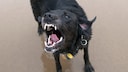
Why Many Dogs Allegedly Bite Suddenly
Why Dogs Seem to Bite “Out of Nowhere”
Still, there are situations where an attack seems completely surprising to people. According to Marioth, this is often because dogs have already gone through several strategies unsuccessfully. Basically, they have various ways to deal with stress: avoid, calm, freeze—and only attack as a last resort.
If a dog has no escape option, such as being cornered or pressured in its basket, and its previous signals are ignored, it eventually has only the last option left. “From its perspective, it has already tried everything else,” says the trainer.
How to Act After a Bite
If a bite or even a snap occurs, the situation is usually already resolved for the dog. Because typically, the person automatically backs away—exactly what the dog wanted to achieve. Scolding doesn’t help at this moment, emphasizes Marioth. It’s more sensible to calmly analyze the situation afterward: Where was the dog? Was it defending something? Was it pressured? Was there an opportunity to avoid?
Based on this, professional support should be sought as quickly as possible. “This is not a case to solve alone,” says Marioth. It’s not just about training but also about rebuilding trust between humans and dogs. Because such an incident often leaves marks—many owners feel insecure or tense in their own homes afterward.
The good news: In many cases, behavior can be effectively addressed. However, the prerequisite is understanding the causes—and recognizing the often subtle signals of dogs early on.

About the Expert
Katharina Marioth is the founder of the Stadthundetraining brand and the KEML principle. She is an IHK- and government-certified dog trainer and behavioral assessor for dangerous dogs in the state of Berlin. In her daily work, she collaborates closely with veterinarians, scientists, and other specialists on dog-related topics. With her expertise, she secured the title of Dog Trainer of the Year 2023 in the Sat.1 show “The Dog Trainer Champion.”