


May 26, 2026, 4:39 pm | Read time: 4 minutes
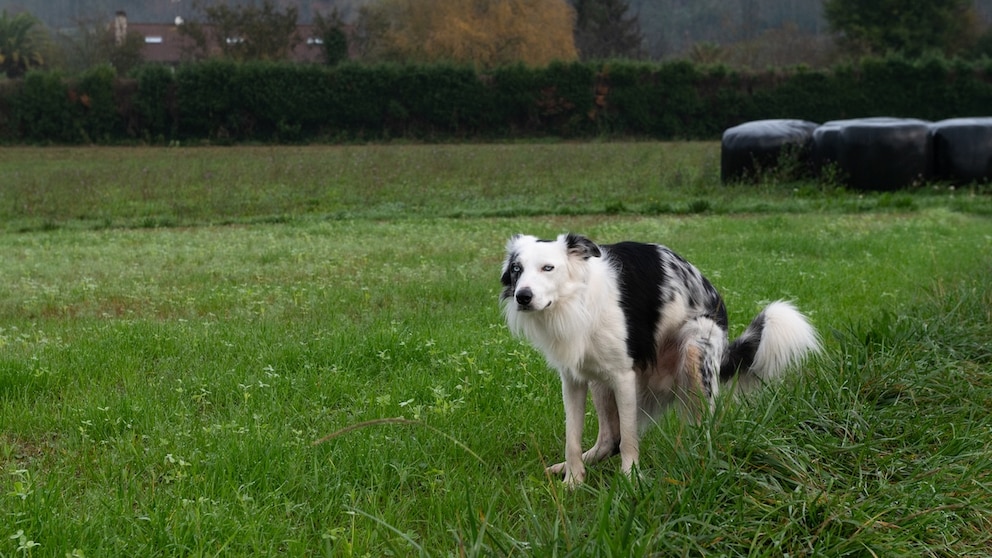
Why do dogs stare at us so intently when they do their business? Many owners know this moment: The dog squats or lifts its leg—and the gaze goes directly to their human. There’s usually less drama behind it than some might think. What body language has to do with it—and why staring back isn’t a good idea—is explained by dog trainer Katharina Marioth.
Body Language Is Key
“First of all, if owners notice this—compliments,” says dog trainer Katharina Marioth. Because those who notice such details are observing their dog closely. And that’s important, as the gaze can mean different things. Especially when marking, you need to look more closely.
Body language is crucial: If the dog stares, pushes its neck forward, and appears overall stiff, it can indeed be a territorial gesture. Then it’s less about the human and more about sending a clear message to other dogs.
Gaze to Maintain Communication
More often, the gaze simply serves communication. Many owners continue walking or move a bit away while the dog relieves itself. “The dog is trying to maintain communication, so to speak—as if to say: Wait a moment, I’ll be done soon,” explains Marioth.
The “type of dog” also plays a role. Territorial animals prefer to mark on elevated surfaces, on stones, walls, or prominent intersections. This applies to both males and females. “The higher the mark, the more important the message,” says the trainer.
Should I Stare Back?
And how should you react when the dog fixes its gaze on you? Staring back is not a good idea. It tends to unsettle many dogs and has “no status significance,” emphasizes Marioth. Internet myths that you need to return the gaze forcefully can be safely ignored. It’s better to turn sideways to the dog in a friendly manner and wait calmly.
At the latest, when picking up the poop, you’ll have a look at the result anyway, which is quite useful, as the consistency says a lot about the health condition. But you don’t need to “watch the dog to death” while doing so.
Exception for Puppies
Marioth sees an exception with puppies. They are just learning that they should relieve themselves outside—and not in the apartment. In such moments, the gaze can indeed be a kind of reassurance: “Look, I’m doing it outside—do I get my reward now?”
The difference is clearly visible in the expression. While territorial behavior is accompanied by a rigid, stiff gaze, the look in puppies is more friendly and expectant.
Is the Dog Seeking Protection When It Looks at Me?
The theory persists that dogs feel particularly vulnerable when defecating or urinating and therefore seek eye contact, as if to say: “Are you there? Are you watching?” According to Marioth, this can be true in individual cases—for example, with very insecure dogs. These indeed retreat more often into bushes or seek sheltered places.
Nevertheless, this assumption should not be overestimated. A dog is always able to interrupt its business if it feels threatened. Frantic looking around or demonstrative “watching” by the owner only increases the insecurity. Instead, the trainer recommends calmer walking routes so that sensitive dogs generally learn that nothing threatens them. Overall, she categorizes the vulnerability theory more in the realm of “myth.”

Why Your Dog Suddenly Stares at You
Why Sneaking Up on Dogs Is Dangerous
Can I Keep Walking While the Dog Does Its Business?
The question remains about the right distance: Do you have to stand right next to them? It depends on what you mean by proximity, says Marioth. On a two- or three-meter leash, the dog can calmly use the radius. When urinating, you can also keep walking, as it’s usually done quickly.
With defecating, she sees it differently—not least out of consideration for other walkers. “It needs to be picked up, and then I stay nearby,” says the dog trainer. In general, she is not a fan of leaving the dog completely out of communication: “We are out together.”
Conclusion: The Gaze During Business Is Not a Cry for Help
In summary, when dogs look at us during their business, it’s mostly about communication—not a cry for help. Body language is key. Those who remain calm, don’t stare, and convey security to their dog through composure are generally doing everything right.

About the Expert
Katharina Marioth is the founder of the Stadthundetraining brand and the KEML principle. She is an IHK- and government-certified dog trainer and behavioral assessor for dangerous dogs in the state of Berlin. In her daily business, she works closely with veterinarians, scientists, and other specialists on dog-related topics. With her knowledge and skills, she secured the title of Dog Trainer of the Year 2023 in the Sat.1 show “The Dog Trainer Champion.”