

July 8, 2026, 3:09 pm | Read time: 6 minutes
Does your dog suddenly turn its back on you on the sofa or prefer to lie in the doorway? Many owners misinterpret this behavior. Dog trainer Katharina Marioth explains why both are usually signs of trust or alertness.
More Than Just a Sitting Position
This is one of those observations that many dog owners bring to me with uncertainty: The dog lies relaxed next to you on the couch and then suddenly turns around, sitting with its back to you. Or it positions itself in the middle of the hallway, right in the doorway, looking out while the family sits in the living room. Many people initially interpret this as rejection.
Does it turn away from me because I’m unpleasant? I can reassure you: The interpretation as “rejection” is almost always wrong. In fact, it is usually the opposite—an expression of trust and, depending on the situation, a deeply rooted protective instinct. To understand this, it’s worth looking at two different scenarios that at first glance seem similar but have entirely different causes:
1. The Dog Turns Its Back to You on the Couch
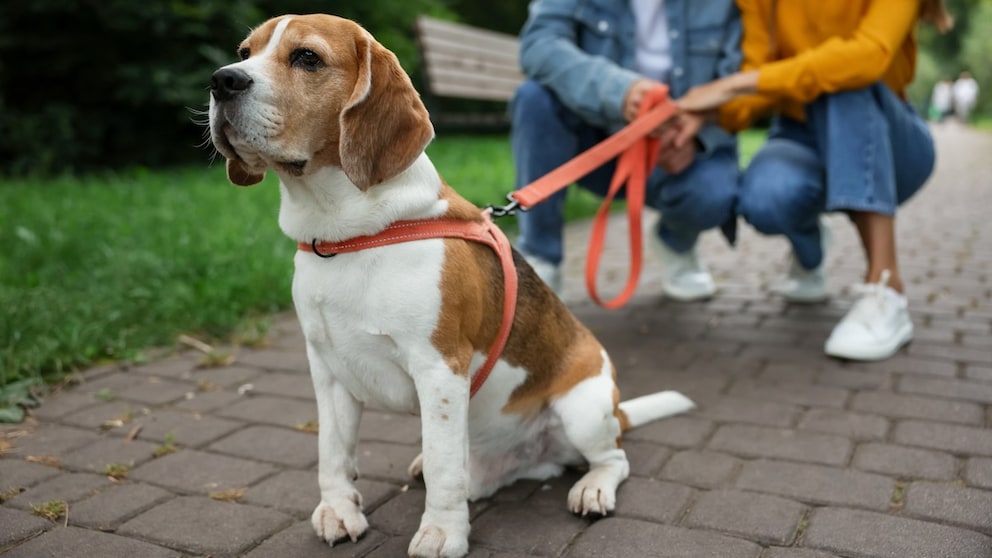
If your dog curls up or sits next to you and turns its back to you, this is in most cases a sign of deep trust. The back and especially the neck are among the most vulnerable parts of a dog’s body. An animal that turns this area toward another being signals: I feel so safe here that I don’t need to monitor my most sensitive zone. Among dogs, this is a well-known gesture in social interactions, such as when resting together in a pack. When a dog transfers this behavior to a human, it literally places them in its closest circle of trust.
There is a second, complementary explanation that often applies simultaneously: the watch aspect. If the dog sits with its back to you and its face toward the room, door, or window, it keeps an eye on what is happening around you both while maintaining contact with you through body warmth and proximity. It combines closeness and control over the environment—from its perspective, the perfect position to be both relaxed and alert. This is also why many dogs prefer this position in retreat spots like the sofa, where they already have an elevated view.
2. The Dog Sits “on Watch” in the Doorway
The situation is somewhat different when the dog is not in immediate physical proximity to you but deliberately takes a position in the doorway, on the landing, or at the entrance to a room—looking outside or toward the front door.
This behavior has less to do with the relationship to a single person and more with the need to keep an eye on the family as a group and to detect potential changes from outside early on. You can think of it as a kind of self-appointed sentry duty. The dog positions itself at a strategically advantageous point from which it can watch both its people behind it and the access from outside.
This behavior is more pronounced in certain breed groups than in others. Herding and guard dogs, for example, whose ancestors were bred over generations for precisely this task—guarding the house, yard, or herd—often display this watch behavior naturally, even without training. But mixed-breed dogs or breeds without a pronounced guarding role can also exhibit this pattern if they are naturally more alert or cautious.
Alertness Is Not the Same as Nervousness
At this point, an important distinction is often overlooked in guides: A dog that occasionally sits at the door to observe, lying relaxed, occasionally blinking, keeping its jaw loose, and easily redirected when you call it, is showing normal, unremarkable behavior.
It only becomes an issue when the occasional watch position turns into a permanent, tense state. That means if the dog hardly ever relaxes, jumps at every noise, barks or growls persistently when something moves outside, or can’t be called away from the door. Then it is no longer relaxed attention but constant tension or even fear. This is a signal to take a closer look, possibly with professional support.
Observe not just the position but the body tension. An alert but relaxed dog has a soft body, a hanging or neutral tail, and normal ear position. A stressed watchdog, on the other hand, appears tense, with a high and stiff tail, ears pointed forward, and a fixed gaze. This difference tells you more about your dog’s emotional state than the mere sitting position.

What Rabbit Ear Positions Mean

Why Your Dog Suddenly Stares at You
What This Means for Your Daily Life
For most dog owners, there is no need for action here—quite the opposite. If your dog turns its back to you on the couch trustingly, you can safely take it as a compliment. You don’t need to constantly turn it toward you or actively demand eye contact; doing so would signal that its chosen behavior was wrong, even though it isn’t.
It’s different if you notice that the watch position at the door develops into a tense permanent state. In this case, it often helps to offer the dog an alternative but equally attractive resting place, such as a basket from which it still has some overview but is further from potential stimuli like the front door. Also, deliberate activity before rest periods, such as a long walk or sniffing games, can help reduce general tension, making it easier for the dog to truly relax instead of patrolling.
It’s also important how you react to your dog’s possible “alerts.” If it barks briefly when someone passes by outside and you respond enthusiastically or become hectic, you reinforce the feeling that there is indeed danger. Calm, factual reactions—a brief “Thanks, it’s handled” in a calm tone, followed by a distraction—convey to your dog that the situation is under control and it doesn’t need to worry further.
Why Don’t All Dogs React the Same?
I often receive questions in consultations about why one dog in the family constantly sits at the door while the second dog in the same household takes no notice at all. This often has less to do with upbringing and more with individual disposition and role within the dog group. In multi-dog households, I often observe a kind of informal division of labor: One dog takes on the watch task, while the other focuses entirely on closeness and cuddling. This is not a conscious agreement among the animals but usually results from character, age, and experience.
Age also plays a role. Young dogs often still orient themselves strongly to adult dogs in the household in unfamiliar situations and adopt their behavior, while very young or very old dogs generally show less watch behavior because they either lack the experience or the energy for it.