


September 15, 2025, 9:54 am | Read time: 4 minutes
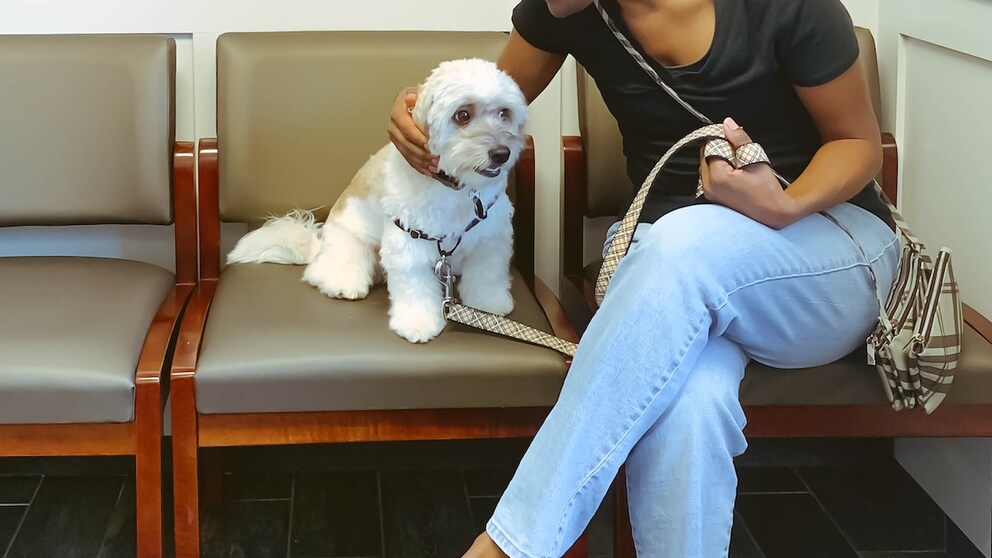
Many dogs initially go to the vet’s office without any issues. But a single negative experience can be enough to trigger fear or even trauma. Editorial dog Yumi used to enjoy going to the vet, but after having a burr removed from her ear, she now refuses to enter the office at all. Editor Saskia Schneider asked dog trainer Katharina Marioth how to address a dog’s fear of the veterinarian.
For all dog owners facing the same issue: It’s completely normal for a dog to be afraid of the vet, explains Marioth. “Many dog owners know this. The first visits are unproblematic, but a particularly unpleasant experience sticks. The dog remembers: That was bad, I’m not going back there.”
Situations where the dog is restrained and experiences pain can have a lasting impact. However, the expert emphasizes that much can be done to ensure the dog no longer perceives the vet visit as a threat but cooperates because it knows: “It will be briefly unpleasant, but nothing bad will happen afterward.”
Creating Positive Associations
The first step is to associate the vet’s office with positive experiences again. Marioth advises visiting regularly without treatment after a negative experience: go to the waiting room, give a treat, and leave immediately. This way, the environment is linked to something positive.
Training for the examination table can also help if dogs are afraid of the vet. “Many dogs hate the smooth metal surface,” she explains. “A non-slip mat provides stability. At home, you can practice placing the dog on an elevated surface, rewarding it, and then taking it down again.”
Medical Training for Everyday Life
The trainer is particularly passionate about what’s called Medical Training. In this, the dog learns a cooperation signal—such as placing its chin in your hand and holding still. “Manipulations can be practiced step by step, initially playfully at home, later at the vet,” says Marioth. This is not only helpful for veterinary examinations but also for everyday care, such as for dog breeds that require regular ear or wrinkle cleaning.
However, it should be practiced regularly: “Once a week is completely sufficient,” emphasizes Marioth. It’s important that it is fun and adapted to the dog’s daily condition. Additionally, the training can be made more realistic by incorporating sounds like the spraying of disinfectant or light manipulations. This creates routine for real situations.
Also interesting: Why Dogs Pull on the Leash and What Really Helps
Painful Procedures Are Inevitable
Painful experiences at the vet cannot be completely avoided. A vaccination, for example, can sting and press. “But that doesn’t undo the training,” reassures Marioth. It’s crucial to immediately follow up with a positive experience—such as a special treat or a short training session. This quickly overwrites the negative experience, and the fear of the vet can diminish over time.

Dog Trainer Reveals: “I Would Immediately Decline These 5 Jobs”

People Who Are Barked at Most Often Revealed by a Trainer
Comfort—Yes or No?
There’s often disagreement about whether dogs should be comforted after a painful treatment. Marioth is clearly in favor: “Timing is crucial.” It’s best to coordinate with the vet and distract the dog at the exact moment of the injection—with a treat or a small sound. Afterward, the dog should definitely be celebrated and praised so that it stores the situation positively. Only in cases of aggressive behavior should a trainer be brought in to work on it specifically.
Conclusion
A traumatic vet visit is a reality for many dogs, but it doesn’t have to become a permanent problem. With targeted training, positive reinforcement, and proper preparation, owners can do a lot to relieve their pet’s stress. “In the end, it’s about the dog developing trust despite unpleasant moments—in its human, in the process, and in the situation,” summarizes Marioth.

About the Expert
Katharina Marioth is the founder of the brand Stadthundetraining and the KEML principle. She is an IHK- and government-certified dog trainer and behavioral assessor for dangerous dogs in the state of Berlin. In her daily business, she works closely with veterinarians, scientists, and other specialists on dog-related topics. With her knowledge and skills, she secured the title of Dog Trainer of the Year 2023 in the Sat.1 show “The Dog Trainer Champion.”