


March 20, 2026, 8:58 am | Read time: 3 minutes
Many dog owners are frustrated by their dogs pulling on the leash. Dog trainer Katharina Marioth explains why pulling is not a sign of disrespect, the role humans play, and why there is no one-size-fits-all solution for good leash training.
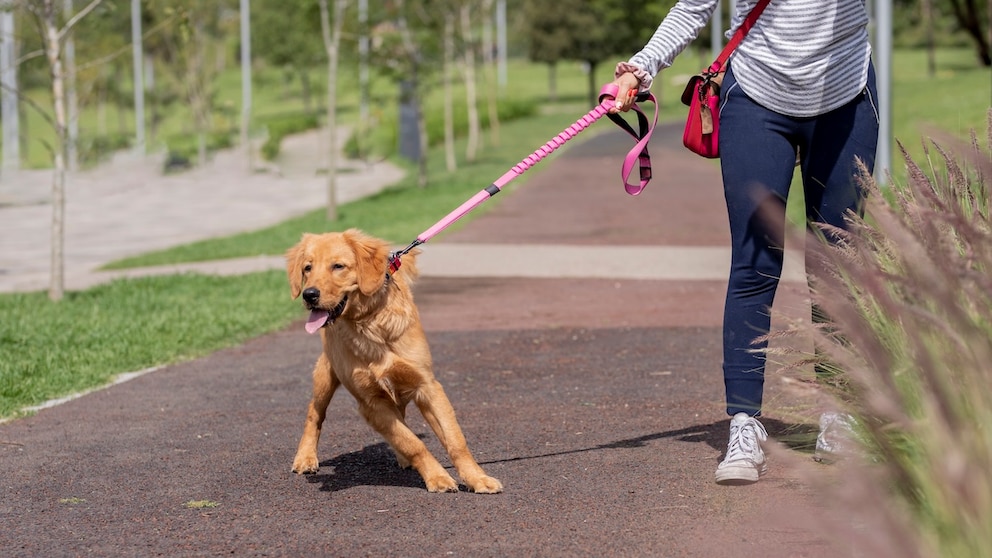
Leash training is one of the biggest challenges in everyday life with a dog. Almost every owner knows the problem when their dog pulls during a walk. “The most common misunderstanding is the question of why,” says dog trainer Katharina Marioth. Many assume a dog pulls because it is “naughty.” In reality, the dog has learned that pulling works: “It gets them to the sniffing spot, the other dog, or the interesting person faster.” Pulling is simply a learned behavior.
“Leash Training Requires Time, Consistency, and Good Reward Points”
But it’s not just the dog; humans also significantly influence the behavior. Many owners unconsciously give in by extending their arm. This alone teaches the dog that pulling is worthwhile. “Leash training requires time, consistency, and good reward points,” Marioth emphasizes. Additionally, the dog must first understand where its “dance area” is next to the human.
According to the trainer, there is no universal method for all dogs. It depends on the interaction between the animal, the human, and the environment. A very fast dog needs a correspondingly quick-reacting owner, while dogs with slower learning abilities benefit mainly from consistency. For anxious rescue dogs, it is initially important to build trust and security. “Leash training is not a question of respect or status,” Marioth clarifies. “For dogs, it is simply unnatural to walk slowly and controlled next to us—we must teach them fairly.”

Your Dog Doesn’t Come When Called? Here’s What You Might Be Doing Wrong

Dog Trainer Reveals: “I Would Definitely Turn Down These 5 Jobs”
Retractable Leashes Not Recommended
She also dismisses the common belief that pulling on the leash is a sign of a lack of bond. A dog that wants to chase a squirrel is not less bonded to its owner—the animal is simply more interesting at that moment. Additionally, the length of the leash plays a significant role: If you let your dog run on a long retractable leash, you cannot expect it to suddenly walk calmly on a 1.5-meter leash.
Marioth is particularly critical of these retractable leashes. They encourage pulling because there is always a basic tension on the leash. Additionally, the sudden locking often results in an unpleasant jerk for the dog. They are only useful if the dog has learned to stay within its range and reliably respond to stop signals. Then they can be a safe addition, for example, when hiking.
3 Tips for Better Leash Training with Your Dog
- Stay consistent
Even small exceptions shape the dog. If you give in once, it learns immediately: Pulling is worthwhile. - Train individually
Every dog is different—speed, motivation, and learning behavior determine the appropriate method. - Use positive reinforcement
Calm walking next to the human should always be rewarded, such as with treats or praise.

About the Expert
Katharina Marioth is the founder of the brand Stadthundetraining and the KEML principle. She is an IHK- and government-certified dog trainer and behavioral assessor for dangerous dogs in the state of Berlin. In her daily work, she collaborates closely with veterinarians, scientists, and other specialists on dog-related topics. With her knowledge and skills, she secured the title of Dog Trainer of the Year 2023 on the Sat.1 show “The Dog Trainer Champion.”