

September 14, 2026, 11:06 am | Read time: 7 minutes
“Sit,” “Stay,” and “Come” are considered essential commands for a well-trained dog by many. But are these really the commands that matter most in everyday life? After all, perfect obedience is of little use if the dog doesn’t pay attention to its owner while out and about or can’t be calmed down. Dog trainers André Vogt and Katharina Schlegl-Kofler explain what dogs should actually master and how owners can train the most important basics.
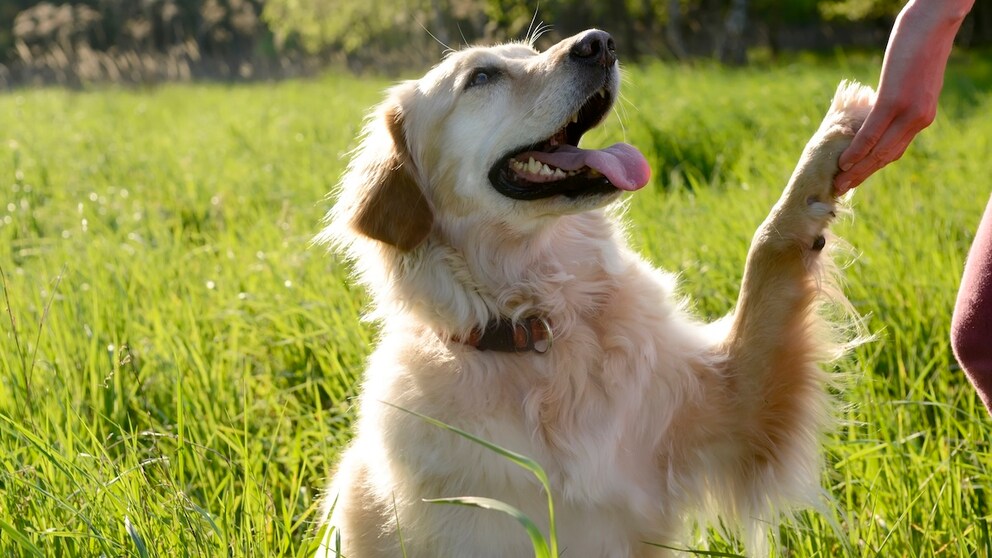
Recall is one of the most important basic commands for dogs
“Most owners today primarily want their dogs to listen to them and integrate calmly into everyday life,” says dog trainer Katharina Schlegl-Kofler. But what sounds so easy and natural actually requires work and patience.
Two things are most important to her: that the dog reliably comes when called and that it naturally stays close to its owner while out. “After all, it’s no use if I can call him back well, he gets his treat, and then he’s off again,” she says.
Control and calmness–without force
Dog trainer André Vogt also understands dog training as “something completely different from the classic sit, stay, and down.” Andreas Ohligschläger shares this view, revealing in an interview with PETBOOK that his dogs don’t even know these commands.
“For me, a well-trained dog is one that I can control in any situation–without force,” adds André Vogt. How can this be achieved? For him, the path leads through relationship and communication. The dog must not only find me interesting but also trust me. That takes time.
“I know people who are highly motivated, and their puppy can do all the commands at five months. But none of them properly. And he’s totally hyper, nervous, and can’t concentrate well,” warns Vogt. One of the biggest mistakes dog owners make is not giving their dogs the calm and relaxation they desperately need.
No basic commands for dogs without positive reinforcement
But how do you get the desired eye contact as a good start to training and the necessary attention? For example, by hand-feeding the entire meal, especially at the beginning. This means feeding the dog during walks and using the food as a reward for positive behaviors.
So I can simply wait until he turns to me by chance. “Then I immediately adopt an inviting body posture and reward him,” explains Vogt. This lays important foundations for future walks: “I can then get him to pay more attention to me and, for example, look to me in situations where he encounters other dogs and check in first.”
Bonding walks to help the dog orient to the owner
For Katharina Schlegl-Kofler, so-called bonding walks are essential, especially at the beginning. In unfamiliar terrain, she says, puppies naturally try to stay close to their owners due to their instinct to follow. “I walk at a pace that he can keep up with–not one that makes him race.”
In between, you change direction repeatedly. Practicing for a few minutes daily is enough. “If I do this regularly, he learns to check where I am on his own.” Bonding walks are mainly done with puppies and continue into adolescence.
You adjust to the dog’s age. Start with a few minutes–initially only in a manageable area. Later, you might go into a light forest and extend the duration appropriately: about ten minutes at four months. Once the dog masters this, you move on to reinforcing what has been learned in a group. How these “social walks” work is explained by dog trainer Jochen Bendel in the PETBOOK Dog School.
“Sit” as a classic starting point
But the dog trainer actually starts with the classic “sit” quite quickly–parallel to bonding walks and recall training. This also succeeds through positive motivation: by holding a treat in a closed hand above his head and only giving it to him when he sits and looks up.
In the next stage, I then introduce the verbal cue “sit” when he sits voluntarily–only then does he get the treat. “Otherwise, it would be bribery, not a reward.” And you should never say “sit” while he’s still jumping around–only at the moment when he actually sits.
Once “sit” is mastered, you can move on to “down.” The principle is the same–only that I initially place the treat under the palm and wait until he lies down on his own.
Also interesting: Trainer reveals the most unnecessary command for dogs
Some dogs need a “stay” before other basic commands
The “stay” exercise is a point of contention. Because once “sit” and “down” are mastered, a dog can remember these commands for several hours. An extra command to stay in this position is therefore not very useful–if you have trained a release signal for “sit” and “down.” However, there are also dogs that first need to learn to calm down and stay in place before training “sit” and “down.”
If you want to use “stay,” you should build it up in small steps. It only makes sense to train this when the dog can sit quietly next to the owner for at least half a minute. Then stand in front of the dog with the command “stay” for a few moments, so he isn’t tempted to follow his owner. “Wait two or three seconds and then return,” advises Katharina Schlegl-Kofler. Gradually extend the time first, then move a few centimeters further away.
And the most important thing: Never walk away backward or hastily and then call the dog from a distance, but always return to him at the starting position. “Otherwise, I’ll have a dog waiting excitedly like on a launch pad, ready to take off.”
In general, the rule in training is: quality over quantity. “Better to practice a little less than half-heartedly. Then it certainly won’t work later when it counts,” says the dog trainer.

Basic Commands Every Dog Should Know

Elvis Goes Wild on the Leash! How TV Dog Trainer André Vogt Helped Us
How to achieve the perfect recall
Calm, relaxed, and consistent: Body language is also important. “The more relaxed I approach the matter, the quicker I achieve success,” says André Vogt. He advises dog owners to practice the perfect recall with their dogs, which should work almost reflexively.
He prefers to work with a whistle: When the dog turns around after the command, you run off and have something super exciting ready–either a great treat like cheese or sausage pieces or a special toy.
When the dog comes within two meters, you throw the object of desire forward like skipping a stone across water. “This triggers the hunting behavior, the dog retrieves the reward. And it’s controlled and initiated by me,” says the dog expert. If you practice this repeatedly, it works for a dog’s lifetime.
For basic commands in dogs, you need orientation and stability
Of course, you don’t always have to carry sausage in your pocket. “The only thing I need later is the whistle to make him come,” says Vogt. This doesn’t mean you can’t occasionally reward your dog with special treats for coming quickly.
Dog trainer Katharina Marioth has developed a different method to practice recall with dogs. For her, recall must be something pleasant for the dog, but instead of a whistle, she prefers to use a long leash.
It’s important for dog owners to be reliable, providing the dog with orientation and stability. And also to be confident when it comes to setting boundaries or correcting wrong behavior. “The main thing is not to humanize the dogs,” says Vogt. What he means by this and why it’s a major issue for him is revealed in the PETBOOK interview.
“They may find some rules or boundaries annoying, but if they see that we take responsibility, they can relax more easily.” Because ultimately, that’s what leads to dogs having a good life.
With material from dpa