

November 7, 2025, 5:13 am | Read time: 5 minutes
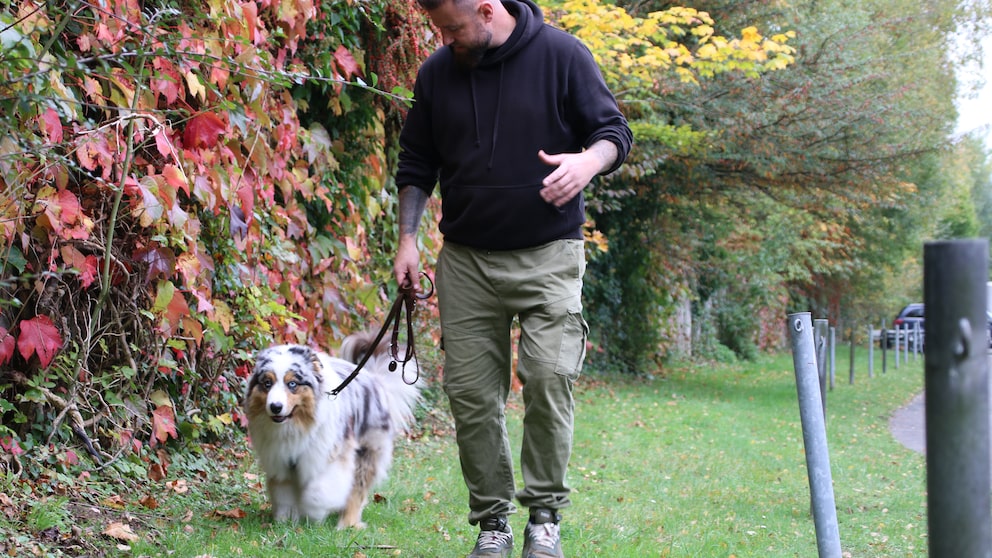
PETBOOK author Manuela Lieflaender is generally very satisfied with her two-year-old Australian Shepherd. However, with her partner, Volker, Elvis regularly loses control during on-leash encounters with other dogs. Volker would prefer not to walk the dog at all. His idea: training with TV dog trainer André Vogt. Can the professional help the couple?
Imagine having a dog that wants to approach every other dog—with full enthusiasm. One that barks on the leash and is hard to control. Then TV dog trainer André Vogt tells you, “I guarantee you, if you train now, you decide whether your dog makes contact with other dogs or not. You can let him off the leash and still have control during every dog encounter.” Sounds like a dream, right? For us, that was the moment we decided to tackle Elvis’s behavior anew.
When Your Own Dog Becomes a Challenge
Elvis, our two-year-old Australian Shepherd, is a typical representative of his breed: attentive, intelligent, sensitive—and mostly “on fire.” On walks, he wants to approach every dog. With me, he has learned an alternative behavior. I taught him to walk by my side instead.
For this correct behavior, he gets to take food from my hand. A training method I developed 15 years ago during my dog trainer training. It works for Elvis and me. For Volker, however, it’s not a solution. He doesn’t want “food training” or embarrassing scenes when Elvis rears up on two legs on the leash.
In Search of a Real Solution
Volker knew André Vogt from his TV shows and online courses. He liked his calm manner and the idea that good leadership has nothing to do with harshness but a lot with clarity. So we made an appointment. Vogt’s philosophy initially sounded simple: trust, acceptance, and relationship are the foundation of every human-dog relationship. But in practice, it meant working on one’s body language and inner attitude.
The Foundation: Body Language Instead of Commands
The training didn’t start outside in the hustle and bustle with other dogs, but in the quiet training room—with a piece of cheese. André’s credo: We build the foundation first.
The Basic Exercise:
André crouched down, holding a piece of cheese in his hand. When Elvis tried to grab it, he closed his hand, leaned his upper body slightly forward—a gesture that claims space—and said a clear, energetic “Hey” as a distraction.
The dog learns: The human claims this space and this object for themselves.
The Next Level: Space Management
Once the first exercise was successful and Elvis no longer went for the piece of cheese, André placed an entire pack of cheese on the floor. Volker was to approach it with Elvis, then just before Elvis could grab the pack, lean his upper body toward the dog and say “Hey”–if necessary, supplemented by a light tap on the shoulder.
The Key: We had to learn to pay attention to Elvis’s subtle signals (ears back, licking his lips). This feedback showed us: He got the message! The leash was only for safety. The actual communication was through our body language.
Dog Owner: “How We Were Misled by a ‘Firework-Free’ Vacation Park”

Basic Commands Every Dog Should Know
From the Cheese Pack to the Dog Visit
Once the first foundation was set, the most fascinating part followed. Elvis was to stay on a dog bed without a command. The rule: As soon as even one paw touched the floor, I had to react.
I was to sit relaxed on a chair, only standing up if necessary, leaning forward, and using body language to send Elvis back to his place. The bed was his space, the rest was off-limits.
Then came the ultimate distraction: another dog entered the room. Eva came in with the bulldog Arielle. She played, rustled with food, and walked close to Elvis. And Elvis? He whimpered briefly but stayed in his place. Only a few minimal corrections were needed. Even when a large male dog entered the room and moved freely, Elvis sat and watched curiously.
We were speechless. Elvis accepted that I claimed the space—and that included the other dog. He didn’t need to go to him because he received clear leadership and boundaries from me.
Training with André Vogt—What We Learned
With his approach, André Vogt showed us that training isn’t about masking a problem with food but solving it at its core. Now it’s time to continue working on the foundation at home.
In the coming weeks, the focus of home training will be to understand Elvis even better. “Who moves whom?” is a guiding principle we will keep in mind. Our task is to determine how much body language and energy are necessary for us to claim special treats at a distance. Because that’s the precursor to dog encounters.
At the moment, we’re not yet at the point where dog encounters on narrow paths work without food. In pedestrian zones with many dog encounters, however, my progress is greater. In two weeks, the next training session with André Vogt will take place. Will we really manage to let Elvis off the leash without him making contact with other dogs?