

September 9, 2025, 3:43 am | Read time: 5 minutes
The Westerwald Cattle Dog is considered the last bastion of old German herding dogs, specifically bred for working with cattle. It carries on an ancient tradition dating back to the 15th century. However, with its disappearance, the knowledge of the art of using herding dogs with cattle is also at risk of fading. What makes this robust, intelligent dog so special?
Origin
The Westerwald Cattle Dog originates from the Westerwald and Siegerland regions in western Germany. As early as 1465, this type of dog was mentioned in the “Nassau’sche Weisthum,” a collection of regional legal customs, as a guardian of cattle herds—a testament to its centuries-long significance in agricultural pasture management.
Unlike many other breeds, the Cattle Dog did not arise from selective breeding for beauty but from choosing the most capable animals for practical use in livestock farming. Its task was to safely guide cattle herds through the dense oak forests of Siegerland or across the fields of Westerwald—often without direct commands, relying instead on initiative, courage, and assertiveness.
Until the second half of the 20th century, the Cattle Dog was an integral part of agricultural work in its home region. Today, its population has significantly declined, prompting the Working Group for the Breeding of Old German Herding Dogs (AAH) and the Association for the Promotion of the Westerwald and Siegerland Cattle Dog (FWSK) to work for its preservation. The Society for the Conservation of Old and Endangered Livestock Breeds (GEH) lists it as “extremely endangered” on their Red List.
Appearance & Coat
The Westerwald Cattle Dog has a robust, nearly square body with a muscular build that combines agility and endurance—ideal traits for working in the field. The height at the withers ranges from 45 to 55 cm, and the weight is functional—neither too heavy nor too light.
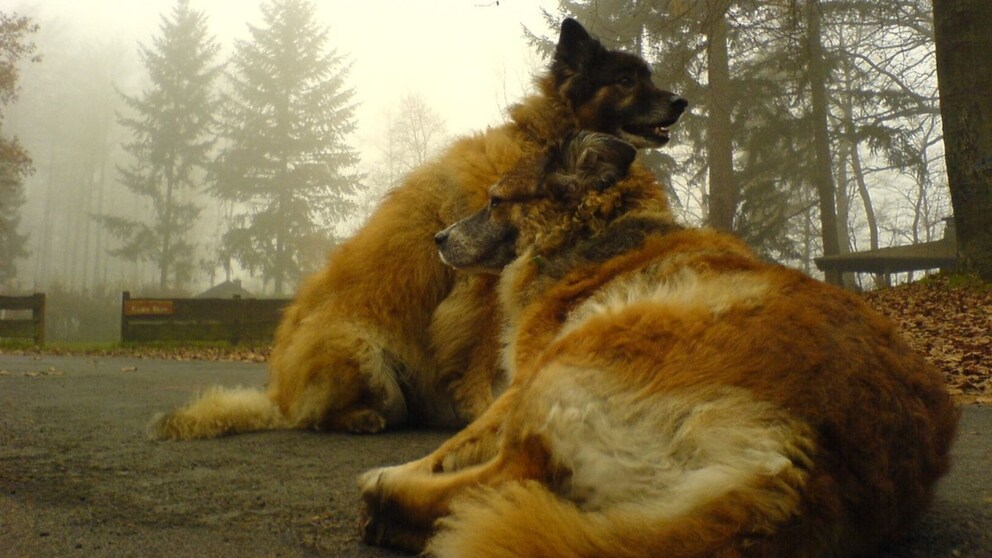
Its coat is long-haired, often slightly wavy, with a dense undercoat that reliably protects it from wind and weather. Particularly striking are the “feathering” on the forelegs and the “trousers” on the hind legs. The tail is long, densely haired, and usually carried slightly curved.
Color variations are diverse: from sandy to wheat-colored to reddish-brown, sometimes with darker hair tips (“sooty”), occasionally with a dark mask or white markings on the head, neck, chest, and legs. Natural stump tails—dogs with naturally short tails—also occur. The ears are usually tipped, less often erect or hanging. The compact head with a moderate stop completes the typical appearance.
Character & Temperament
The Westerwald Cattle Dog is characterized by a pronounced herding instinct and high working intelligence. As a working dog, it is assertive, resilient, and mentally stable—qualities essential for working with cattle.
According to the AAH, the Cattle Dog is precocious, enduring, frugal, and loyal and devoted to its human. Its independence can lead it to work without explicit commands—requiring trust and clear structures in daily life.
In a family setting, it is loyal but not a typical companion dog. It needs tasks, exercise, and mental stimulation. With appropriate leadership, it can integrate well into a family with experience and time.
Training
Training the Westerwald Cattle Dog requires clear leadership, consistency, and understanding of its breed-specific needs. Its independence and intelligence demand experienced hands that maintain a loving but firm approach.
Due to its natural herding behavior, early socialization is crucial, especially in dealing with children, other animals, and everyday situations. Consistent rules, structure, and joint activities promote bonding and obedience.
With proper guidance, the Cattle Dog is highly willing to learn and cooperative. Traditional training methods with positive reinforcement generally yield good results.
Proper Care & Maintenance
The Westerwald Cattle Dog is not a typical apartment dog. It needs plenty of exercise, mental engagement, and ideally a task—whether in herding, dog sports, or daily running training.
Its ideal environment is rural, with access to ample space for movement. It can also channel its energy effectively as a riding companion dog or in canicross. If not actively employed, it requires regular, intensive engagement to prevent behavioral issues.
Coat care is generally straightforward: regular brushing is sufficient, especially during shedding. Thanks to its robust coat, it is weather-resistant and low-maintenance.
Nutrition
As a high-performance working dog, the Westerwald Cattle Dog has a correspondingly high energy requirement. High-quality food with a balanced ratio of animal protein, fat, and complex carbohydrates is essential for its health and performance.
The amount of food should be adjusted to the activity level and weight. Overfeeding can lead to obesity, while underfeeding can cause performance drops or coat problems.
Fresh drinking water, regular feeding times, and occasional supplements with high-quality oils or minerals can further support well-being.
The Australian Cattle Dog is Ideal for Active Owners
The Australian Stumpy Tail Cattle Dog is Best Suited for Experienced Handlers
Susceptibility to Certain Diseases
The Westerwald Cattle Dog is considered a robust and resilient breed. Due to functional working breeding over centuries, it has largely remained free from overbreeding and typical hereditary diseases.
However, due to the significantly reduced gene pool, there is an increased risk of inbreeding issues if not actively countered. The AAH and the FWSK, therefore, strictly monitor breeding lines and document all breeding animals.
Regular veterinary check-ups, appropriate care, and a healthy diet form the basis for preventing potential health problems.
The Westerwald Cattle Dog at a Glance
- Size: 45–55 cm at the withers
- Weight: functional, not standardized
- Coat: Long-haired, weather-resistant, low-maintenance
- Character: Independent, enduring, leadership-oriented, eager to work
- Special Feature: Rare dog breed