

August 21, 2025, 4:13 am | Read time: 4 minutes
Anyone who has seen the New Zealand Huntaway at work won’t forget it: With powerful barking and impressive stamina, it drives large flocks of sheep or cattle over vast, sometimes rugged terrain. This rare breed from New Zealand is a pure work specialist—bred for performance, not appearance. No FCI standard, no beauty ideals, just pure functionality. But what makes this versatile canine so special beyond its work?
Origin
The New Zealand Huntaway was developed in the early 20th century in New Zealand to meet the increasing demands of sheep and cattle farming. The vast, wet pastures and large herds were challenging for traditional herding dogs like the Border Collie. Farmers needed a dog that could direct animals from a distance with loud, deep barking and tremendous endurance.
Its development likely involved crossing various breeds—including Border Collie, Bearded Collie, Labrador Retriever, Rottweiler, Harrier, Gordon Setter, and Smithfield Collie. The goal was a strong, weather-resistant working dog that wouldn’t shy away from physical contact with livestock and could easily handle long workdays. Selection focused solely on work performance, not looks. It wasn’t until 2013 that the Huntaway was officially recognized by the New Zealand Kennel Club as the country’s first national breed. Internationally, such as with the FCI or AKC, it remains unrecognized. Outside New Zealand, the breed is rare and found almost exclusively on specialized farms in Europe.
Appearance & Coat
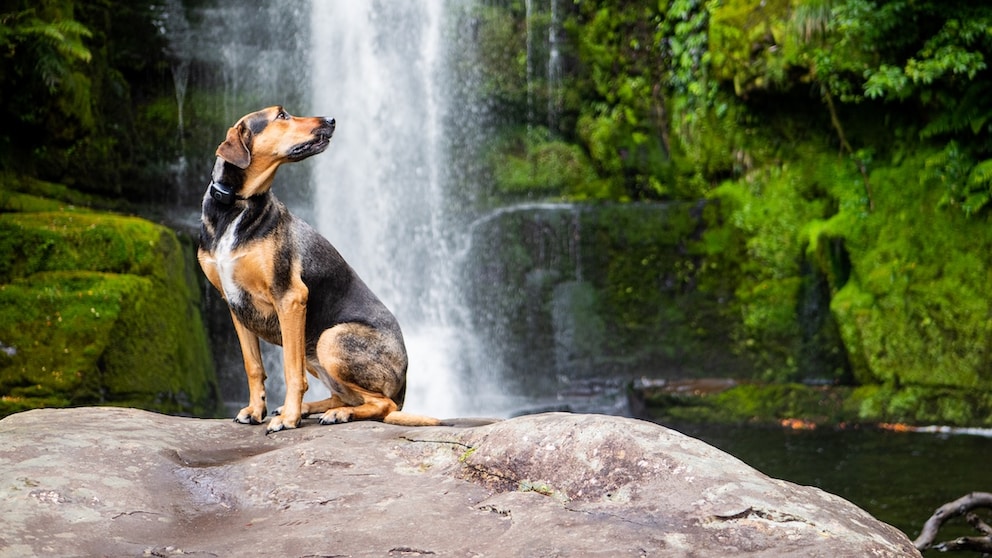
The Huntaway is medium to large, robustly built, and muscular, with a deep chest and strong hindquarters. Males reach about 24–26 inches in shoulder height and weigh 66–88 pounds, while females are 22–24 inches and weigh 55–77 pounds. Its head is moderately broad with a flat skull, strong jaw, and dark, almond-shaped eyes. The ears hang halfway down, often in a folded shape.
The coat varies greatly: from short to medium-length to rough, with or without an undercoat. Most common is short, dense stock hair that protects against wind and weather. Black with tan markings, tricolor combinations with white and beige, or brindle patterns are predominant. Since there is no international standard, visual differences between individual lines are noticeable. However, all share a functional, athletic appearance optimized for endurance, strength, and weather resistance.
Character & Temperament
The Huntaway is an energetic, enduring, and work-loving dog with high intelligence. It is considered leader-oriented, loyal, and reliable, yet also shows pronounced independence—necessary to manage herds without direct instructions. Its strong tendency to bark is typical: While other herding dogs often work silently, the Huntaway drives with loud barking. It is generally friendly, social, and good with children, provided it is adequately exercised. It usually gets along well with other dogs or pets. Understimulation can easily lead to frustration and problematic behavior.
Training
Training a Huntaway requires consistency, patience, and experience with working dogs. Early socialization is as important as learning to take breaks—since this dog naturally works “at full throttle.”
Key commands in herding work often include “Speak up” (bark) and “Quiet” (stop signal). It is only suitable as a companion dog if it is still physically and mentally challenged. In an agricultural setting, training is usually easier, as the dog can follow its calling.
Proper Care & Maintenance
The Huntaway needs plenty of space and exercise. Ideally, it should live in the countryside, preferably on a farm with livestock. Daily long work sessions or intensive training are mandatory. City or apartment living is unsuitable.
Coat care depends on the hair type: Short-haired variants require little effort, while long-haired ones should be brushed more frequently. During shedding season, daily brushing is advisable. Hanging ears should be regularly checked and cleaned to prevent infections.
Nutrition
As an active working dog, the Huntaway requires a high-energy, protein-rich diet with a high-quality meat content. The amount of food depends on workload and body weight. Consistent feeding in two to three portions per day prevents stomach issues. Fresh water must always be available.
Smooth Collie: This Herding Dog Is Also Suitable for Beginners
Why the Boykin Spaniel Excels as an Eager-to-Learn Family Dog
Susceptibility to Certain Diseases
Despite its robust constitution, the Huntaway can suffer from breed-specific diseases such as hip dysplasia and heart problems. Regular veterinary check-ups, especially in senior years, are recommended. Prevention through controlled breeding and adjusted workload is important.
The New Zealand Huntaway at a Glance
- Size: Males 24–26 inches, Females 22–24 inches
- Weight: Males 66–88 pounds, Females 55–77 pounds
- Coat: Short, medium-length, or rough; mostly black with tan markings
- Character: Willing to work, independent, friendly, very prone to barking
- Exercise: Very high, requires daily intensive activity
- Special Feature: Drives livestock with loud, targeted barking