

April 22, 2026, 8:54 am | Read time: 7 minutes
“Should your dog be allowed in bed?” Few questions divide dog owners as reliably as this one. For some, it’s the epitome of closeness and trust; for others, it’s an absolute taboo. But what’s really behind it? Dog trainer Katharina Marioth and PETBOOK author provide insight.
“Should my dog be allowed in bed?”
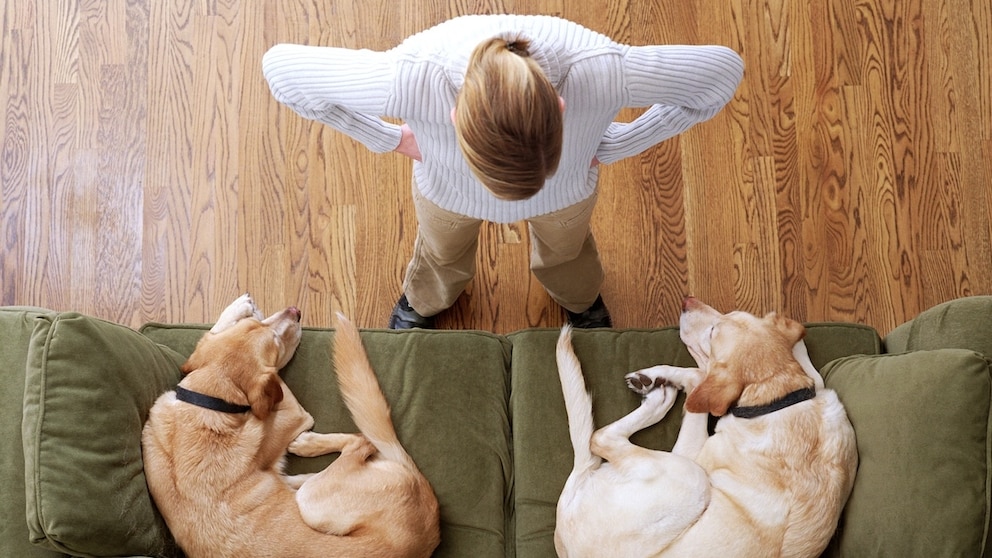
There’s hardly a question dog owners ask me more often than this: “Can my dog be on the sofa?” Or the slightly bolder version: “And in bed?” The answers they’ve heard before are usually alarmingly clear. “Never.” “It undermines your authority.” “The dog will think he’s the boss.”
I’ve been hearing these statements for years–and I can tell you: Most of them are simply wrong. Not just a little wrong, but fundamentally wrong, because they are based on a human view of dogs that science has long disproven. It’s time to set the record straight.
The dominance theory–a persistent myth
To understand why the sofa ban is so deeply ingrained in many owners’ minds, we need to look back briefly. For decades, a concept based on early wolf research dominated dog training: the so-called dominance theory.
The idea was simple–dogs are constantly trying to climb the social ladder, and any human weakness would be immediately exploited. Elevated positions were considered status symbols. Allowing your dog on the sofa supposedly meant giving up ground.
The problem: This theory was shaky from the start. The wolf studies it was based on were observations of mixed captivity groups–animals that didn’t know each other and were under artificial stress.
Later research on free-living wolves showed a completely different picture: cooperative family groups, hardly any visible dominance struggles, no constant jockeying for position. And dogs aren’t wolves. They’ve evolved alongside humans over thousands of years–with a social behavior quite different from their wild relatives.
Science has largely abandoned the dominance theory as a model for human-dog coexistence. Yet it persists in dog training practices. The sofa ban is one of its most enduring remnants.
What really happens when a dog is allowed in bed
Let’s set theory aside for a moment and see what actually happens when a dog sits on the sofa. In most cases: nothing dramatic. The dog is comfortable, the person is comfortable, and both enjoy the closeness. Dogs are social animals that appreciate physical contact and warmth. This isn’t a weakness or manipulation–it’s normal social behavior.
Even sleeping together in bed has been scientifically studied. A study by the Mayo Clinic, published in the “Mayo Clinic Proceedings,” examined this and came to a nuanced conclusion: A dog in the bedroom doesn’t significantly affect most people’s sleep; in fact, it can be beneficial. However, if the dog sleeps directly in the bed, it can measurably reduce sleep quality. But that’s a matter of personal preference–not training.
In short: Whether the dog is allowed on the sofa or in bed is primarily a decision you make for yourself and your household. Not one dictated by a rulebook from the 1980s.
Also interesting: Trainer reveals: “This is the most unnecessary command for dogs”
Why the sofa can still be a site of conflict
Now comes the but–and it’s important. Because there are situations where the sofa or bed should indeed become a topic. Not because the dog becomes “dominant,” but for entirely different, specific reasons.
The first is resource guarding. If your dog growls, snaps, or bites when you sit down, get up, or address him on the sofa, that’s a serious signal. Not because he’s claiming the throne–but because he’s defending a place he perceives as valuable, which can lead to a dangerous state for everyone involved.
In this case, it’s sensible to temporarily restrict access to the sofa and have the behavior professionally addressed. The solution isn’t “never again sofa,” but rather: understand and change the behavior.
The second reason is insecurity. Some dogs, especially rescue dogs or those with little structure in their daily lives, benefit from clear retreats that are distinctly theirs. Not because the sofa must be forbidden, but because having their own bed, corner, or place of rest can be immensely important for the dog. If the dog only sleeps on the sofa or in bed and doesn’t accept its own resting place, it’s worth consciously establishing that–in parallel, not as a replacement.
And then there are, of course, hygiene aspects, allergic reactions, or the simple fact that some people just don’t want their dog on the sofa. That’s completely legitimate too. Boundaries can be set–for personal reasons, without needing to justify them.

Does My Dog Have Genuine Separation Anxiety or Is It Just Acting Out?

Why Cats Steal Our Seats
How to set boundaries correctly
Here’s the real crux of the matter. The problem isn’t the sofa itself–the problem arises when rules are unclear, inconsistent, or not communicated consistently. A dog that’s sometimes allowed and sometimes not, invited onto the sofa by one person and shooed away by another, isn’t a dominant dog. It’s a confused dog.
Clarity is key. If you decide your dog can be on the sofa–great. Then he can always be, and everyone in the household agrees. If you decide against it–also great. Then it applies consistently, for everyone, at all times. What doesn’t work is the gray area: sometimes yes, sometimes no, depending on the mood or day. That confuses dogs and leads to the behaviors often blamed on the sofa.
Boundaries that are clearly and consistently set can be learned by a dog excellently. He doesn’t need to understand why the sofa is off-limits–he just needs to know that it is. This can be achieved without punishment, pressure, or displays of dominance. A simple, calm “off” or redirecting to his own place, coupled with a positive consequence there, is entirely sufficient.
What this all has to do with relationships
In the end, the topic of sofas and beds is about something much more fundamental than furniture protection or training philosophy. It’s about how we shape our relationship with our dog. Closeness, physical contact, and shared rest periods aren’t training mistakes. They strengthen trust, provide the dog with security, and give us humans something in return.
I live and work with dogs every day. I know the studies, I know the practice, and I know the gray areas in between. And my honest assessment is: A dog that sleeps on the sofa and has a person who provides clear structures, leads a nice life together, and takes the animal’s needs seriously is usually a balanced, secure dog.
A dog that’s never allowed on the sofa but otherwise lacks clear orientation points, reliable structure, and a genuine bond often isn’t.
The sofa isn’t the problem. And it’s not the solution either. It’s just a piece of furniture. What matters is everything around it.

About the Expert
Katharina Marioth is the founder of the Stadthundetraining brand and the KEML principle. She is an IHK- and government-certified dog trainer and behavioral assessor for dangerous dogs in the state of Berlin. In her daily business, she works closely with veterinarians, scientists, and other specialists on dog-related topics. With her knowledge and skills, she secured the title of Dog Trainer of the Year 2023 in the Sat.1 show “The Dog Trainer Champion.”