

August 22, 2026, 4:58 am | Read time: 5 minutes
The Karst Shepherd, also known as the Kraški ovčar, is an ancient livestock guardian dog from the Slovenian Karst region–powerful, wary, and uncompromisingly loyal. As an incorruptible guardian, it protects its family with instinctive determination. However, this independent dog with its iron-gray coat demands a lot in terms of care and training. It is unsuitable for beginners but a loyal partner with character for experienced owners.
Origin
The Karst Shepherd, also known by its Slovenian name Kraški ovčar, is one of the oldest European livestock guardian dogs. Its origin lies in the Karst region of present-day Slovenia, where it has protected sheep and cattle herds from predators such as wolves and bears for centuries. Its history is closely linked to that of the Šarplaninac–both were originally classified as “Illyrian Shepherd Dogs.” The first written reference to the breed dates back to 1689 in the work of Baron Valvasor. It was not until 1939 that the FCI recognized it under the name “Illyrian Shepherd Dog.” Due to increasing breeding differentiation, it was decided in 1968 to name the line from the Karst region “Karst Shepherd” from then on.
The turbulent years of the Yugoslav wars in the 1990s nearly led to the breed’s extinction. Some crossbreeding with Newfoundlands was done to stabilize the population–which also contributed to the darker coat color of today’s specimens. Despite its primitive nature and deep regional roots, the Karst Shepherd is rarely found outside its homeland.
Appearance & Coat
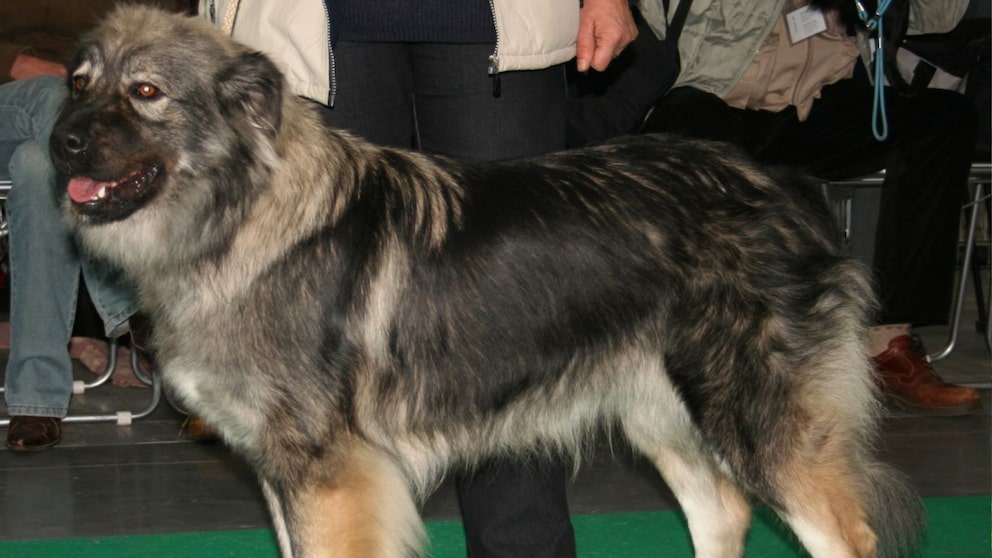
The Karst Shepherd is a medium to large, strong, and harmoniously built dog with strong muscles. Males reach a height at the withers of 57 to 63 cm, while females range between 54 and 60 cm. The weight varies depending on gender and constitution between 25 and 45 kg. Its physique appears athletic yet functional–with an elongated, not high-legged appearance.
Characteristic is its long, smooth topcoat with a dense undercoat. The coat measures at least 10 cm and has a special structure: While the head, front sides of the ears, and forelegs are short-haired, the dog has longer, bushy hair on the neck, chest, and body. Typical are the mane-like hair in the neck area and plush “pants” on the hind legs. The coat color is predominantly iron gray, with shades of yellow, black, or red-gray possible. A dark facial mask and darker coloring at the withers are typical of the breed.
The almond-shaped, dark-rimmed eyes, strong teeth, and v-shaped hanging ears complete the expressive appearance.
Character & Temperament
The Karst Shepherd is a typical livestock guardian dog with an independent nature, pronounced territorial behavior, and a deeply rooted protective instinct. It generally meets strangers with suspicion, without being aggressive or biting. Toward its owner, it is extremely loyal, vigilant, and–with clear leadership–obedient. The breed is considered calm in temperament but always attentive and decisive.
Within its family, it reveals a gentle, good-natured side, especially if socialized early. It is patient with children, provided the interaction is respectful. Its independence, however, requires a high level of experience: The Karst Shepherd often makes decisions on its own–a trait resulting from its centuries-long use as an unsupervised livestock guardian. In unsuitable hands, this behavior can prove problematic.
Training
Training the Karst Shepherd is demanding and requires patience, consistency, and solid dog experience. These late bloomers often reach their mental and physical maturity only around three years of age. Behavioral patterns that manifest early are difficult to correct in adulthood. Early socialization and consistent yet calm training are therefore essential.
The Karst Shepherd generally accepts only one fixed reference person. Commands from changing individuals are usually ignored. As a service dog, such as in police or military roles, it is therefore unsuitable. Building a close trust and a clear leadership role are the basis for a stable relationship with this character-strong dog.
Proper Care & Maintenance
This breed requires ample exercise, mental engagement, and a fixed task–whether it’s guarding a property or protecting a herd. The Karst Shepherd is unsuitable for city apartment living. An ideal setting is a rural environment with enough space for independent territory control.
Its long coat requires regular care. Daily brushing helps control heavy shedding and prevents matting. Especially in indoor living, the year-round shedding poses a challenge. Ears, claws, and eyes should be regularly checked and cleaned. Due to its independence, engagement with meaningful task structures–such as guard duties or territory control–is essential. Games like fetching or trick training are usually uninteresting to it.
Nutrition
In its original environment, the Karst Shepherd was accustomed to finding food independently. Accordingly, the breed remains frugal to this day. A species-appropriate diet with a high meat content–as provided by raw feeding–matches its natural constitution. Industrial dry or wet food is possible, provided it is of high quality and adjusted to its energy needs.
A sensitive stomach is not typical, but a sufficient rest period should be observed after eating to avoid the risk of gastric torsion. In case of uncertainty, consulting breeders or veterinarians is recommended.
Why This Livestock Guardian Dog Doesn’t Belong in Private Hands

Why the Tornjak Isn’t for the Faint of Heart or Small Gardens
Susceptibility to Certain Diseases
Although the Karst Shepherd is considered a robust and long-lived breed, some health weaknesses can occur. The average life expectancy is about 10 to 12 years. Dogs that live within a family unit and are not constantly exposed to weather conditions show particular resilience.
Typical health risks include:
- Elbow and hip dysplasia (ED/HD)
- Disc problems (“dachshund paralysis”) in larger specimens
- Ear infections due to sensitive ears
- Dewclaws, which need to be regularly trimmed
Early diagnostics, species-appropriate care, and regular veterinary check-ups can help avoid or treat many of these issues early.
The Karst Shepherd at a Glance
- Size: Males 57–63 cm, Females 54–60 cm
- Weight: Males 30–42 kg, Females 25–37 kg
- Coat: Long, smooth, with dense undercoat; at least 10 cm
- Character: Independent, vigilant, territorial, loyal
- Special Feature: Suitable only for experienced owners with enough space and tasks