

May 30, 2025, 9:01 am | Read time: 5 minutes
The English Pointer combines hunting passion with an elegant appearance—a dog that excels in the field and surprises with gentleness in family life. However, this athletic dog is not for everyone: Its energy, hunting instinct, and need for intense activity require an experienced handler. Those who can meet the needs of this sensitive, intelligent canine will gain a loyal partner with a unique character.
As a classic representative of British pointing dogs, the English Pointer is more than just a hunting assistant—it’s a cultural asset. Its name comes from the characteristic pose when spotting game: “pointing.” This ability, combined with a highly sensitive nose and striking appearance, makes it a specialist in bird hunting. However, its suitability as a family dog is limited: Without meaningful tasks, this sensitive dog quickly develops behavioral problems. Those who wish to keep it must cater to its enormous need for exercise, train it sensitively, and focus on hunting or sports activities. Only then does it reach its full potential as a sensitive, loyal, and powerful partner.
Origin
The origins of the English Pointer date back to the 17th and 18th centuries. Its roots lie on the Iberian Peninsula, particularly in Spain. British soldiers brought local hunting dogs to England, where targeted crossbreeding with local breeds—including Greyhounds, Foxhounds, and French hounds—occurred. The goal was a fast, enduring dog with a pronounced hunting instinct.
By 1835, the Pointer was described in its current form in Great Britain. It is considered a pioneer among pointing dogs. The silent pointing—the motionless indication of game with a raised paw—was likely a spontaneous mutation that was deliberately passed on through selection. The name “Pointer” derives from “to point” or the Spanish “perro de punta.” To this day, the English Pointer is especially valued for field hunting. In Germany, it is represented by the German Pointer Club and the Association for Pointers and Setters.
Appearance & Coat
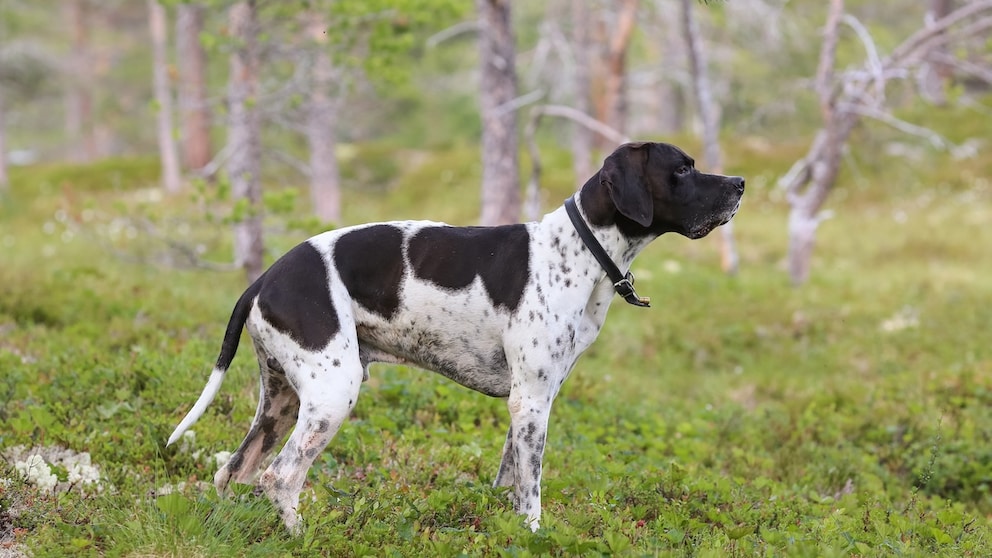
The English Pointer is a medium-sized, powerful, yet elegant hunting dog with harmonious proportions. Its physique is reminiscent of greyhounds±a legacy of its Greyhound ancestors. Males reach a height at the withers of 63 to 69 centimeters, females 61 to 66 centimeters. The weight typically ranges between 25 and 30 kilograms. The head features a pronounced stop and a slightly upward-curved muzzle—described in the breed standard as “dish-face.” The high-set, hanging ears lie close to the head. The Pointer carries its nose noticeably high when searching.
The coat is short, fine, smooth, and shiny. It shows little undercoat and is therefore easy to care for, but not very resistant to cold. Approved colors according to the FCI standard are white-lemon yellow, white-orange, white-liver brown, white-black, as well as single and tricolor variants.
Character & Temperament
The English Pointer is considered a sensitive, intelligent, and people-oriented dog with a pronounced “will to please.” Despite its passion for hunting, it shows a calm, gentle nature at home. It is usually patient and friendly with children but more reserved with strangers. Its social behavior is generally balanced, and it gets along well with other dogs. The Pointer almost completely lacks guarding or protective behavior.
Due to its close bond with caregivers, it finds it difficult to stay alone. Early socialization is essential—especially in dealing with small animals. Without sufficient exercise and mental stimulation, it can become nervous or destructive.
Training
Training the English Pointer requires experience and empathy. It is teachable and cooperative, but its strong hunting instinct can lead to limited recall in enticing situations. Therefore, consistency and positive reinforcement are crucial—harshness is counterproductive for this sensitive dog. Early acclimation to everyday stimuli, other animals, and being alone is essential. A reliable recall must also be intensively trained—preferably in secure areas. Especially for non-hunters, attending a dog school with hunting dog experience is recommended.
Proper Care & Maintenance
The English Pointer does not belong in a city apartment. An optimal environment is a rural setting with a large, fenced property. It needs several hours of exercise daily, ideally combined with scent work, mantrailing, or retrieving games. As a family dog, it can be well-integrated if sufficiently occupied. In the house, it behaves calmly and affectionately.
Coat care is straightforward: weekly brushing is sufficient. After walks in the rain, it should be thoroughly dried to prevent colds. Its floppy ears require regular checks and cleaning if necessary. The Pointer is sensitive to cold and wet—a dog coat in winter may be necessary.
Nutrition
An English Pointer needs high-quality, meat-based food with a high protein content. Meat should be the main ingredient at the top of the list. The amount of food depends on activity and body weight—for non-hunting dogs, weight gain should be monitored. Two portions a day are considered optimal. After feeding, a rest period should always be observed to prevent gastric torsion. Fresh water must be available at all times.

Rare Hybrid Breed! Have You Heard of the Lurcher?

Can the German Longhaired Pointer Also Be Kept as a Family Dog?
Susceptibility to Certain Diseases
The English Pointer is considered a robust breed with an average life expectancy of 12 to 14 years. However, genetically predisposed diseases can occur. These include hip dysplasia (HD), rarely acral mutilation syndrome (a neurological disorder), as well as occasional epilepsy, cancer, or eye diseases. Gastric torsion also poses a risk. Reputable breeders test their animals for hereditary diseases, especially HD.
The English Pointer at a Glance
- Temperament: Sensitive, intelligent, people-oriented, hunting motivated
- Size: Males 63–69 cm, females 61–66 cm
- Weight: 25–30 kg
- Coat: Short, smooth, shiny, no undercoat
- Colors: White with lemon yellow, orange, liver brown, black; also solid or tricolor
- Care Needs: Low, weekly brushing is sufficient
- Special Features: Extremely high hunting drive, needs lots of exercise and activity