

August 15, 2025, 4:13 am | Read time: 5 minutes
The Australian Stumpy Tail Cattle Dog, or “Stumpy,” is a true specialist among herding dogs. With its natural bobtail, square build, and relentless work ethic, it is perfectly adapted to the harsh conditions of the Australian outback. Yet behind its rugged exterior lies a sensitive, often reserved dog that belongs only in experienced hands. Those who respect its independence and provide it with real tasks will find an indefatigable partner—for everyone else, it can be a real challenge.
Origin
The history of the Australian Stumpy Tail Cattle Dog begins in the 19th century, when settlers in Australia needed dogs capable of handling the vast, semi-wild cattle herds of the outback. Historical sources point to Thomas Simpson Hall, who, around 1830, crossed North English herding dogs, known as Smithfields, with dingoes. These crosses became known as “Hall’s Heelers.” An alternative theory mentions the drover Timmins, who also paired Smithfields with dingoes, creating the “Timmins Biters.” It is certain that smooth-coated blue-merle collies were later introduced, shaping the versatile working dog we know today.
Initially, Stumpies and Australian Cattle Dogs were bred together, distinguished only by tail length. In 1927, they were recognized as a separate breed, but in 1950, they were merged again, drastically reducing the Stumpy population. By the 1980s, it was nearly extinct until the Australian National Kennel Council launched a breeding program in 1988. In 2002, it officially received the name “Australian Stumpy Tail Cattle Dog,” followed by FCI recognition in 2005. Today, it is rare outside Australia and Canada, with only a few registered breeders worldwide.
Appearance & Coat
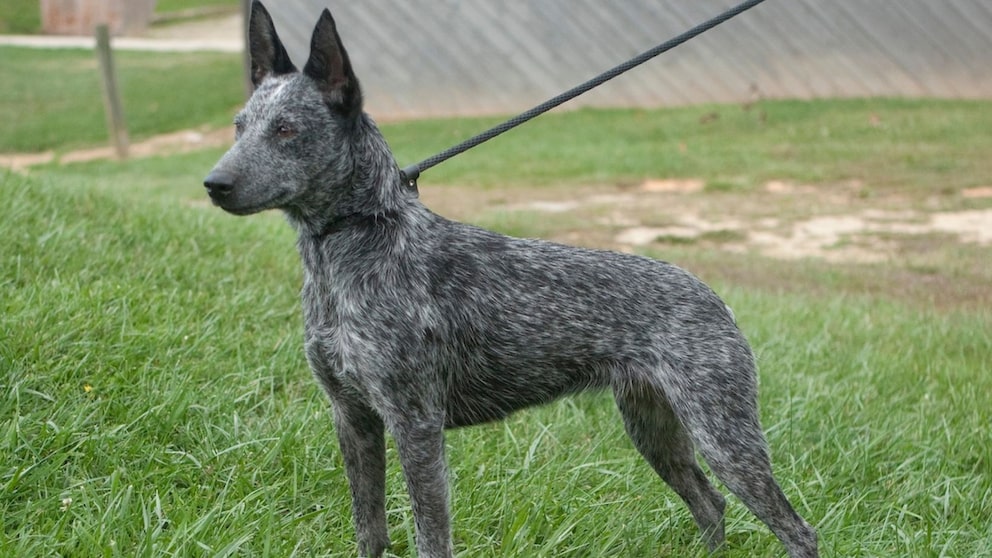
The Australian Stumpy Tail Cattle Dog is a medium-sized, square-built working dog with strong muscles and well-defined proportions. Males reach a shoulder height of 18–20 inches, females 17–19 inches. Its most distinctive feature is the natural bobtail, no longer than 4 inches, set high but not carried above the backline.
The head is powerful, with small, erect ears and alert, intelligent eyes. The coat is short, straight, and of medium-harsh texture, with dense, soft undercoat. A slight ruff around the neck enhances the robust impression. The color patterns are red-speckled or blue, the latter often associated with the merle defect gene, which poses health risks. Unlike the Australian Cattle Dog, tan markings are not allowed. Overall, the Stumpy conveys an image of toughness and endurance without exaggerated features.
Character & Temperament
The Stumpy is considered a highly intelligent, independent, and extremely work-driven dog. According to the standard, it is attentive, alert, courageous, and loyal to its owner. It is strongly oriented toward its caregiver but shows marked reserve to shyness with strangers. Crowds and noise can unsettle it, making early and comprehensive socialization essential.
As a born herding dog, it requires mental and physical stimulation and is happiest when it has real tasks daily—whether working with livestock or in demanding dog sports. Its independence can be interpreted as stubbornness, but it remains a reliable partner when leadership is clear and respectful. It is not suitable for beginners but is ideal for experienced owners who appreciate its sensitivity and energy.
Training
Training a Stumpy requires patience, consistency, and expertise. Its high intelligence and independence mean it learns quickly but also makes its own decisions if it doesn’t sense clear leadership. Positive reinforcement, combined with clear rules and a close bond, is key to its obedience.
Early socialization is mandatory to mitigate its natural reserve toward strangers and acclimate it to environmental stimuli. Owners benefit from varied training that challenges both body and mind. The Stumpy responds sensitively to rough treatment, making fair and respectful training essential.
Proper Care & Maintenance
The Australian Stumpy Tail Cattle Dog is not suited for city life in a small apartment. It needs space, exercise, and tasks—ideally in a rural setting with access to work opportunities or demanding dog sports. Kennel living is unsuitable for this human-oriented dog; it wants to be part of family life.
The coat is easy to maintain: Regular brushing is sufficient to remove loose hair and keep the undercoat healthy. More frequent brushing is advisable during shedding. Besides physical activity, it needs mental challenges, such as scent work or obedience training.
Nutrition
As an active working dog, the Stumpy requires a high-energy, balanced diet with a high meat content (at least 70%), supplemented by healthy fats and 20–30% vegetables or fruit. The exact composition should be adjusted to age, weight, activity level, and health status.
Puppies, active working dogs, and seniors have different nutritional needs. Both BARF and high-quality commercial food are possible, as long as they are free from low-grade fillers, excessive grains, and artificial additives. Fresh water must always be available.
The Australian Cattle Dog is Ideal for Active Owners

Why the Tibetan Terrier Doesn’t Simply Obey Blindly
Susceptibility to Certain Diseases
The Stumpy is considered a robust breed with few hereditary problems due to its limited distribution. However, congenital sensorineural deafness and Progressive Retinal Atrophy (PRA) occur, especially in dogs born white.
Another risk is spina bifida (open spine), which may be associated with the genetically determined bobtail. To minimize these risks, responsible breeding practices, health screenings, and regular veterinary check-ups are essential.
The Australian Stumpy Tail Cattle Dog at a Glance
- Size: Males 18–20 inches, females 17–19 inches
- Coat: Short, straight, medium-harsh, with dense undercoat
- Character: Work-driven, intelligent, alert, reserved with strangers
- Features: Natural bobtail (max. 4 inches), high endurance