

July 29, 2025, 3:52 am | Read time: 5 minutes
With a shoulder height of up to 34 inches, the Irish Wolfhound is among the largest dog breeds in the world. Despite its imposing appearance, it is considered a balanced and sensitive companion that primarily seeks closeness to its humans. Known as the “gentle giant,” this dog has a long history that once made it a feared wolf hunter. However, the Wolfhound is not a dog for everyone: Its size, strong physique, and keen sense of moods require experienced leadership, close bonding, and a balanced living environment.
Origin
The Irish Wolfhound is one of the oldest known dog breeds in Europe. Its origins can be traced back to antiquity: Archaeological finds show that greyhound-like dogs, likely ancestors of today’s Wolfhound, existed in ancient Egypt. In the third century B.C., these dogs came to Europe with the Celts and made their way to the British Isles–especially Ireland. There, they were used in the Middle Ages primarily for hunting big game such as bears, wild boars, and wolves.
The Irish upper class valued them as a status symbol, making the Irish Wolfhound a coveted gift among nobility. With the spread of firearms in the 17th century, the breed lost significance and increasingly fell into oblivion. By the 19th century, the Irish Wolfhound was nearly extinct.
Scottish cynologist George Augustus Graham worked to preserve the breed by crossing the last specimens with other large breeds such as the Great Dane, Borzoi, and Deerhound. This led to the modern Irish Wolfhound–larger and stronger than its historical ancestors–which was officially reintroduced in the 1870s.
Appearance & Coat
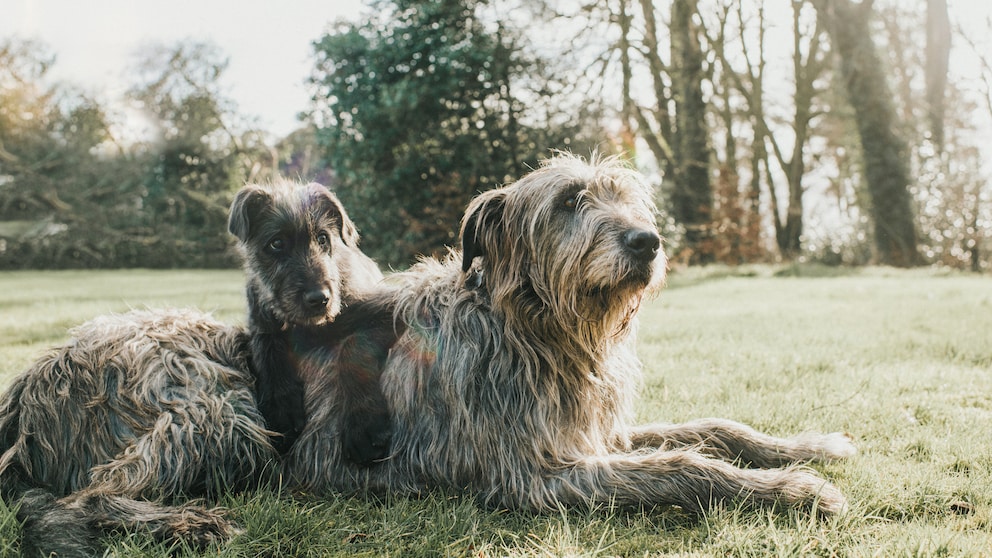
The Irish Wolfhound belongs to the group of rough-coated sighthounds. Its build is tall, slender, and athletic, with a deep-set chest that gives it an elegant silhouette despite its mass. The ears are relatively small and set far back on the head–a typical feature of many sighthounds.
The coat is rough, wiry, and medium-length, giving it a rustic, natural appearance. It reliably protects against cold and moisture and comes in various colors, including gray, white, black, brown, and brindle.
Males reach a shoulder height of up to 34 inches and weigh about 120 pounds. Females are slightly smaller and more delicate. Despite these massive dimensions, the Wolfhound never appears clumsy but impresses with its dignity and balance in movement.
Character & Temperament
Behind the imposing appearance of the Irish Wolfhound lies a calm, gentle, and very people-oriented character. These dogs are often affectionate, sensitive, and regularly seek contact with their caregivers. Their calmness makes them pleasant companions who usually integrate well into family life–provided children are sturdy enough to handle their boisterous nature.
Despite their size, Wolfhounds do not tend to be vigilant in the traditional sense. While they show protective behavior in dangerous situations, they are naturally non-aggressive and rarely bark. Their sensitive nature also makes them prone to stress from isolation or rough treatment. They behave friendly towards strangers as long as no threat is perceived.
Training
Training the Irish Wolfhound requires consistency, patience, and empathy. Due to its independent character, it is not always immediately obedient–but responds well to clear signals with loving guidance. Early socialization and a reliable recall are essential, especially because of its pronounced hunting instinct.
A well-trained Wolfhound can be off-leash in suitable areas. The rule is: The earlier training begins, the more reliable the behavior in adulthood. Despite its intelligence, one should not expect blind obedience–independence is part of this breed’s character. However, much is possible with loving consistency.
Proper Care & Maintenance
As a highly people-oriented dog, the Irish Wolfhound is not suitable for kennel housing. It needs close connection to its family and enough space in the house and garden. Due to its need for movement, regular walks and the opportunity for free sprinting (such as sighthound sports or coursing) are important.
In the home, the gentle giant is surprisingly calm and modest–yet its strength should not be underestimated. For smaller children, its exuberance can sometimes be too much. It is easy to care for thanks to its coat, which should be brushed once or twice a week. Additionally, regular checks of ears, eyes, and teeth are important to detect health problems early.
Nutrition
The high energy needs of the Irish Wolfhound must be met with a balanced, protein-rich diet–especially during growth. Puppies grow rapidly, so high-quality food with controlled energy content is important to avoid skeletal development issues.
The correct ratio of calcium to phosphorus is also essential, as an imbalance can affect bone development. Even in adulthood, owners should focus on quality: Empty fillers and excessive fat content should be avoided. Several small meals a day are better than one large meal to prevent bloat.

Rare Hybrid Breed! Have You Heard of the Lurcher?

The Irish Glen of Imaal is the rarest terrier in the world.
Susceptibility to Certain Diseases
The Irish Wolfhound is particularly prone to certain health issues. Diseases of the musculoskeletal system, such as hip and elbow dysplasia, are especially common. Gastric torsion is also a concern.
Heart diseases, epilepsy, and osteosarcomas (bone cancer) are also common. Regular veterinary check-ups and preventive measures significantly contribute to quality of life and health.
The Irish Wolfhound at a Glance
- Character: Calm, gentle, people-oriented
- Size: 30 to 34 inches shoulder height
- Weight: 106 to 180 pounds
- Coat & Colors: Rough, wiry
- Exercise Needs: High
- Life Expectancy: 6 to 10 years
- Special Considerations: Rarely barks, needs close family connection, not suitable for kennel housing
- Common Health Issues: Hip and elbow dysplasia, gastric torsion, heart disease, epilepsy, bone cancer